The Trinity: Are God and Jesus the same person?
The short answer
Jesus and God are not two different people. Jesus is God, but he is one of the three persons of God: God the Father, God the Son, and God the Holy Spirit. All three are equally God, but are distinct persons in themselves. This community of persons is called the Trinity.
I want to warn you about something before we get into this article. The Trinity is probably the most difficult concept to understand in Christianity. People don’t like that. When people ask questions about Christianity, they tend to want simple answers that are easy to understand. If it isn’t easy to understand, people easily get frustrated and dismiss Christianity. Many people assume that if something doesn’t make immediate sense, then it must make no sense. But mystery and complexity are common in the world. Physics, math, programming, and even things like painting, poetry, and language are all very difficult topics. Life isn’t simple; the universe is complicated, and while we employ a lot of simple answers for surface-level explanations, if you want real answers to things, you have to do a bit of work.
Warning! Real thinking ahead!
At Holy Ground we aim to provided academic, authoritative answers to your questions rather than the simplistic, childish answers you may have heard in Sunday school as a child. To understand that Jesus and God are the same, and to understand what that statement means, requires effort.
At the same time, there’s only so much you can discuss in a short article. I’m going to give you the “quick” version of these ideas, as accurately and clearly as the space allows, but with the understanding that this article cannot be a complete explanation. If you’re interested in a more complete explanation written in a very approachable style, I highly recommend Journey to Reality: Sacramental Life in a Secular Age.
We’re going to start with the idea of God, then discuss the idea of the Trinity, and then we’ll be able to understand how Jesus can be both God and man—and why.
Is there a difference between God and Jesus?
The word “God” is a weird word in English that is fairly ambiguous and causes a lot of problems. “God” is the general way that we refer to deities like Zeus or Thor—beings with distinct personalities, limitations, and even moral weaknesses like anger or lust. Such gods are very like humans, but they have a lot more power.
When Christians refer to “God,” however, they don’t mean one of these personalities. What the early Christians and ancient Israelites meant by “God” was something more like being itself or life itself. Far from any created or existing thing, their concept of God was that he was the source of all life and being. In addition, they believed that he was more than a force or principle: he was also personal—and further, that he was three persons. One supreme God who is life itself and also three persons, a Trinitarian God.
The Holy Trinity
You’ve probably heard Christianity referred to as one of the three Abrahamic or monotheistic religions, along with modern day Judaism and Islam. It’s fairly normal for people to group these three religions together on the basis that they believe in only one God rather than a whole pantheon of gods. This account is a surface-level reading of Christianity, however. The reality is that modern rabbinic Judaism and Islam are more similar to one another than either are to traditional Christianity. They are monotheistic in the sense that they hold to a divine oneness within God. However, it’s not correct to say that Christianity is monotheistic in the same sense. Christianity is different from these other two religions because more Trinitarian than monotheistic.
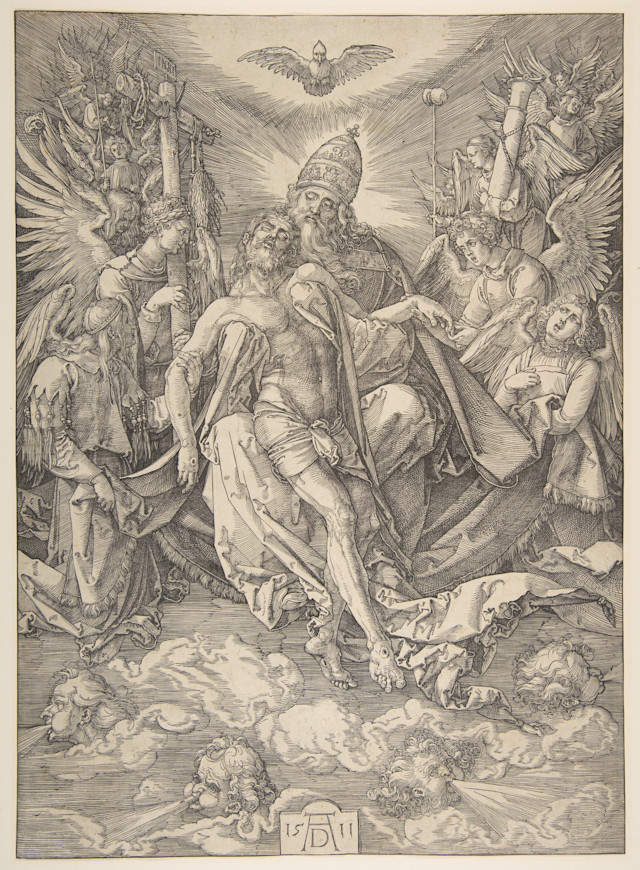
Albrecht Dürer - The Holy Trinity
This account may seem to refer to three different gods—like Odin, Zeus, and Loki, all of whom are distinct and have their own personalities. However, the Christian idea of the Trinity is that there is one single God who exists in three persons, not three different gods. The way that the ancient Christians articulated this idea was that God consisted of “three persons and one essence.”
You might think that it sounds like we’re talking about one God with three different faces or “modes”: when he’s being fatherly and authoritative, we call him “the Father,” when he’s inspiring us we call him the “Holy Spirit,” and so on. However, the Christian idea is that God is both three persons AND one God, with neither the threeness nor the oneness being higher than the other.
People have made many analogies for the Trinity over the last several thousand years, but none of them are perfect. One example is that the Trinity is like a family. A family consists of many different, distinct people but they all share the same biological essence—a similar DNA. They’re one body in a very real sense because they share this biological make-up, but they remain distinct people.
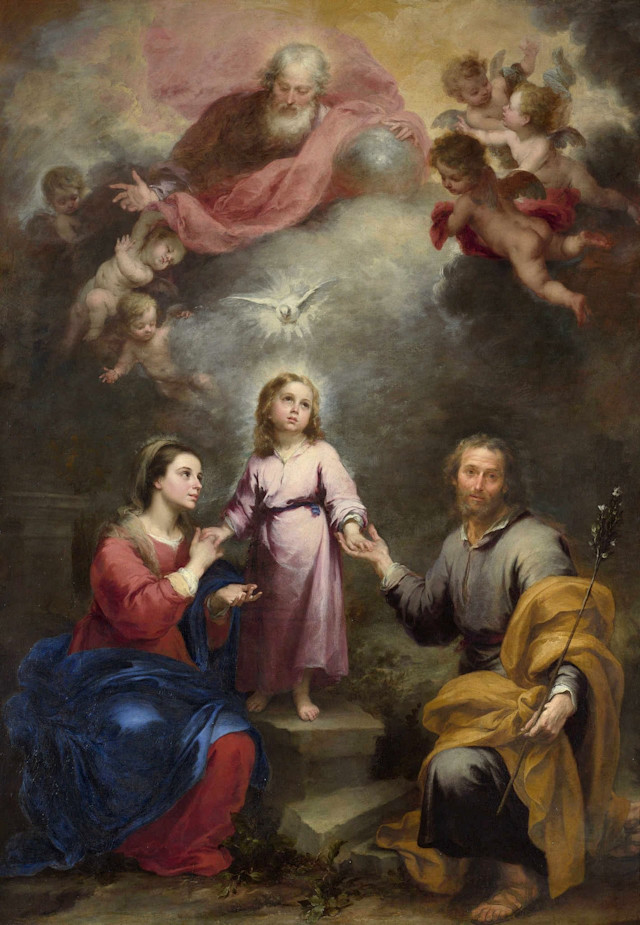
This 1675 painting by Bartolomé Esteban Murillo depicts the heavenly Trinity (the Father, Son, and Holy Spirit) and the Holy Family (Joseph, Jesus, and Mary).
The reality is that there is no good analogy for the Trinity, not because it’s unexplainable, but because the Trinity is fundamentally different from anything else. Remember that when Christians are talking about God, they don’t mean some supernatural being that has all sorts of superpowers—as though God were an omnipotent Santa Claus who spies on people and punishes or rewards them. God isn’t an “entity” in the sense that you or I or a dog or a rock are entities. You and I have life, but God is life (“I am the Way, the Truth, and the Life,” John 14:6). A rock and a dog have existence, but God is existence. He is the source of all existence and reality. As such, any analogies we make about God will be inadequate because analogies compare one thing to another, and God in a Christian sense is not a thing—he is the source of all things and therefore can’t be a thing himself in the same sense.
But the family analogy has an important lesson for us: the idea of interdependence. Sometimes you can’t understand certain things until you understand other things. You can’t understand what a dog is until you understand what a mammal is, and you can’t know what a mammal is without understanding what an animal is. Each of these things is definitional of the other. But sometimes things are what we would call “mutually definitional” or “interdefinitional.” Take father and child, for example. To be a father means to have a child, and to be a child means to have a father—it goes both ways. The two definitions are mutually defined by one another. You’ll notice that the Trinity is similar: “Father” and “Son” are the names of two of the persons of the Trinity, because they are intrinsically a part of one another—and this connection is part of what it means to have the same essence.
As I warned, there’s a great deal more we could say about the Trinity, especially at a technical level. For now, let’s see how the concept of the Trinity applies to explaining the difference between Jesus and God.
God and the incarnation of Jesus
Who is Jesus? Jesus is the name that God the Son took when he became incarnate as a human being. God the Son had always existed, eternally, as part of the Trinity, but it wasn’t until two thousand years ago that he became a human being. “Incarnate” means “to take on flesh.” God the Son took on the flesh and blood of human nature the same way that every other human being does: by being born of a human woman. The Virgin Mary became pregnant by the Holy Spirit and gave birth to Jesus.
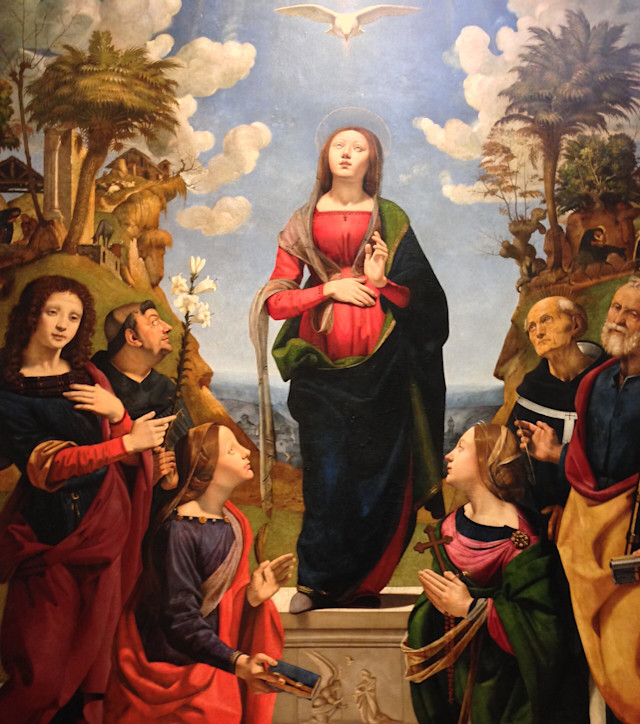
Piero di Cosimo - Immaculate Conception with Saints - circa 1505
But again, the Christian idea is not that Jesus is a demigod. God the Father did not have physical sex with Mary to produce a half-God, half-human offspring (as Zeus so often did). Jesus was not half God and half man. He was both fully God and fully human: God the Son took on human nature in fullness while remaining fully divine. No religion before or since Christianity has made a claim like this one.
So why does this idea matter? Because God fully and completely took on human nature, human beings can connect to God in a more complete, intimate way. Most ancient cultures, and all the great religious traditions, have had some idea of a God who was being itself or life itself, but they typically viewed this power as entirely beyond human comprehension: unapproachable, untouchable, and maybe even impossible to interact with. But with the incarnation of God the Son as Jesus, human nature become completely connected to divine nature. Jesus bridged the gap between these two natures with his own personhood, completely uniting them in the person of himself. And he did so in a physical and concrete way, as something that could be touched and interacted with physically. It is for this reason that, in the New Testament, St. John so emphatically describes Jesus as, “That which was from the beginning, which we have heard, which we have seen with our eyes, which we have looked at and our hands have touched—this we proclaim concerning the Word of life” (1 John 1:1).
The implications of this idea are staggering, and more than we can get into in this one article (again, check out Journey to Reality for more details). Now you may have some sense of why Christianity became the most influential and widespread worldview in history: it made the most mind-blowing, powerful religious claim in history.
Subscribe
Life-giving writing by Christian scholars sent to your inbox once per month

Zachary Porcu has a PhD in church history from the Catholic University of America in Washington DC, with additional degrees in philosophy, humanities, and Classics (Greek and Latin). He is an Eastern Orthodox Christian.
Keep reading
Forgiveness and the Remission of Sins

Stanley Hauerwas: Virtue Ethicist & Postliberal Theologian
Who is Jürgen Moltmann and What Did He Believe?

Jerry Bridges and The Navigators: A Protestant Order
Greg Bahnsen: Apologist and Presbyterian Minister