"Your gift will make room for you." A look at Proverbs 18:16
The short story
Bribery is a sin, and any interpretation of Proverbs 18 that says the opposite is wrong. Whatever gifts you have, remember that they are not for you. You will receive the biggest reward when you offer them to God.
Proverbs chapters 18, like the rest of Proverbs, consists of a series of edifying sayings, good advice, and wise observations about the world. Because the Proverbs are written in a way that makes them seem like self-contained epigrams, it’s easy to take them out of context by accident. Proverbs 18:16 is a good example. It reads:
“A man’s gift makes room for him / And brings him before great men”.
In our success-oriented American culture, it’s easy to take this at face-value and think of it in terms of your talents being recognized and earning you success, fame, and fortune. Many people read the verse and take it to mean exactly that. But there’s an age-old cultural practice whose existence should call such a reading into question: bribes.
Gifts or bribes?
The practice of giving bribes or other enticements is as old as civilization. Sometimes it means giving a tip to someone in order to gain special treatment, like giving an extra tip to a host at a restaurant in order to get a better seat. Sometimes it’s a simple matter of tipping someone to make them more cooperative. Other times it can take the form of real corruption, like paying an authority figure to sway the outcome of a trial, overlook illegal activity, or subvert justice. Of course, most of the time, the people involved don’t look at it that way; they talk about it terms of “tips,” displays of generosity, or “gifts.”
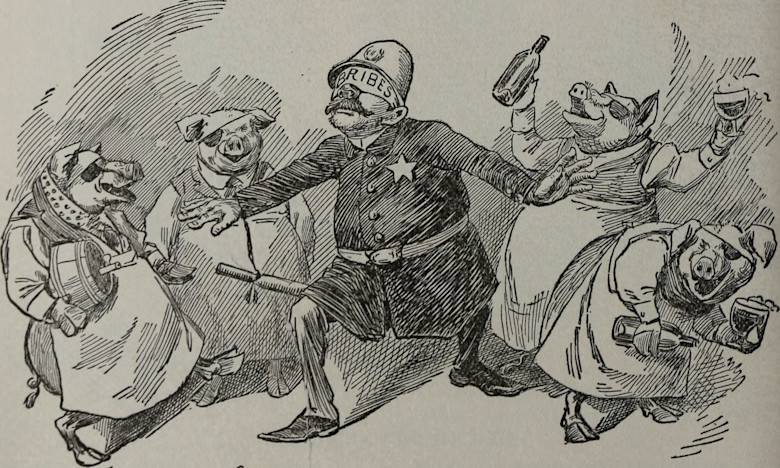
Bribery blinds a police officer to vice in this 1902 caricature from The Ram's Horn.
Historically, such strategic gift-giving was seen as a perversion of justice. It’s no surprise that text of the Old Testament calls out such behavior explicitly. Moses commands the Israelites, saying, "And you shall take no bribe, for a bribe blinds the discerning and perverts the words of the righteous" (Exodus 23:8). Later in Deuteronomy he specifically calls it a perversion of Justice (Deut 16:19). Isaiah says that it takes away justice from the righteous man (Isaiah 5:23), as does Amos (5:12) and Ezekiel (22:12). One of the main indicators that the prophet Samuel’s sons were not righteous like their father is that they took bribes (1 Sam 8:3; 12:3). In Micah it is written, “That they may successfully do evil with both hands—the prince asks for gifts, the judge seeks a bribe, and the great man utters his evil desire; so they scheme together" (Micah 7:3). Here and elsewhere the language of a “gift” is used for this very practice, and is identified as a way to “successfully do evil.” And these quotations are just a few of the many places that the Bible condemns this practice.
The proverb in question makes more sense in the context of bribery. It doesn’t say something general, such as, “a man’s skill makes room for him, it helps him get noticed by others” or “brings him success in life” or anything like that. It specifically says that a gift “brings him before great men;” in other words, giving a gift grants him an audience with the rich and powerful, people he would not normally be able to interact with. And of course, the rich and the powerful respond well to things like gifts.
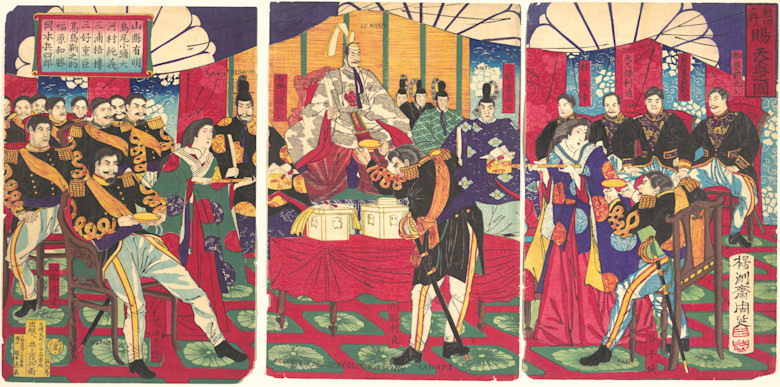
An officer presents a gift cup to the emperor in this 1877 woodblock print by Yōshū (Hashimoto) Chikanobu.
It’s possible to massage your interpretation of this passage to mean something else, but you’d have to overlook a lot of the context. Besides the whole context of the Biblical literature in which bribery is condemned, chapter 18 of Proverbs—the immediate context of the verse—is themed around justice, disputes, and the law. Verse 5 says, “It is not good to show partiality to the wicked, or to overthrow the righteous in judgment;” verse 11 points out how wealth creates an illusion of power; and verse 17 observes how arguments made in court are not always what they seem.
Perhaps more to the point, the big problem with this sort of “prosperity” interpretation of Proverbs 18:16 is that it goes against the fundamental Christian message of humility and service.
The Bible on gifts and talents
There are many other passages in the Bible that discuss the proper use of one’s talents, but chapter 12 of St. Paul’s letter to the Romans is particularly valuable because of how it contrasts with the “prosperity” reading of Proverbs 18:16. St. Paul outlines three important elements of how to understand our gifts.
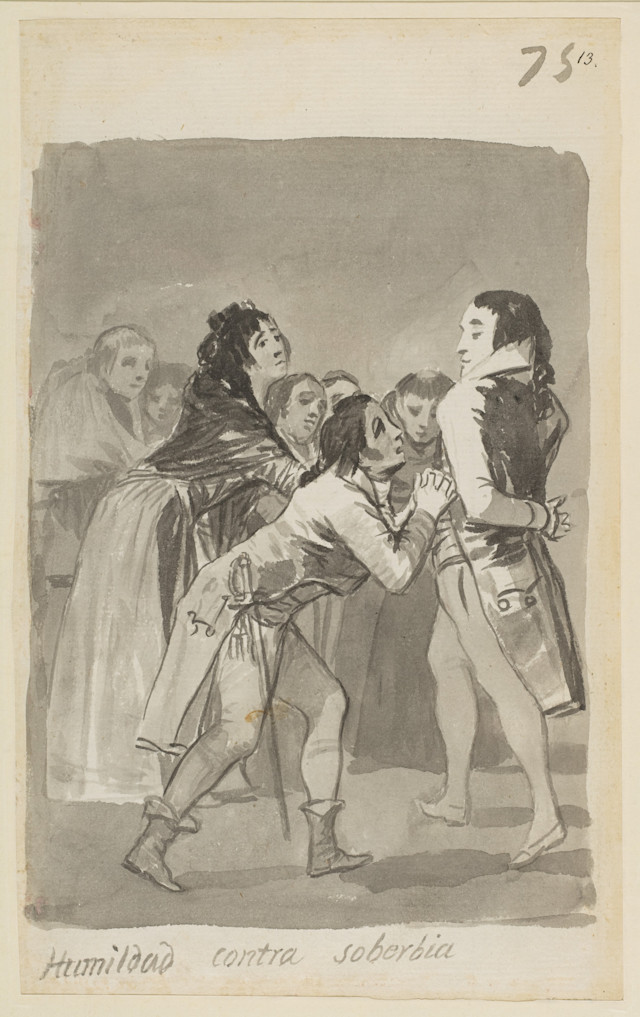
Goya - Humility Versus Pride - circa 1796
Second, the reason for our humility is that we are all part of the same body. “For as we have many members in one body, but all the members do not have the same function, so we, being many, are one body in Christ, and individually members of one another” (12:4-5). Paul makes a similar point in 1 Corinthians when he gives his famous analogy about how the church is the one body of Christ and everyone it in it is a different part of that body. But again, in the prosperity reading of Proverbs 18:16, there is a clear implication that the gifted man gains access and status that someone without that gift would not have. It’s a more divisive and individualist understanding of the benefits of having a gift—namely, that the benefits are for you.
Third, the gifts are not for our own glory or exaltation, but for the good of others. St. Paul is explicit about the purpose of our individual talents and gifts elsewhere in his epistles: “Now to each one the manifestation of the Spirit is given for the common good” (1 Cor 12:7). In Romans 12, he expands on this by explaining that we ought to use our gifts well, that our prophecy has to be “in proportion to our faith,” our giving must be “with liberality,” our leadership “with diligence,” our mercy “with cheerfulness,” and so on (12:7). We shouldn’t take our gifts for granted; we should take them seriously as gifts that are given to us for the good of all and not merely for our own glory.

Andrey Mironov - Parable of the Talents - 2013
As a side note, it’s important to understand that the parable of “the talents” isn’t about really about our “talent” the way we talk about it. A “talent” was the name of a unit of money in the ancient world. The traditional interpretation of this parable, according to the early church fathers, is that the “talents” are analogies not for literal talents—like being athletic, good with numbers, musical, et cetera—but for spiritual gifts like humility, wisdom, compassion, discernment, and so forth.
We should, therefore, be careful about interpretations of the Proverbs (or any passage in the Bible) that seem to deviate from the overall spirit of a Christian approach to life. Many people want to read the Bible as some sort of secret recipe for enjoying worldly success, as though “following God’s teachings” is simply the best way to produce a robust life of health and wealth. But if you know anything about the history of Christianity, you know that this idea doesn’t make much sense. Many of the most famous Christians in history were celebrated precisely because they chose Christ at the cost of illness, poverty, and misery. Many early Christians were brutally martyred, but they went to their martyrdoms with joy, because they were seeking a higher life with Christ. A modern saint, like St. Paisios, did much the same when he learned he had cancer. To be a Christian means to aim higher than anything this life can offer, to seek life in its fullness from the author of life himself. So, whatever gifts you have, remember that they are not for you, they are for Goodness’ sake.
Subscribe
Life-giving writing by Christian scholars sent to your inbox once per month

Zachary Porcu has a PhD in church history from the Catholic University of America in Washington DC, with additional degrees in philosophy, humanities, and Classics (Greek and Latin). He is an Eastern Orthodox Christian.
Keep reading
Forgiveness and the Remission of Sins

Stanley Hauerwas: Virtue Ethicist & Postliberal Theologian

Who is Jürgen Moltmann and What Did He Believe?

Jerry Bridges and The Navigators: A Protestant Order
Greg Bahnsen: Apologist and Presbyterian Minister