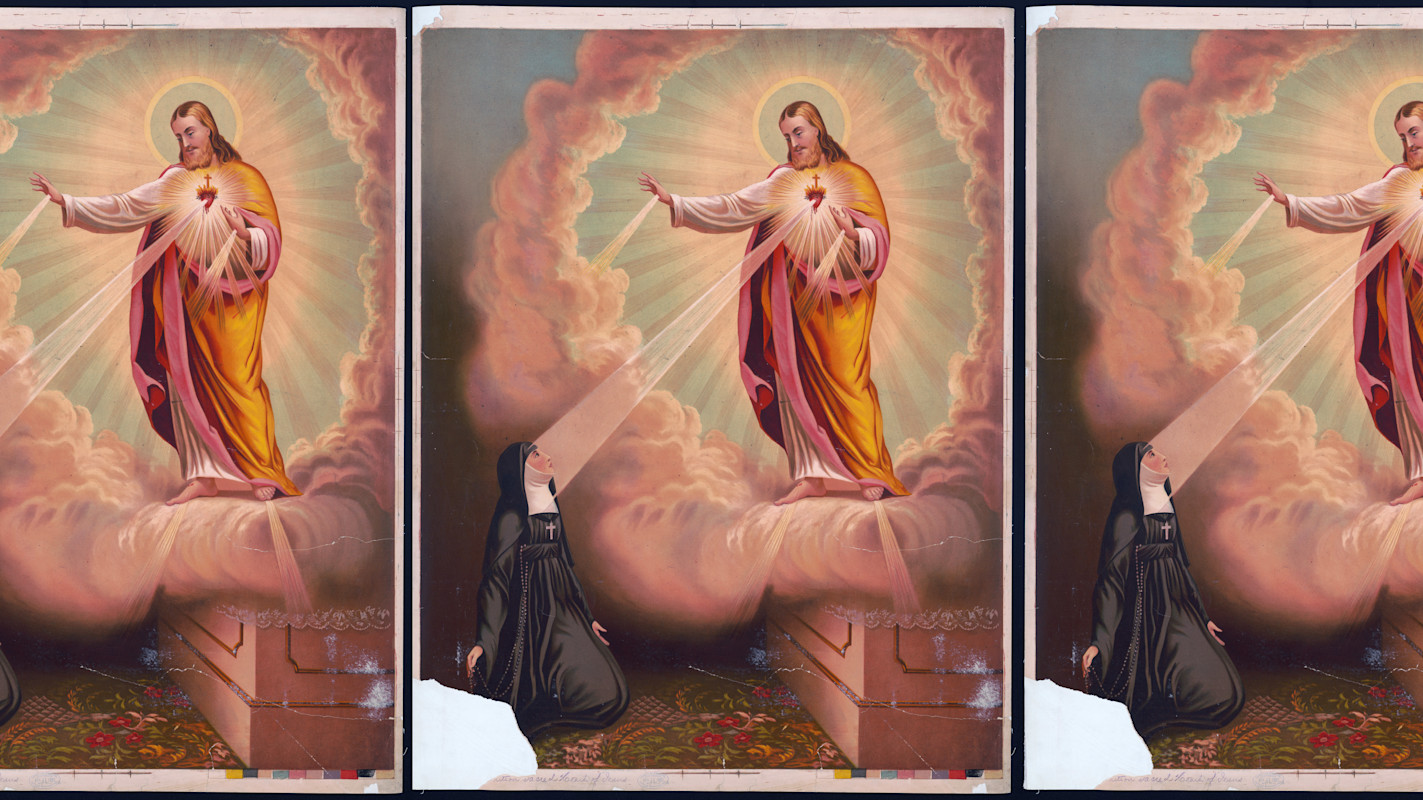
What is the Litany of the Sacred Heart of Jesus?
The short story
The litany has all the features of a good, pious prayer. In contrast to spontaneous prayer, a formalized prayer like this litany can be very helpful for focusing the person into a sincere prayerful mindset. The meditation on the suffering heart of Jesus is a beautiful thing to think on, cultivating humility through the repentance of the person praying.
The “litany of the sacred heart” is a prayer that petitions God to have mercy on the petitioner. The prayer directly addresses the “heart of Jesus”, with much of the litany describing its characteristics, such as “king and center of all hearts”.
The litany was finalized by Pope Leo XIII in 1899. It has thirty-three invocations, one for every year of Christ's life.
The Litany of the Sacred Heart of Jesus
Lord, have mercy on us.
Christ, have mercy on us.
Lord, have mercy on us. Christ, hear us.
Christ, graciously hear us.
God the Father of Heaven, have mercy on us.
(Continue to repeat "have mercy on us" after each line)
God the Son, Redeemer of the world,
God the Holy Spirit,
Holy Trinity, one God,
Heart of Jesus, Son of the Eternal Father,
Heart of Jesus, formed by the Holy Spirit in
the Virgin Mother’s womb,
Heart of Jesus, substantially united to the
Word of God,
Heart of Jesus, of infinite majesty,
Heart of Jesus, holy temple of God,
Heart of Jesus, tabernacle of the Most High,
Heart of Jesus, house of God and gate of heaven,
Heart of Jesus, glowing furnace of charity,
Heart of Jesus, vessel of justice and love,
Heart of Jesus, full of goodness and love,
Heart of Jesus, abyss of all virtues,
Heart of Jesus, most worthy of all praise,
Heart of Jesus, King and center of all hearts,
Heart of Jesus, in whom are all the treasures
of wisdom and knowledge,
Heart of Jesus, in whom dwells all the fullness of the Godhead,
Heart of Jesus, in whom the Father was well pleased,
Heart of Jesus, of whose fullness we have all received,
Heart of Jesus, desire of the everlasting hills,
Heart of Jesus, patient and rich in mercy,
Heart of Jesus, rich to all who call upon You,
Heart of Jesus, fount of life and holiness,
Heart of Jesus, propitiation for our offenses,
Heart of Jesus, overwhelmed with reproaches,
Heart of Jesus, bruised for our iniquities,
Heart of Jesus, obedient even unto death,
Heart of Jesus, pierced with a lance,
Heart of Jesus, source of all consolation,
Heart of Jesus, our life and resurrection,
Heart of Jesus, our peace and reconciliation,
Heart of Jesus, victim for our sins,
Heart of Jesus, salvation of those who hope in You,
Heart of Jesus, hope of those who die in You,
Heart of Jesus, delight of all saints,
Lamb of God, who takest away the sins of the world,
Spare us, O Lord.
Lamb of God, who takest away the sins of the world,
Graciously hear us, O Lord.
Lamb of God, who takest away the sins of the world,
Have mercy on us.
Jesus, meek and humble of Heart,
Make our hearts like unto Thine.Let us pray:
Almighty and eternal God, look upon the Heart of Thy most beloved Son and upon the praises and satisfaction which He offers Thee in the name of sinners; and to those who implore Thy mercy, in Thy great goodness, grant forgiveness in the name of the same Jesus Christ, Thy Son, who livest and reignest with Thee forever and ever. Amen.
The idea of a specific devotion to the sacred heart of Jesus was not present for the first ten centuries of Christianity. During the late Medieval era, there was however a growing emphasis on the crucifixion of Christ as the most important element of Jesus’ ministry, and Christians in that time began to be more and more fixated on the pain that Jesus’ endured and specifically his injuries. This gradually gave rise to a fixation on the particular wounds that Christ received in the crucifixion, many of which were specifically about Christ’s wounded heart. Over time specific devotions to Jesus’ heart began to emerge, the most famous ones occurred when certain prominent monks and nuns had divine visions about Jesus’ heart. One of the main nuns who experienced a vision about the heart of Jesus was St. Gertrude the Great, who had her visions in the thirteenth century.
Probably the most influential figure in the development of this devotion was a French Catholic nun named Margaret Mary Alacoque, who, in 1673 had a series of private visions in which she beheld Jesus visiting her and instructing her in devotional practices to the sacred heart, which included taking communion every month and attending a Catholic service called Eucharistic adoration. The credibility of her visions took time to establish, but gradually grew into a widespread Catholic practice. Various prayers – called litanies – were written by different figures as part of this devotion to the sacred heart, and in 1899, a complete litany was approved for public use by Pope Leo XIII.
What is the litany's spiritual value?
The prayer has all the features of a good, pious prayer. In contrast to a spontaneous prayer, formalized prayer can be very helpful for focusing the person to getting into a certain kind of prayerful mindset. The meditation on the life-giving attributes of Jesus is a beautiful thing to think on, and the emphasis on cultivating humility through the repentance of the petitioner is a beautiful thing. That said, the prayer is rooted in Western and especially Catholic theology. If you aren’t Catholic then there are some elements of it that may not match up well with your tradition.
It’s important to understand the spiritual tone of this devotion. What I mean by that is that spiritual practices – like how you conduct a church service or how you pray – are not just personal preferences about what sort of worship you enjoy or find edifying. They contain, by their nature, a specific theology. I’ll give an example. How you physically move your body when you pray says something about the nature of prayer. If you pray with your eyes closed and your head bowed, it implies that God is mostly invisible and that your experience of God is mainly something you experience on the “inside” of yourself – through your thoughts and feelings. If you pray with your eyes open, facing an image of Jesus, that more emphasizes the fact that God became a real, living man in the incarnation of Jesus, and that the way we interact with him is physical and visual, not just "internal". The first way emphasizes that God is beyond the physical world, while the second way emphasizes that he has entered into the physical world.
The meaning of Jesus' sacred heart
The content of the Sacred Heart of Jesus litany also says something theological. In Western Christianity, especially in Catholicism, there is an emphasis on the suffering and wounding of Christ as the main element in his ministry. “Look how much Jesus suffered for you” is something very common in both Catholic and Protestant Christianity, though they come to somewhat different conclusions about it. This is why, by the time we get to the Late Medieval era, the emphasis in Christianity’s visual depictions had almost completely become focused on Christ’s suffering on the cross. This is how the crucifix image developed – the image of Jesus physically on the cross, rather than just depicting a cross without Jesus hanging on it. Especially in Catholicism there was a push towards artistic depictions that emphasized the horror and brutality of a death on a cross. The Litany of the Sacred Heart comes out of this tradition, where Jesus’ suffering, physical heart is the focus. You see this kind of emphasis in the life of Margaret Mary Alacoque herself, who so wanted to imitate the suffering of Christ that she carved the word “Jesus” into her bare chest with a knife.
In the centuries that followed, the Protestant Reformation would break off from Catholicism and lead to many thousands of new denominations, and most of them retained their Catholic emphasis on Jesus’ suffering. The difference for most Protestant groups is that they rejected Catholicism’s emphasis on imitating Christ’s suffering – there isn’t much Protestant tradition that has anything to do with ritual self-harm, unlike many parts of old Catholicism. The emphasis among Protestants was instead to marvel at how much suffering that Jesus endured and use that as fuel for their gratitude towards what Jesus has done for them. These are, of course, generalizations, but a fair generalization is that the suffering of Jesus, in one way or another, is frequently a point of emphasis among most Western Christian denominations.
In Eastern Christianity, this emphasis is mostly absent. The most important thing for Eastern Christians (what is usually called “Eastern Orthodoxy”) is Jesus’ defeat of the devil and death. In Eastern Orthodoxy, the central problem is that mankind is doomed to death by their bondage to the devil, and that Christ freed us from this fate by dying so that he could go to the underworld and defeat Death itself. All of the Easter hymns in Orthodoxy emphasis this point: death is often presented as a personification that Jesus defeats. One major reading is to read the story of Jonah and the Whale as a kind of spiritual “prefigurement” of Jesus: Jonah stands for Jesus and the whale (or “great fish”) stands for Death. Death swallows up Jesus but because Jesus is life itself (“I am the way, the truth, and the life”, John 14:6), death becomes “embittered” and spits Jesus out, dying as a result. It’s almost like Death eats Jesus but Jesus “poisons” Death by being life.
What do these different emphases have to do with the Litany of the Sacred Heart? Only that formal prayers – like litanies – don’t arise out of nowhere. They arise out of concrete and specific traditions that themselves have certain theological ideas behind them. When you pray them, therefore, you’re shaping yourself – body and soul – into a certain kind of form. That’s the point of pre-written prayers, of course, which is to mold your soul into a certain kind of shape – the same exact reason we do repetitive drills in sports or other games. When you pray the Litany of the Sacred Heart, you’re going to be molding yourself into a tradition that has a certain sort of emphasis. If you’re Catholic, this is probably in-line with your tradition (depending, somewhat, on what kind of Catholic you are). If you’re Protestant or Eastern Orthodox, this may not line up with your theology as well.
Subscribe
Life-giving writing by Christian scholars sent to your inbox once per month

Dr. Zachary Porcu has a PhD in church history from the Catholic University of America in Washington DC, with additional degrees in philosophy, humanities, and Classics (Greek and Latin). He is an Eastern Orthodox Christian.
Keep reading

Pastor vs. Priest: What are the differences?

What is the sin of envy in the Seven Deadly Sins?

Are there aliens in the Bible?
The Sigil of Baphomet and the Satanic Pentagram
Healing is the children's bread?
