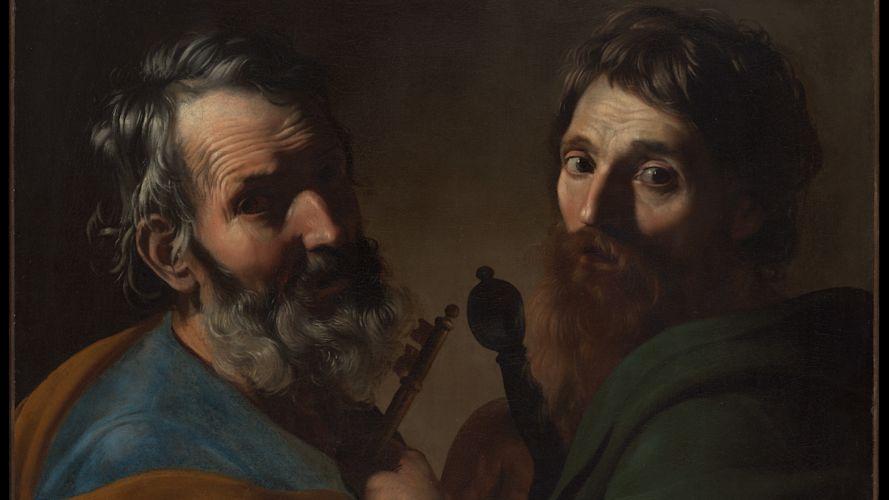
What are the best Bible verses for men?
The short answer
Below is a list of 15 excellent Bible verses for men. After the list is an in-depth look at two of my personal favorites: (1) St. Paul’s encouragement to treat the spiritual life like an athletic competition and (2) the famous passage on husbands and wives in Ephesians.
The Bible is not a single book; it’s a collection of many books from a variety of time periods, cultures, and genres. Much of the Bible is encouraging across a wide range of situations, both in practical matters as well as the spiritual life. While the Bible offers a lot of general advice that applies to everyone, there are many passages that may be specifically helpful to and encouraging for men.
Encouraging scriptures for men
Here are a few that may encourage you through times of difficulty (all scripture is ESV):
1 Corinthians 16:13:
Be watchful, stand firm in the faith, act like men, be strong.
1 Corinthians 15:58:
Therefore, my dear brothers and sisters, stand firm. Let nothing move you. Always give yourselves fully to the work of the Lord, because you know that your labor in the Lord is not in vain.
Psalm 118:6:
The Lord is on my side; I will not fear. What can man do to me?
Psalms 1:1-3:
Blessed is the man who walks not in the counsel of the ungodly, nor stands in the path of sinners, nor sits in the seat of the scornful; But his delight is in the law of the Lord, and in His law he meditates day and night. He shall be like a tree planted by the rivers of water, that brings forth its fruit in its season, whose leaf also shall not wither; and whatever he does shall prosper.
Proverbs 27:17:
As iron sharpens iron, so one man sharpens another.
I Corinthians 10:13:
No temptation has overtaken you except such as is common to man; but God is faithful, who will not allow you to be tempted beyond what you are able, but with the temptation will also make the way of escape, that you may be able to bear it.
II Corinthians 4:16:
Therefore we do not lose heart. Even though our outward man is perishing, yet the inward man is being renewed day by day.
James 1:2-4:
Consider it pure joy, my brothers, when you encounter trials of many kinds, because you know that the testing of your faith develops perseverance. Allow perseverance to finish its work, so that you may be mature and complete, not lacking anything.
James 1:19-20:
So then, my beloved brethren, let every man be swift to hear, slow to speak, slow to wrath; for the wrath of man does not produce the righteousness of God.
John 16:33:
In the world you will have tribulation. But take heart; I have overcome the world.
Isaiah 41:10:
So do not fear, for I am with you; do not be dismayed, for I am your God. I will strengthen you and help you; I will uphold you with my righteous right hand.
Philippians 4:6–7:
Do not be anxious about anything, but in every situation, by prayer and petition, with thanksgiving, present your requests to God. And the peace of God, which transcends all understanding, will guard your hearts and your minds in Christ Jesus.
Matthew 6:31–34:
So do not worry, saying, “What shall we eat?” or “What shall we drink?” or “What shall we wear?” For the pagans run after all these things, and your heavenly Father knows that you need them. But seek first His kingdom and His righteousness, and all these things will be given to you as well. Therefore do not worry about tomorrow, for tomorrow will worry about itself. Each day has enough trouble of its own.
Isaiah 41:13:
For I, the LORD your God, hold your right hand; it is I who say to you, “Fear not, I am the one who helps you.”
Revelation 21:4:
“He will wipe away every tear from their eyes, and death shall be no more, neither shall there be mourning, nor crying, nor pain anymore, for the former things have passed away.” And He who was seated on the throne said, “Behold, I am making all things new.”
It’s important, of course, not to take Bible verses out of context. You should read the whole book, or at least the whole chapter, that a specific verse is in. But these verses are classic verses that have been used by millions of people over the centuries as sources of encouragement.
Faith as athletics in Corinthians
Some of the most manly passages in the Bible are those that compare the spiritual life to athleticism. It can be easy to think of the spiritual life as something “fluffy” or emotional, and many men might view this language as overly feminine. Believing in Jesus, feeling close to God, being inspired by the Spirit—all of these things can seem passive, emotional, and, in a word, unmanly. But from the very beginning, the Church has understood the spiritual life to be a matter of action and training.
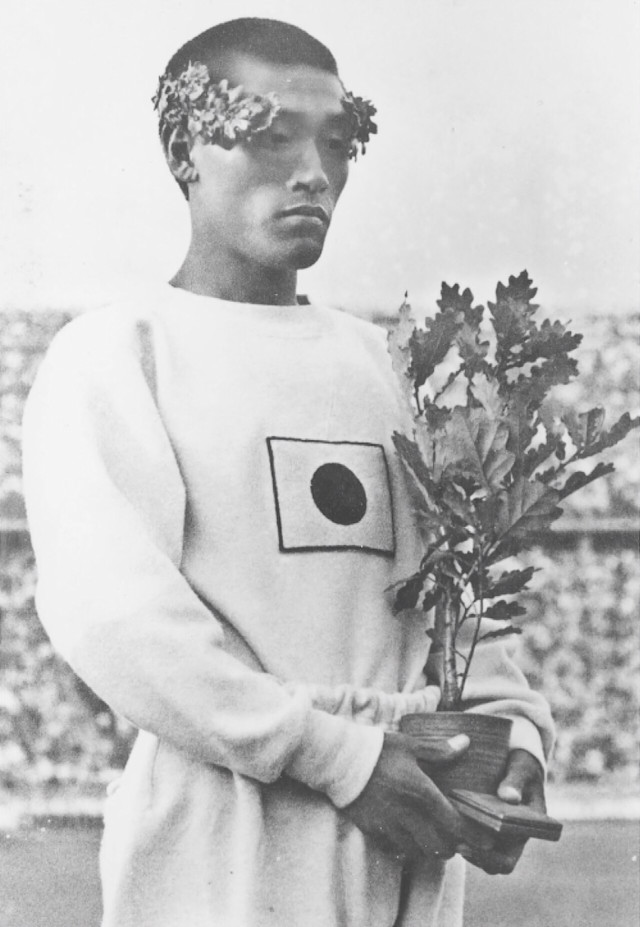
A modern Olympic athlete, Sohn Kee-chung, crowned with laurels at the 1936 Olympics.
Perhaps St. Paul’s most famous passage in the New Testament is in his first letter to the Corinthians:
Do you not know that in a race all the runners run, but only one gets the prize? Run in such a way as to get the prize. Everyone who competes in the games goes into strict training. They do it to get a crown that will not last, but we do it to get a crown that will last forever. Therefore I do not run like someone running aimlessly; I do not fight like a boxer beating the air. No, I strike a blow to my body and make it my slave so that after I have preached to others, I myself will not be disqualified for the prize. (1 Corinthians 9:24)
All the athletic imagery is there: the spiritual life is a race that we run, and he even describes it with competitive overtones. To accomplish this feat of power, you have to undergo training, with intention (not running “aimlessly”)—it is an almost physical struggle. The crown that you win is not merely a crown made of laurels or gold, but the highest and mightiest crown of perfecting your true power in Christ.
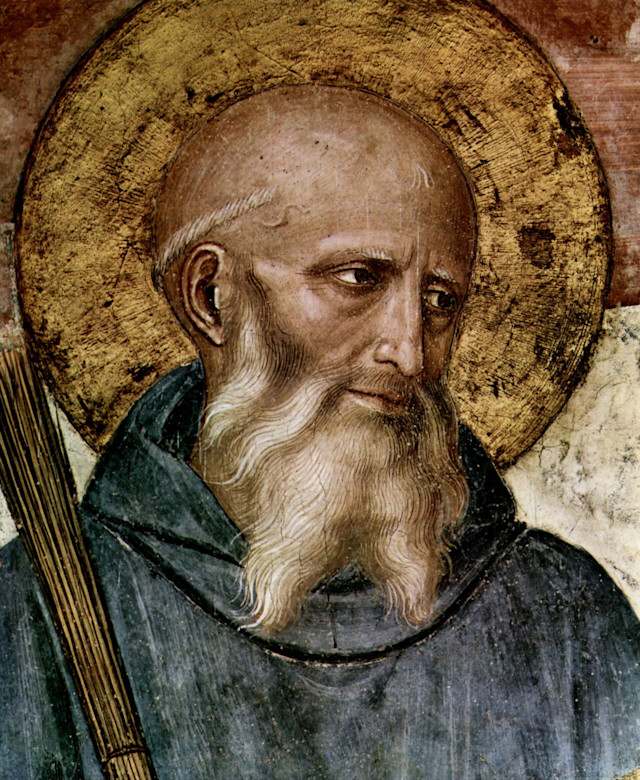
A close-up picture of St. Benedict from Fra Angelico's 1441 fresco Crucifixion with Saints.
There is a famous story from the desert fathers about a monk named Lot and his spiritual father, Abba Joseph. The story goes like this:
Lot went to Joseph and said, “Abba, as far as I can, I keep a moderate rule, with a little fasting, and prayer, and meditation, and quiet: and as far as I can I try to cleanse my heart of evil thoughts. What else should I do?” Then the hermit stood up and spread out his hands to heaven, and his fingers shone like ten flames of fire, and he said, “If you will, you can become all flame.”
The spiritual life of the Christian, in other words, isn’t about beliefs and feelings (although beliefs and feelings are not unimportant). Its essence is a manly, athletic struggle to become full of life and true, spiritual power. All throughout history, the saints have appeared in power and glory and stood against evil. Saint Patrick of Ireland is perhaps the most famous example of a saint who did manly battle in the face of evil, going so far as to engage in battle with pagan druids.
Here are nine other passages on growing, facing trials, and having good character:
1 Timothy 4:8
Ephesians 6:10
Joshua 1:9
2 Corinthians 4:16
Proverbs 27:17
1 Corinthians 16:13
James 1:2-3
How to be a good husband: Ephesians 5
Ephesians contains a famous passage—probably the most famous passage—on the relationship of husbands and wives in marriage. Saint Paul writes:
Wives, submit yourselves to your own husbands as you do to the Lord. For the husband is the head of the wife as Christ is the head of the church, his body, of which he is the Savior. Now as the church submits to Christ, so also wives should submit to their husbands in everything. Husbands, love your wives, just as Christ loved the church and gave himself up for her. (Ephesians 5:22-25)
Paul concludes by saying:
In this same way, husbands ought to love their wives as their own bodies. He who loves his wife loves himself. After all, no one ever hated their own body, but they feed and care for their body, just as Christ does the church—for we are members of his body. (Ephesians 5:28-30)
This passages sometimes causes difficulty for modern people who are sensitive to the idea of women being “obedient” to their husbands, as modern people have been trained to value a radical notion of absolute freedom as the highest good, to view authority of any kind as oppressive, and to see obedience as essentially slavery. Such values impede a proper understanding of this passage.
The clue to how we should read this passage comes in the very next verse. Saint Paul quotes Moses, who explains in Genesis that, “for this reason a man will leave his father and mother and be united to his wife, and the two will become one flesh” (Gen. 2:24, my emphasis). Moses indicates that marriage is not an alliance between two people who have simply agreed or promised to work together. The Christian idea is that a marriage is a unification of two people so profound that it creates a bond at a spiritual and a physical level: the spouses are literally one flesh, that is, one body, just in two different parts. That’s why St. Paul says that “he who love his wife loves himself”. He wasn’t being metaphorical, but literal. You and your wife are the same body; that’s the Christian definition of marriage.
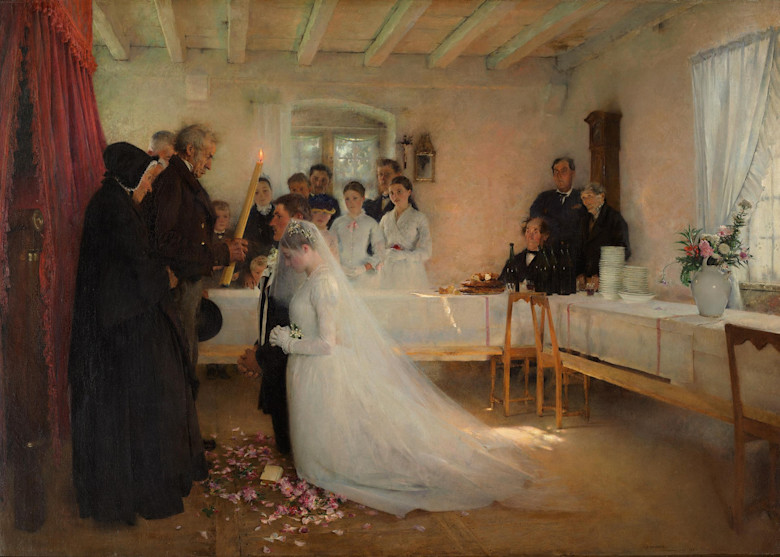
Pascal Dagnan-Bouveret - Blessing of the Young Couple Before Marriage - 1881
And leadership is no joke. People often think about being “in charge” of something as having all the power and being able to “do whatever you want.” But anyone who’s been in a real leadership role knows that leadership is mostly responsibility in which everything is ultimately up to you. The more leadership you have, the fewer people there are to fall back on and the more everything is up to you. This responsibility is a high and manly calling, and in marriage it puts you at the head of a small organization: the family. The wellbeing of your wife and children is, ultimately, on your shoulders as a man.
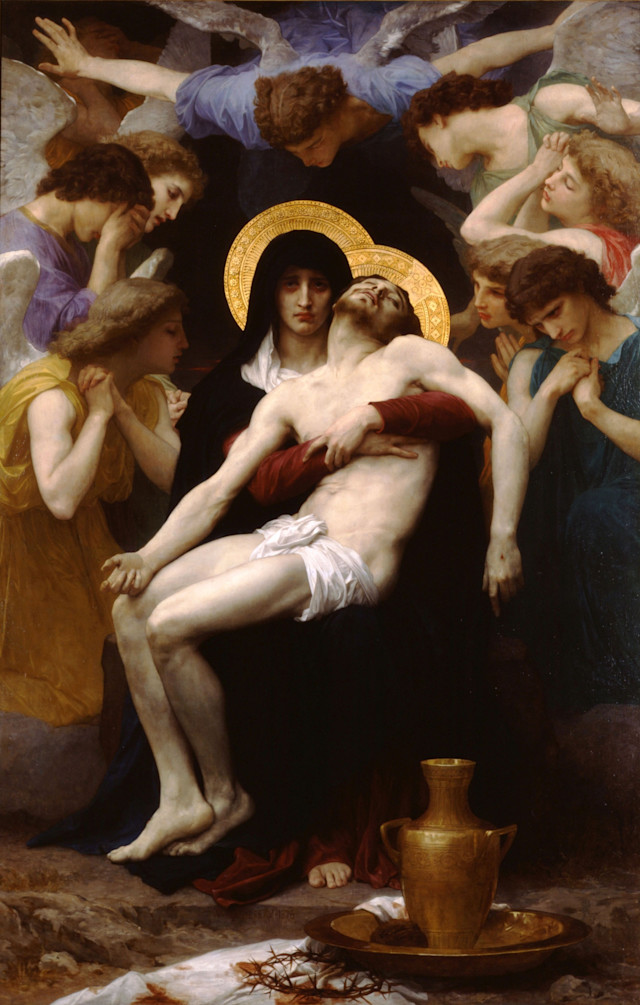
William-Adolphe Bouguereau - Pietà - 1876
To be a good leader and husband in a family requires the delicate cultivation of strength and love; it requires a willingness to make hard calls and also to accept responsibility; it requires listening to one's wife and making the best decision you can—for her wellbeing and for the health of the family. These requirements follow from the essential Christian view of marriage as a physical unity between husband and wife—from their literally being part of one another. Marriage is, in other words, something much more, and much more profound, than just being roommates who have sex. For men, marriage is a call to manliness.
Subscribe
Life-giving writing by Christian scholars sent to your inbox once per month

Zachary Porcu has a PhD in church history from the Catholic University of America in Washington DC, with additional degrees in philosophy, humanities, and Classics (Greek and Latin). He is an Eastern Orthodox Christian.
Keep reading
How Hot is Hell? Biblical Ideas vs. Pop Culture Depictions


The Problem with Sexual Sin

The Baptism of Poland: Unification and Christianization
What is a Pastor Emeritus? Should they exist?

What are the best Bible verses about love and trust?