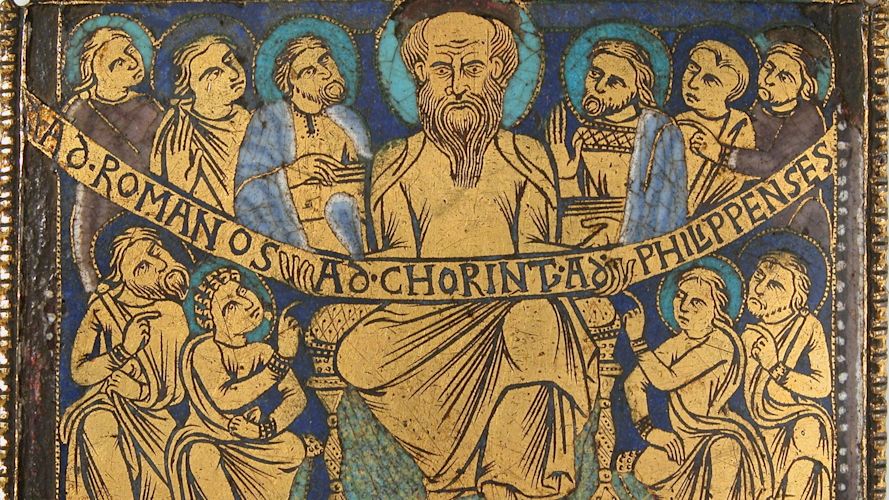
Jesus went to Hell for 3 days as seen in Scripture
The short story
Jesus went to Hell, as described in the book of Acts, chapter 2. He went there because he had a real body that experienced a real death. When Jesus went to Hell, he conquered it. Instead of being stuck there, Christ overcame Hell and set its captives free.
Because telling someone to “go to Hell” is an insult, the idea that Jesus went to Hell is probably a bit unnerving to many people. Yet the idea that Jesus descended into Hell when he died is all over the writings of scripture, was believed by the early church fathers, and was even stamped into the language of the Nicene Creed—the first universal declaration of what you had to believe to be a Christian. But how does this idea make sense if Hell is the bad place where you go to be punished? To understand this part of Christ's death and resurrection, you have to understand how ancient people thought about these things.

People tortured in the popular and false version of Hell. 12th century manuscript.
The thing about this picture of Hell is that it is not found in the Christian scriptures, nor is it in the writings of in the church fathers, nor is it how ancient people understood the afterlife. A better way to understand the ancient view of Hell is to use a different word: Hades.
Did Jesus descend into Hell or into Hades?
Hades is a Greek word used both for the realm of the dead and for the lord of the dead. You might see it referenced in the Bible as “the grave” or “the pit” (“sheol” in Hebrew). Hades was the place where people went when they died. For the ancients, because everyone died, everyone went to the same place: somewhere under the earth. Every ancient culture understood that there was a place called Hades (Duat in Egyptian, Orcus in Latin, et cetera) where the dead went. And while there might be different places in the land of the dead that were better or worse depending on what sort of life you lived, everyone went to more or less the same place, because everyone died.
It is in the context of this near-universal understanding among ancient people that we have to consider the references to Jesus’ descent. Jesus didn’t go to Hell exactly—again, hell is a modern word with lots of pop-culture connotations. Rather, early Christians believed that Christ went to the realm of the dead. He went to Hades.
What scripture says that Jesus went to Hell?

1425 AD manuscript: Joseph cast into the pit, Jesus placed into the tomb, Jonah swallowed by a fish (source)
But there’s more to it than that. The early Christians all had a very explicit understanding that, in descending into the realm of the dead, Jesus didn’t merely stop by for a visit. Christ invaded it and conquered it. They understood the realm of the dead as a realm that was ruled over by the Devil.
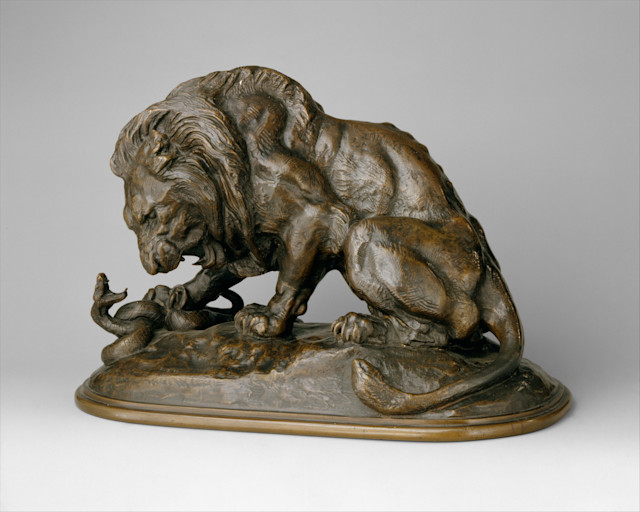
Antoine-Louis Barye - Lion and Serpent - circa 1848
After the fall, God explains to Adam that he will have to work for his food, and that, “you will eat your food until you return to the ground, since from it you were taken; for dust you are and to dust you will return” (Gen 3:19, emphasis mine). The spiritual meaning, therefore, of God saying that the serpent will “eat dust all the days of your life” is that the serpent will eat Adam all the days of his life. In other words, the serpent (who is really the Devil) will become the lord of death, “eating” all humans, for all humans will die. The devil became the lord of the dead. “The Lord of the Dead" is a title that, in ancient Greek pagan religion, belonged to the god Hades.
Where did Jesus go when he died?
Jesus went to Hades when he died. What did he do there? He conquered Hades along with its ruler, the Devil. When modern Christians think about Jesus' saving act, they often emphasize his death on the cross. The early Christians and the New Testament authors, however, emphasized that it was Christ’s conquering of Hades that saved mankind, because we had been enslaved to the devil. By going to the Devil’s kingdom and overthrowing it, Christ freed the captives who were in bondage there. St. Paul explains this idea in Hebrews, where he says, “that through death He might destroy him who had the power of death, that is, the Devil, and release those who through fear of death were all their lifetime subject to bondage” (Heb 2:14-15). The Devil had the power over death, and the main effect of Christ’s descent was to release those who were under his power.

Christ setting free the captives of death, 15th century painting
St. John also relays this idea in his Apocalypse. Christ declares, “I am He who lives, and was dead, and behold, I am alive forevermore. Amen. And I have the keys of Hades and of Death” (1:18). It was a common practice in the ancient world for conquerors to take as spoils of their conquest things that were important in the place they conquered, such as the keys to the city. In this case, Christ conquered death and now holds its keys; he dethroned the old lord who used to rule there, and now he is the one who rules over it. St. Paul talks about this conquering in his letter to the Colossians. He writes of Christ, “Having disarmed principalities and powers, He made a public spectacle of them, triumphing over them in it” (Col 2:15).
This imagery is perhaps most potent in the Psalms. Psalm 24 describes Christ’s dialogue with the gatekeepers of Hades:
“Lift up your heads, O you gates!
And be lifted up, you everlasting doors!
And the King of glory shall come in.
Who is this King of glory?
The Lord strong and mighty,
The Lord mighty in battle.
Lift up your heads, O you gates!
Lift up, you everlasting doors!
And the King of glory shall come in.
Who is this King of glory?
The Lord of hosts,
He is the King of glory."Psalm 24:7-10 (LXX 23:7-10)
One of the most moving and powerful liturgical uses of this passage is in the midnight Easter service of the Eastern Orthodox church. During this service, all of the faithful leave the church and walk around it, holding candles, in the middle of the night. The night is dark and cold, symbolizing the darkness and coldness of Hades. When the people go all the way around the church, they gather in front of the steps, outside the church, and face the doors of the church. The priest, representing Christ, goes up to the doors of the church and bangs on them, quoting the first part of the psalm in a loud voice: “Lift up your heads, O you gates! And be lifted up, you everlasting doors! And the King of glory shall come in!” and then someone inside the church calls back out to him, representing the gatekeeper of Hades, and says the next lines. The two go back and forth, quoting the entirety of the passage. On the final declaration of “the king of glory,” the church doors are opened. All the faithful stream into the church yelling, “Christ is risen!” And the church service transitions into a celebration of Christ’s conquering of death.
That the church doors symbolize the gates of Hades is an additional bit of imagery: it is only by passing through the gates of death that we enter into the kingdom of God (represented by the church) and are able to take communion. All of us have to pass through death in order to receive life.
So yes, Christ goes to Hades: but as a conqueror, not as one conquered. And he leads us to share in his glorious conquering of death and the devil. If you’ve ever wondered why the gospel is called “the good news,” now you have some idea as to why.
Subscribe
Life-giving writing by Christian scholars sent to your inbox once per month

Zachary Porcu has a PhD in church history from the Catholic University of America in Washington DC, with additional degrees in philosophy, humanities, and Classics (Greek and Latin). He is an Eastern Orthodox Christian.
Keep reading

Jesus and the Syrophoenician Woman: Gentile Salvation

Who was the first woman preacher in the Bible?
Was Jesus a Rabbi?

Who was Phanuel? Archangel or Father of Anna?

Is “love conquers all” in the Bible?