Holy Ground is Changing the Quality of Online Theology

Holy Ground is doing quality theology that is written by scholars and written for a wide audience. Welcome.

Today is a big day, as we are finally launching what has been a long-dreamt passion project. The first ideas of it were whiteboarded six years ago, the earliest initial scraps of imagination about what a new theological resource could look like. A lot of time, thought, and hard work later, and you see before you the site that has rendered in your browser.
The driver behind Holy Ground’s approach is the masses of low-quality theology on the internet in 2023. When average people bring their questions about Christianity to the web, they usually are greeted by:
Short, shallow articles
Written by untrained laypeople who lack formal training
Written for Christian culture (usually, for American Christian culture)
This needs to change. So let’s go through these three issues one by one.
The internet is filled with shallow, low-quality spam
Let’s say someone is looking for an answer to the question “Did Jesus go to Hell for 3 days?” Some of these people are going to be faithful church-going Christians. But a lot of the people asking the internet this question will not be faithful Christians. So let’s imagine one. Let's say there’s a guy named Moe in Montana:
Moe does not go to church
His friends and family do not go to church
Thus, Moe knows little about Christian faith and theology
Moe is walking to the grocery store to buy a gallon of milk when he passes a beautiful church. He hears the music outside, realizes a service is happening, and he gets curious. Moe checks the time, sees he has a few minutes to spare, and ducks inside the church to see what is happening.
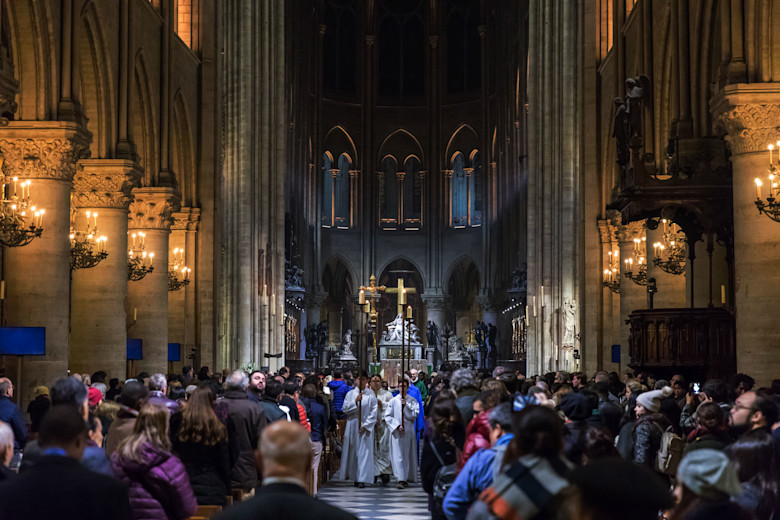
Moe goes to church (source)
As he is standing in the back he hears the congregation reciting the Apostle’s Creed:
We believe in God the Father almighty,
Maker of heaven and earth,
and in Jesus Christ, His only Son, our Lord,
who was conceived of the Holy Spirit
and born of the Virgin Mary,
who suffered under Pontius Pilate,
was crucified, died, and was buried,
He descended into hell...
Moe realizes he's out of time and leaves the church. "That’s funny," he thinks as he exits. "Jesus went to Hell?" As he steps into the street, Moe pulls his mobile phone and searches online for “Did Jesus go to Hell?”.

Moe googles "Did Jesus go to Hell?" (source)
The article that greets Moe is the average theological writing on the internet in 2023. The article will likely be short and low-effort, perhaps just 400 words long. As a result, the shallow spammy article cannot properly engage the deep and weighty topic of what it means for God to go to Hell. Instead, the article will stick to the surface: simply that Jesus died and went to Hell. Maybe it will mention in passing that Christ rose from the dead and “defeated death”. Maybe it won't.
As a result, Moe from Montana gets very little clarity around his question; a touch confused, he now has more questions than answers. “Ah well,” Moe sighs to himself. “Perhaps these religious mysteries are beyond my ability to know them.” He puts his phone back in his pocket and continues on to buy his milk, largely forgetting the matter.
What a lost opportunity. Imagine instead that Moe had found Holy Ground’s article by Dr. Porcu, an article that appropriately goes into depth around this question. Dr. Porcu does not simply affirm Jesus Christ dying, going to Hell, defeating death, etc. Instead the article goes into detail what Christ going to Hell actually means, its significance. If Moe had found Dr. Porcu's article there is a much greater chance that his curiosity would have resulted in him actually learning something, and maybe in having his very life changed forever for the better.
The internet is filled with unqualified opinions
If Moe had been reading the average theology site of 2023, he would also probably be struggling to trust the writer of the article. This is because a surprising number of theological writing on the internet does not even list an author at all! Some do though, and may have given the author’s name and short bio, perhaps also saying that the author is a Christian, perhaps even saying the author has created an eBook or a podcast. But typically, that is all the author has. This is because most of the theology on the internet today is written by laypeople who do not possess formal training. This is a problem because good theology is difficult. And this is normal. If theology is good then it is engaging the most pressing, difficult, complex problems of life. A Christian layperson giving a their opinion is probably better than nothing, but Moe would much more benefit from reading authors with formal training.
All articles on Holy Ground are written by faithful Christians who also possess a doctorate from a reputable school.
If Moe would come across Holy Ground’s article, and he sees it is written by a scholar with formal training, he will be more likely to listen to what the author is trying to say. He is more likely to actually learn theology, perhaps even creating a further line of questioning that someday results in Moe coming to faith in God.
The internet is filled with writing meant for insiders
Let’s return to Moe from Montana one final time. As mentioned earlier, Moe is not a Christian. As a result, Moe does not have any real grasp of Christian terminology. This is a real problem because most Christian writing on the internet today is written for insiders. It is often written by cultural Christians for Christian culture. As a result, it is going to be filled with a lot of jargon and unnecessary terminology that makes it difficult to understand for outsiders like Moe, words like “saved”, “born again”, “faith alone”.
This is not necessarily a Christian problem. For example, let’s say that evening Moe goes to drink beer and watch the World Cup with his friends. If someone is sitting at the bar listening to Moe and his friends watch the game, and if they are unfamiliar with soccer, they may be confused by words like “offsides”, “header”, and “GOAL!!!!”.

Moe at a pub, watching the soccer game (source)
When writing theology for people to read, we need to take great care to define any words that might sound strange or unfamiliar to people who are not Christian. To do so is to follow Christ incarnationally, extending ourselves toward the lost. This is why Holy Ground has, from its very start, dedicated itself to doing theology in a way that is easy to read. Using terminology can be very important. Often a theological term will help an article from getting dragged down into tedious explanation. But the difference with Holy Ground is that we are aware of this issue. Our scholars are constantly examining their writing to see if the words they are using are understandable for average non-Christians who might come across them.
Welcome to Holy Ground
This is the distinction that Holy Ground seeks to bring to people’s lives. This is our sweet spot. Unlike most popular Christian theology on the internet that is low-quality, written by laypeople, and full of in-group terminology, Holy Ground is doing quality theology that is written by scholars and written for a wide audience.
Welcome!
Subscribe
Life-giving writing by Christian scholars sent to your inbox once per month

Dr. Simon Cunningham is the founder and director of Holy Ground. He has a PhD in theology from the University of Nottingham in the UK. Simon is passionate about faithful Christian existential theology, namely theology that interacts with the tangible, immediate, and real elements of life.
Keep reading

The Story of Holy Ground’s Beautiful Functional Design

Why Holy Ground is Better than Wikipedia