
Are there aliens in the Bible?
The short answer
The Bible has nothing to say about aliens. It contains many stories that involve the spiritual realm: angels, demons, and miracles. Some people today want to believe that these stories involve aliens because they have more faith in technology than the spiritual realm.
What does the Bible say about aliens? Nothing. At no point does any part of the Bible discuss the existence of creatures from other planets. Indeed, the idea of beings living on other planets was not even conceived by ancient people at all.
However, this fact has not stopped people from creating theories that the Bible contains hidden references to visits from extraterrestrial creatures. People who support this view refer to passages such as “the sons of God” visiting and impregnating human women in Genesis 6:4, the bizarre angelic beings described in the visions of the prophets (such as Ezekiel 1:4-28), or supernatural occurrences like Elijah being taken up to heaven in a chariot of fire (2 Kings 2:11 / 4 Kingdoms 2:11). They make the argument that these stories are actually accounts of aliens as described using the vocabulary of ancient near-eastern people. Elijah’s chariot, they claim, might have been an alien spacecraft, but was only described as a “chariot of fire” because ancient Hebrews didn’t know what a spaceship was.
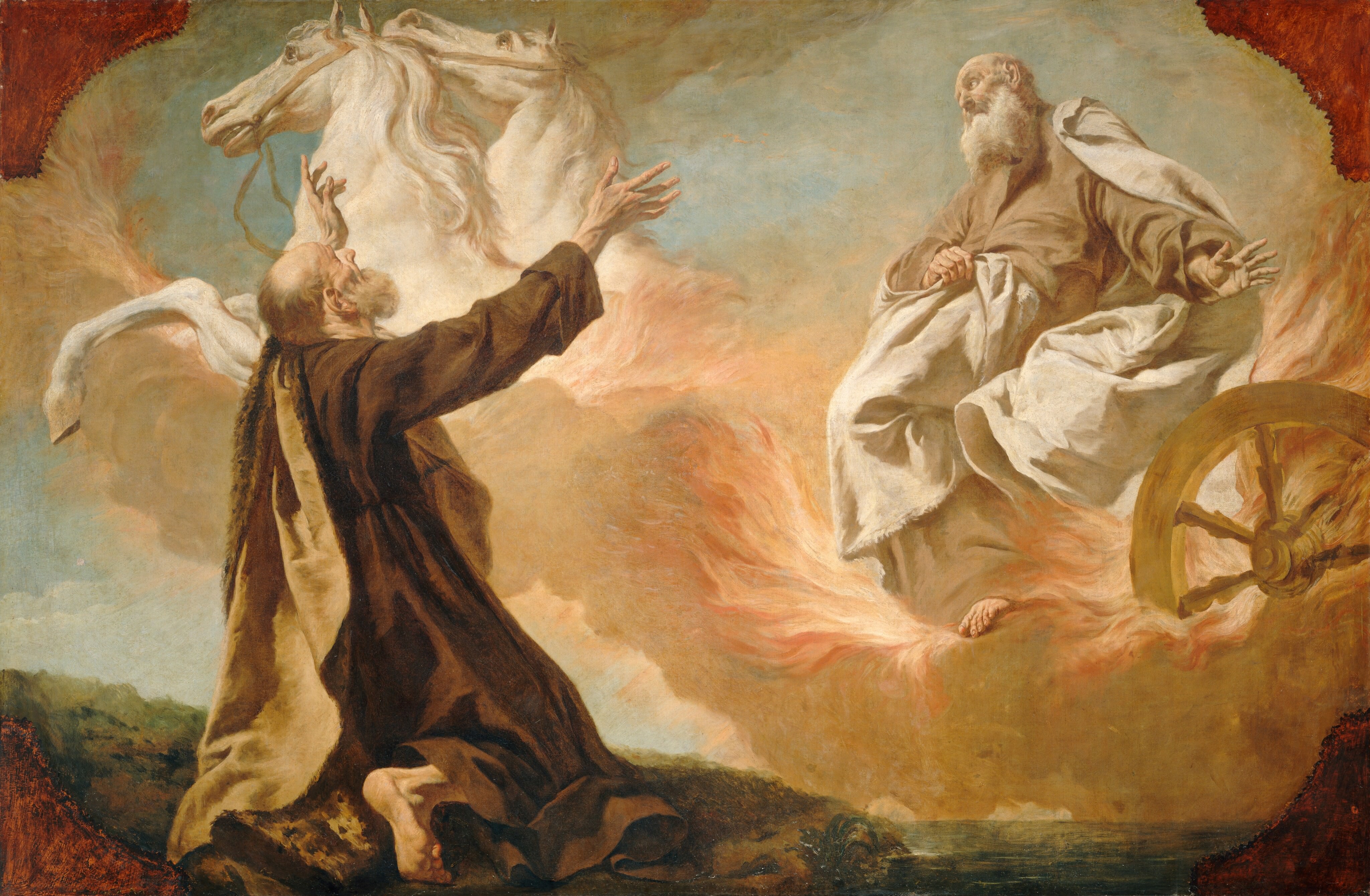
Giuseppe Angeli - Elijah Taken Up in a Chariot of Fire, 1740
Proponents of this hypothesis do not limit their theories to the Bible, but will tell you that all ancient religions have their source in some sort of contact between ancient man and visitors from other planets. This hypothesis is called “ancient astronauts” or “ancient aliens”, and was popularized in part by the History Channel program, Ancient Aliens.
Is it possible that these passages in the Bible support the idea of extraterrestrial creatures? To answer this question we need to understand two important things: what counts as evidence and the role of modern prejudice in our thinking.
Are there UFOs in the Bible? No.
The most important distinction in this discussion is between the possibility for something and evidence for something. Let’s say you go to work and all your co-workers are mysteriously absent. Nobody is sitting at their desks. You are alone. In this crazy scenario, you might jump to the conclusion that your co-workers are gone because they have all been eaten by a monster, but that conclusion confuses evidence for possibility. The fact is that your co-workers are gone, but this fact is not evidence that they were actually eaten by a monster. Their demise in the gullet of a monster is only a possibility. In order to believe that something is the case, you need actual, real, concrete evidence for that belief. Possibility alone is not enough.
In the same way, just because it is possible to interpret certain passages in the Bible as supporting an ancient aliens hypothesis does not mean that the Bible provides actual support or evidence for that theory. Remember, but the Bible can be interpreted in almost any way if you are creative enough. The question is not, “can we interpret the Bible in this way?” but “what is the right way to interpret the Bible?” As there is no actual, real, concrete evidence, we must conclude that aliens are not in the Bible. That said, I think it’s important to address why modern people might find the idea of the ancient aliens hypothesis attractive.
Belief in aliens allows belief in the supernatural
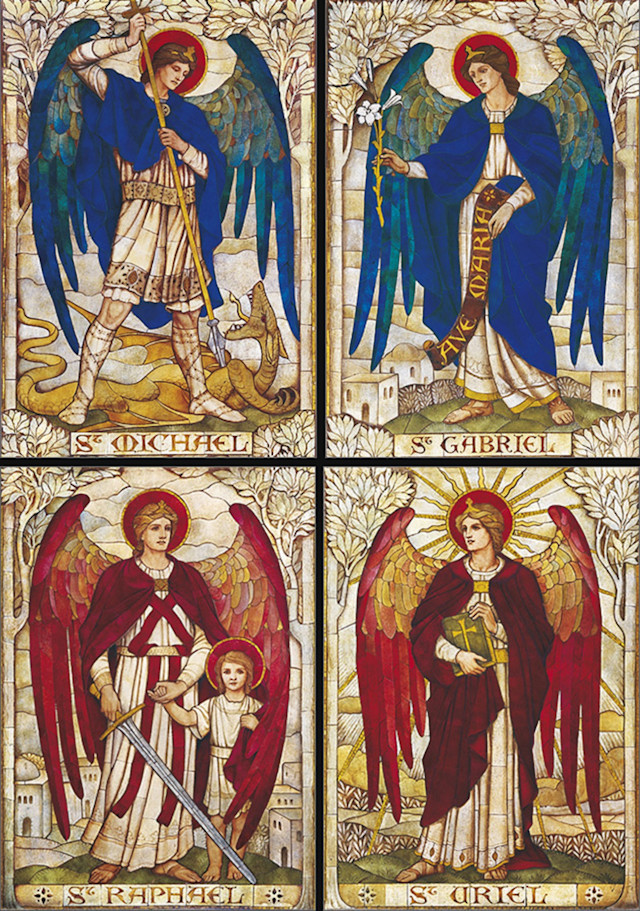
Mosaics of the four archangels - James Powell and Sons - 1888
These modern beliefs are prejudices. They are not examining the evidence of ancient texts and letting those texts speak for themselves. Instead, this modern view has already made up its mind about whether spirits, gods, or magic exist. It is reframing ancient texts like the Bible to fit modern materialistic or “scientific” beliefs (often as a result of scientism). Naturally, modern people are free to believe whatever they like about these topics, but to force that reading onto ancient authors is not an intellectually honest way to engage with ancient stories like those in the Bible.
Are aliens demons, or angels? The spirits that surround us.
What does the Bible actually say about these supernatural episodes, when we read it on its own terms? When you examine the beliefs of the Biblical authors, the Jewish religious communities surrounding the Biblical authors, and the earliest Christians, you will find that did believe in the existence of non-human, intelligent, “advanced” beings. These creatures are what we might today call “spirits.”
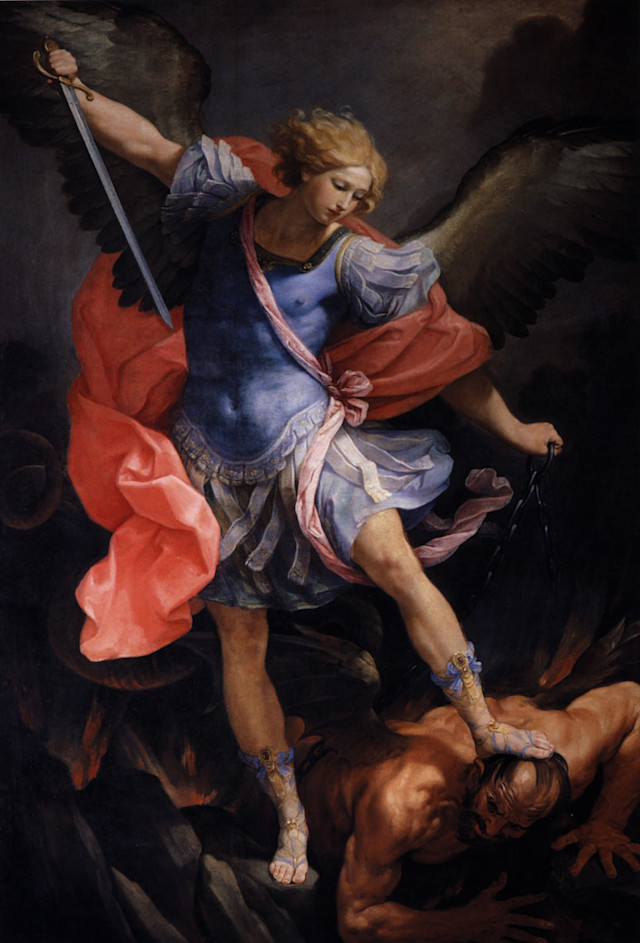
Guido Reni - Michael Defeats Satan - 1630
St. Augustine, a fourth-century Christian thinker, observed that the pagans use the term “gods” to refer to what the Christians called “angels”. He thought that there was no problem with this concurrence, provided that everyone understood that there was a difference between the lesser “gods” who were created and the One God who is uncreated and lord of all.
What did these spiritual beings do? There are many examples in the Bible and the surrounding literature. These spiritual beings are described as having a variety of tasks, including taking care of creation, overseeing the wellbeing of humans, performing errands across the cosmos, assembling in a divine council before the throne of God, and acting as messengers and intermediaries between God and human beings.
One of the most important elements in the ancient understanding of these spiritual creatures is that some portion of them became wicked, rebelled against the supreme God, and ultimately founded the religions of the pagans. The traditional interpretation of the story in Genesis 6:4 about the “sons of God” sleeping with human women is that these were spiritual beings who committed adultery with human women and produced half-human, half-spirit hybrids that the Bible refers to as “nephalim” or “giants.” This story was elaborated on in , a non-Biblical writing from the second temple period (~200 B.C.), but which the Biblical authors took as authoritative (Jude 1:6-7 and 1:14-15; Heb 11:5). In the story, the “sons of God” are fallen spiritual creatures who teach secret knowledge to their human wives and sons, including the art of making poisons and metalworking to create weapons and wage war. That behavior was what lead to the corruption and immorality that ultimately caused the great Flood.

Gustave Dore - The Fall of Lucifer
Another part of this story comes from the account of the Tower of Babel. Genesis chapter 11 details how ancient humans came together to build a city with a great tower in the center, to which God responded by changing their languages so that they could not communicate. They ultimately abandoned the project and dispersed over the earth. The way this passage was interpreted by ancient Jewish and Christian commentators was alongside Deuteronomy 32:8: "When the Most High gave to the nations their inheritance, when he divided mankind, he fixed the borders of the peoples according to the number of the sons of God” (ESV). Here, like in the story of the nephalim, the “sons of God” were understood to be spiritual beings originally entrusted to rule over mankind, to steward and protect them. The traditional understanding is that these spiritual beings ultimately ended up becoming wicked and desiring worship, ultimately founding religions based on themselves rather than directing people to worship the God of gods. Hence the pagan religions that the Israelites frequently came into conflict with during their history.
Accordingly, the early Christians did not disbelieve the existence of the pagan deities, they simply classified them as wicked, fallen gods. In a word: demons. We see this across the Old and New Testaments. The Psalmist declares that “all the gods of the nations are idols” (Psalm 96:5; LXX 95:5) and St. Paul links idols to demons when he explains that sacrifices offered to idols of the pagan gods are offered to demons (1 Cor 10:20-21).
Thus there is a sense in which, according to Christianity, most of the world’s ancient religions were founded by non-human, super intelligent beings. They simply were not from another planet but actually native to Earth.
What does the Bible say about life on other planets?

The cover of the novel Out of the Silent Planet by C.S. Lewis.
Conclusion
While specific passages in the Bible can be interpreted in a number of ways, the Biblical accounts do not support or lack support for the existence of extraterrestrial life. When you look at traditional Jewish beliefs from that time, and how they were understood by early Christians, the Bible does present a witness to the existence of non-human, spiritual beings like demons as the origin for various pagan religions. But neither the Biblical literature nor Christian tradition make any dogmatic or doctrinal statement for or against the possibility of extraterrestrial life. In the absence of any real evidence, such ideas—fun as they may be—remain entirely speculative.
Further Reading
Fr. Stephen De Young, The Religion of the Apostles
Augustine, The City of God, Books VIII-XVI
Justin Martyr, Apologies
Origen, Against Celsus
Tatian, Orations Against the Greeks
C.S. Lewis, The Space Trilogy
Out of the Silent Planet
Perelandra
That Hideous Strength
Subscribe
Life-giving writing by Christian scholars sent to your inbox once per month

Dr. Zachary Porcu has a PhD in church history from the Catholic University of America in Washington DC, with additional degrees in philosophy, humanities, and Classics (Greek and Latin). He is an Eastern Orthodox Christian.
Keep reading

Where is Amenadiel in the Bible?


Why stay away from the Book of Enoch

Samyaza and the fall of the angels
What is the sin of envy in the Seven Deadly Sins?
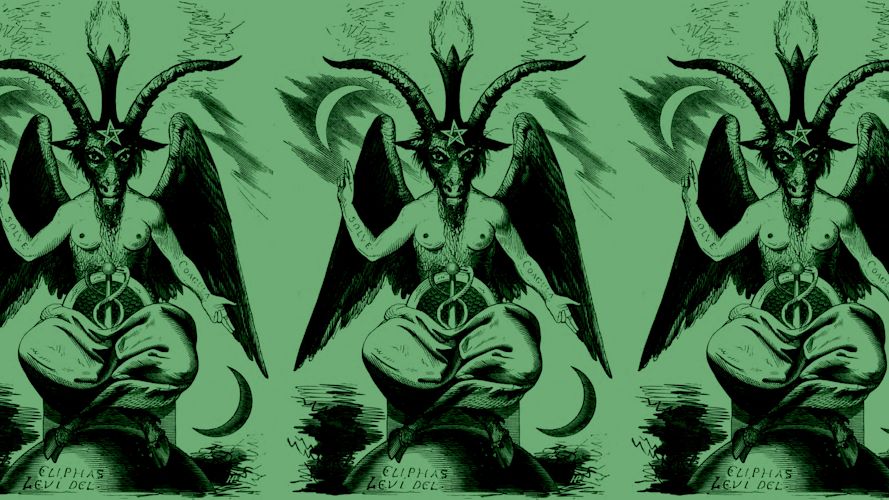
The Sigil of Baphomet and the Satanic Pentagram
