What does the Bible say about AI or artificial intelligence?
The short answer
The Bible doesn’t say anything about computer programs, especially not the ones we are designing now in the 21st century but the biblical authors’ warnings about the pagan practice of creating gods and the bans on divination should make us cautious about this new technology.
It’s important to understand that when engineers and programmers talk about artificial intelligence, they aren’t actually talking about something that functions like the human brain at all. What we call “artificial intelligence” is not a thinking mechanism, but something more like very complicated guesswork. The better name for programs like ChatGPT is “large language model,” or LLM for short. The essence of an LLM is that it takes a question you ask and tries to predict what combination of words and characters is the “right” response. It's unable to actually understand language—not in the way that humans do. Instead, it learns to recognize patterns across millions and millions of associations and combinations of words and then predicts which string of words is the best response to the combination of words that you sent it. If you interact with such programs enough, it quickly becomes evident that the program isn’t thinking or communicating; it just keeps guessing at responses until it gets the one that satisfies you. Its responses can be outright wrong or even nonsensical, because it isn’t actually thinking.

ChatGPT, currently the most popular LLM (large-language model)
What is an LLM actually like, then? Weird as it may sound, this sort of process is most like a type of divination—what you might call fortune-telling. Divination is the art of trying to read the future based on certain types of signs. The reason that ancient people believed in this sort of art is because they saw the physical and spiritual worlds as intrinsically connected, and they thought that everything in the physical world was also connected in various ways. If there was a weird event in the sky—like an eclipse, a blood moon, a supernova, a meteor shower, et cetera—they thought that it was a sign of something happening or about to happen on Earth. Even in the Bible, the Star of Bethlehem was a powerful astrological sign that Jesus had been born and God had become man. Reading tea leaves, laying out Tarot cards, palm reading, star-reading, and so on, are all just ways of interpreting a specific dataset according to some model in order to predict the future or understand the present.

Fortune-teller reading the palm of a woman, 1936.
While predicting what you want to hear is a little bit like fortune-telling, when you start asking such a machine questions about the weather, the stock market, or world events, then you are certainly engaging in a kind of divination. By creating LLMs, we’ve effectively built the most powerful divination method in human history; and though we might think we’re superior to our ancestors because we have machines while they were reading tea leaves or doing astrology, in reality, we’re all trying to do the same thing: predict the future so we can control it.
Divination and magic in the Bible
While simulated intelligence programs like ChatGPT are not mentioned in the Bible, divination is. The laws of the Old Testament forbid the ancient Israelites from using divination, from practicing magic, and from constructing idols. It wasn't that the ancient Israelites and Christians disbelieved in the reality of magic, demons, or the pagan gods. They absolutely believed in those things, but they were concerned about their danger and wickedness. What danger and wickedness? It has to do with the source of magic and the nature of these spiritual beings.
As I covered in my articles on the book of Enoch and the pagan God Tartak, the ancient Israelites and early Christians believed in the existence of the pagan deities. Their conception of the universe was that the highest God—the Lord of Hosts, the God of Gods, the God of Heaven—created all the lesser gods: the heavenly hosts, the “sons of God,” et cetera. These beings helped God oversee and manage the world, met regularly in assembly to discuss the affairs of the cosmos (see Job chapter 1), and even watched over specific nations. After the fall of the Tower of Babel, the Old Testament records that God divided the nations “according to the number of the sons of God” (Deut 32:8), which was traditionally understood to be a reference to the angelic beings that came to be called the “gods of the nations.” The issue is that, as recorded in the Book of Enoch, these creatures had their own “fall”: they became corrupt slaves of their appetites and created the various religions of the pagan world as a means to obtain worship and sacrifices for themselves.
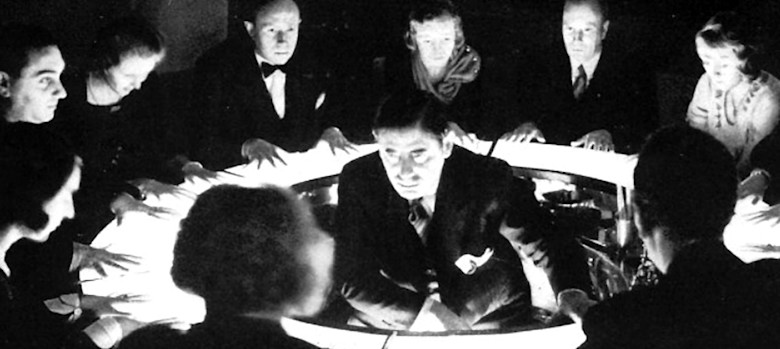
The medium Erik Jan Hanussen (middle) at a séance in 1928.
Divination and magical practices were, in large part, about interacting with these creatures and trying to obtain knowledge from them. Magical healings, wise advice, and especially predictions of the future were all sought after when interacting with these imposter deities. But of course, if such creatures were fallen angels, rebel gods, and usurpers of the highest God, then interacting with them is at minimum going to be dangerous. Such fallen creatures have no interest in being honest, nor do they care about your wellbeing; they want what they want, and so whatever they tell you might be misleading or intentionally dishonest. When you consider the number of absolutely brutal pagan gods who demanded things like human sacrifice and who frequently took out their anger on their worshipers, you can see why the Old Testament law of Moses would forbid any kind of interaction with them.
In the same way, building a massive, mechanized divination machine could have similar dangers. Because the algorithms are designed to tell you what you want to hear, there’s a strange sense in which building an LLM is about making a machine whose whole focus is to fulfill our desires and show us what we want to see. You might think that that sounds great, or that that’s the purpose of technology, but think about it more soberly for a minute: do you always want what’s best for you? I know that I don’t. What about wanting to know the truth? We very often don’t want to know the truth, or the full truth, because it can be painful and may force us to change. It usually takes someone you love to really help you understand where you’ve gone wrong; by default we tend to avoid painful truths and seek only what is pleasant.
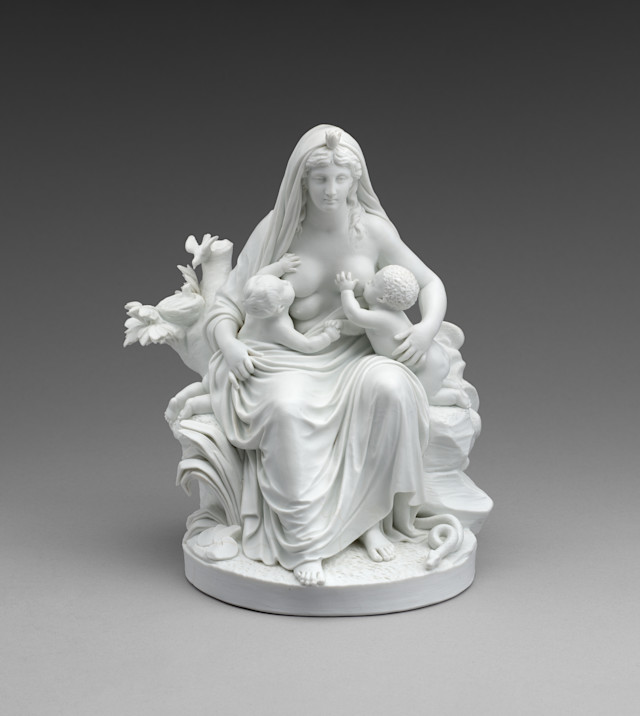
Louis Simon Boizot - La Nature - circa 1794-1795
But with a modern intelligence simulator, the question of truth becomes very muddled. Remember that such a program works by guessing at the right response. It’s not focused on the truth of the things it’s saying, because it doesn’t have a way to verify the truth. How could it? All it can do is guess based on pattern-recognition about what words and ideas are related to each other.
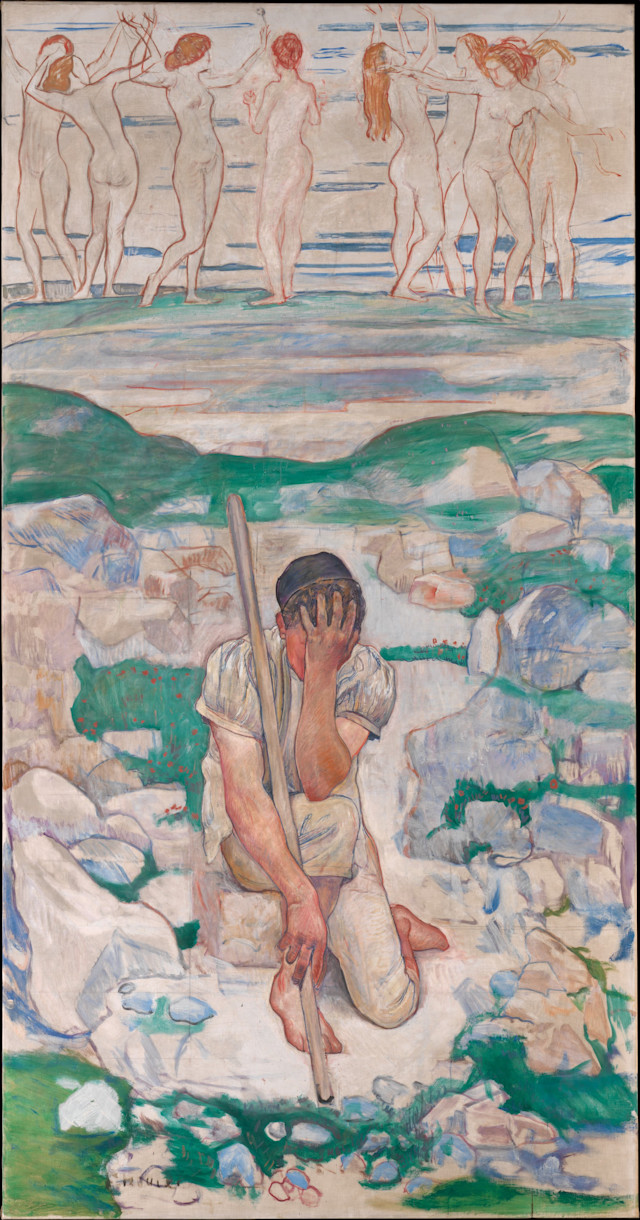
Ferdinand Hodler - The Dream of the Shepherd - 1896
So what’s the issue? The issue is that we’re building something whose fundamental goal is to tell us what we want to hear. In other words, our desires have been substituted for truth. A simulated intelligence is not an objective source of truth or even of factual information. At a fundamental level, it’s a mirror of our own desires; one that could become so good at predicting what we want that it knows what we want before we realize it. It’s like taking our all of our most basic impulses and urges and then giving a machine absolute power to gratify them, especially if you put an LLM in control of a virtual reality interface with the task of entertaining you in various ways.
Again, such a system is not as good as it sounds. In order to raise ourselves up higher than our biological urges, we have to do all sorts of things like delay gratification, make sacrifices, abstain from pleasure, and think long-term. The state of having all your impulses constantly and instantly gratified is a kind of hell: it reduces the human being to a mere animal and enslaves you in the dungeon of your urges.
The science of idol-making
The concerns we’ve discussed so far assume a more benign vision of this new technology. In fact, the above scenario is the minimum of what this sort of technology is capable of doing to us, especially when combined with virtual reality and the ability to generate any combination of images, sounds, and sensations. But there could be a much darker side to it. I want to end with a final concern, something that comes straight out of the Bible and the experience of the early Church. You might find it a little weird, but I think it’s worth thinking about.
There are many places where the Biblical authors condemn interaction with what they call “idols.” In many modern Christian circles, this language has been used to mean things that you “worship” instead of worshiping God. If you get obsessed with a sports franchise, a hobby, or whatnot, someone might say that it has become your “idol,” that you need to make sure you’re not giving it so much “worship” that it’s displacing God in your life. While it’s important to moderate your behavior and be aware of when things are disrupting your spiritual life, this modern usage was not what the Biblical authors meant when they talked about idols. In the ancient world, making and worshiping idols was a near-universal pagan practice that was understood in a specific, literal way.
Pagan thinkers across most cultures believed in something that we might call the “science of idol-making.” Their understanding was that if you build a physical object such as a statue in just the right way, and you performed certain magical rituals on it, you could actually lure and summon a spirit into the statue and bind it there. It is the same idea as a “genie in a bottle”—a powerful spirit trapped in a physical object.
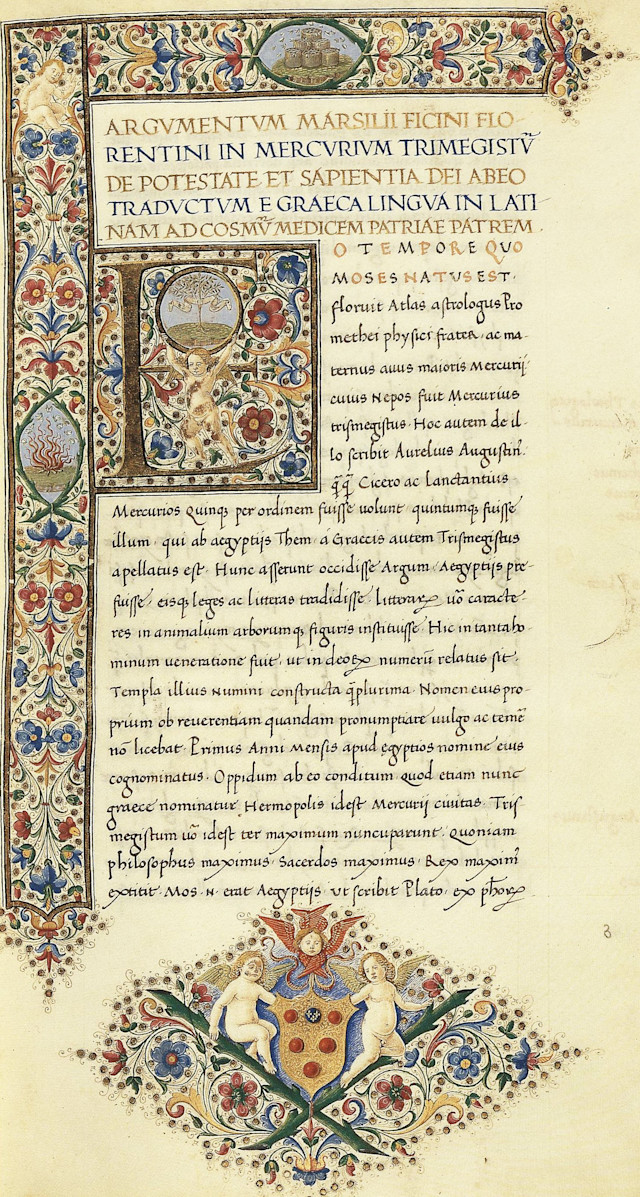
Marsilio Ficino’s 1491 Latin translation of the Corpus Hermeticum (source)
When pagans built idols, they created statues of gods or spirits and lured or bound those spirits into them so that they could gain access to the spirits’ powers. You might think of this practice as pure superstition, but if you are a Christian, you should take it seriously. The Biblical authors and the early Christians all believed in and took this practice very seriously—that’s why they condemned it.
What am I saying, therefore, about the advent of AI and LLMs? I don’t want to say anything too strongly yet. I’m not saying that computers are “the devil” or anything like that. It’s just that when I hear that we are, in essence, working very hard to build physical objects in such a way that we can put a kind of “mind” inside of them that can predict the future or tell us what’s best, it sounds a lot like idol-making.
Subscribe
Life-giving writing by Christian scholars sent to your inbox once per month

Zachary Porcu has a PhD in church history from the Catholic University of America in Washington DC, with additional degrees in philosophy, humanities, and Classics (Greek and Latin). He is an Eastern Orthodox Christian.
Keep reading
How Hot is Hell? Biblical Ideas vs. Pop Culture Depictions

The Problem with Sexual Sin

The Baptism of Poland: Unification and Christianization

What is a Pastor Emeritus? Should they exist?
What are the best Bible verses about love and trust?