The Sigil of Baphomet and the Satanic Pentagram
The short story
Both the Satanic Pentagram and the Sigil of Baphomet are anti-Christian symbols created in opposition to Christianity. These symbols claim to promote freedom. Ironically, the universe prescribed by these symbols leads to less freedom, "liberating" man by reducing him to an animal.
Most people know the famous story of the apple falling on Isaac Newton’s head, inspiring him to articulate the law of gravity. But most people don’t know that the Apple logo, released in the 1976, originally depicted this very scene, before it was updated in 1977 to the familiar image of an apple with a bite taken out of it. Yet the idea of an apple as a symbol for knowledge remained, for of course the bitten apple references the story of the forbidden fruit in the garden of Eden. Although Apple has offered various practical explanations as to why the apple in their logo has a bite out of it—such as to prevent it from being confused visually with a cherry or a tomato—the symbolism of the logo remains.
Symbols have a life of their own in that they connect the world of meaning to the physical world, embodying the spiritual in the physical. All throughout human history, symbols and icons have been used to instantiate ideas, ground meaning, and make statements about the nature of reality.
One of the most ominous symbols in the modern world is what’s called the “Satanic Pentagram.” It’s a symbol that has become so associated with evil, magic, and the devil that many people have become wary of any five-pointed geometric shape. But what is really going on with the so-called “satanic star?”
What is the Satanic Pentagram?
The goat headed pentagram was officially adopted as the logo for the Church of Satan, a religion founded in 1966 by Anton LaVey.
The pentagram has been an enduring symbol across a variety of religions and philosophical movements throughout history, often in a positive context. It was a symbol associated with ancient near-eastern deities like Ishtar or Marduk. It was used in the Liangzhu culture of China to represent the interaction between the five traditional Chinese elements (fire, water, air, wood, and metal). It was even used as a symbol for Jerusalem by Jews in the fourth century B.C., since “Jerusalem” is spelled in Hebrew with five letters. From a purely mathematical perspective, the pentagram is an interesting shape. For example, the four different line lengths that make up the pentagram exist in a golden ratio to one another. How then did the pentagram become associated with evil and with the church of Satan?
The pentagram: a traditional symbol of good
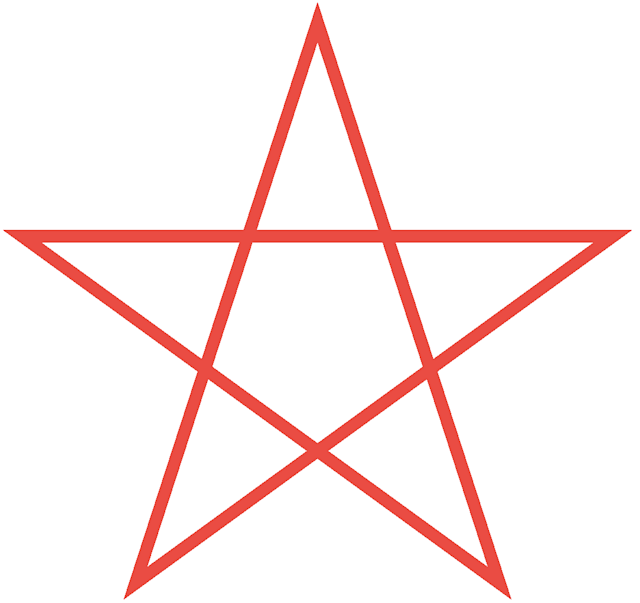
A basic pentagram
The Satan star: inverting the pentagram
If you wanted to invert this symbolism, however, you could flip the pentagram upside-down, such that the middle point of the star is pointing downward instead of upward. The symbolism there would be that matter is higher than and triumphs over the spirit, an inverting of the moral order of the universe and therefore an obvious sign of evil and corruption to any traditional religion.

Inverted pentagram (with the Hebrew letters for Leviathan - לויתתן) from the 1897 book “La Clef de la Magie Noire” by Stanislas de Guaita. The Church of Satan based its symbol on this picture.
The Sigil of Baphomet
What about the image of the goat-face in the middle of the pentagram? The figure of Baphomet has a complicated (and disputed) history going back to the Medieval period, but by the modern period he had been adopted as an important symbol in various occult traditions. Baphomet came to symbolize the harmonious balance of opposites: male and female, man and animal, good and evil, sun and moon, and so on. This is why he was depicted by the French occultist Eliphas Levi as a human-like creature with a goat’s head (both man and animal) and with both male and female physical features. Eliphas even made his own drawing of the creature (see the top of the page) which became its most popular representation.
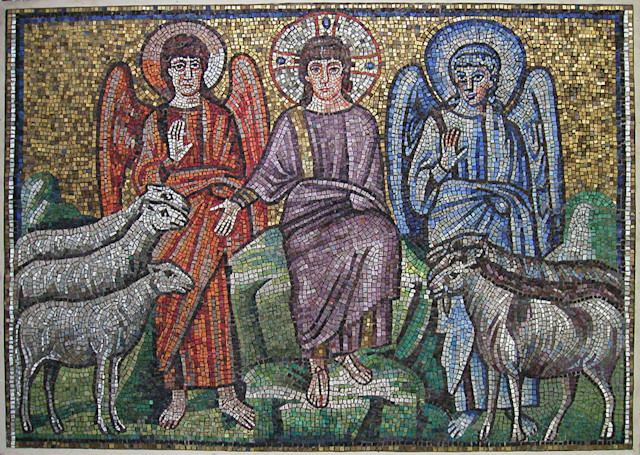
A 20th century reproduction of a 6th century Byzantine mosaic depicting the separation of sheep and goats.
The associations with the devil and other religions antagonistic to the mainline religions of Western civilization make Baphomet a perfect addition to the Satanic Pentagram, as LaVey was trying to subvert not only Christianity in particular but the long-held values of Western civilization in general.
Morality in the Satanic Pentagram
Did LaVey really believe in Baphomet? If we take his atheism seriously, it seems that he didn’t believe in supernatural creatures of any kind—neither God nor the devil. But he also seemed to be comfortable around other occultists who believed in the real existence of Satan and other spiritual entities. LaVey may have been an atheist, but that doesn’t mean the Pentagram has to be. As we see with the Apple logo, symbols are extremely powerful, and the meaning they convey can have implications beyond what their original authors intended.
Let’s take the Satanic pentagram seriously for a moment. A religion that focuses on allowing rather than suppressing our natural impulses initially sounds very liberating. But do we really want to live in a world where matter conquers spirit? I don’t think we do, for two reasons: (a) it doesn’t make logical sense; and (b) it leads to a kind of moral doom.
If you wanted to be a materialist, you’d have to throw out most of the experience of the human race.
But a world where matter is the only (or even the primary) thing is also very grim, morally speaking. For of course one of the main things you’d have to throw out in this model is morality itself. The laws of physics or the impulses of biology simply are, they don’t tell you anything about how you ought to act in the world. You might feel, for example, a strong impulse to run from danger, which would be a natural part of a biologically-based reaction to fear—but that doesn’t tell you whether or not you ought to run away. Our instincts, in other words, are one thing, but our morality is what helps us determine which of our instincts to obey and which to suppress at any given time. If you have no criteria for making these kinds of choices, then you’re simply at the mercy of your instincts and appetites, which means—in a very real sense—that you are their slave.
It might seem freeing at first to give in to your impulses, but the universe prescribed by the Satanic Pentagram ironically leads to less freedom. It claims to offer liberation to man, but in reducing him to an animal it takes away his most profound freedom, cuts him off from all true beauty, and confines him to the cage of matter. It’s not hard to imagine that the real devil would find this outcome particularly appealing.
Subscribe
Life-giving writing by Christian scholars sent to your inbox once per month

Dr. Zachary Porcu has a PhD in church history from the Catholic University of America in Washington DC, with additional degrees in philosophy, humanities, and Classics (Greek and Latin). He is an Eastern Orthodox Christian.
Keep reading
What is the sin of envy in the Seven Deadly Sins?


Are there aliens in the Bible?

Pastor vs. Priest: What are the differences?
Healing is the children's bread?

Where is Amenadiel in the Bible?