Abishai: Military leader for King David in the Bible
The short answer:
Abishai was a military commander under King David. He was a man of great physical courage and strength, but the text suggests that he did not have the same sense of mercy as David. This difference may have led to his downfall—but we aren’t sure.
Abishai was a military leader who served under King David. He was the oldest son of David’s sister Zeruiah, who married a man named Suri. He commanded one of the three divisions of the army in the battle against David’s betrayer son Absalom. Abishai was a man of great valor and physical ability. At one point he “raised his spear” against three hundred men and killed all of them (2 Sam 23:18)!
In the Bible: Abishai saves David
Abishai, however, was a bit too eager to spill blood. At one point, he volunteered to go with David when he infiltrated Saul’s army at night. Saul and David were enemies at this time, and when Abishai and David found Saul asleep, Abishai offered to kill Saul, but David forbid him to do so. David favored mercy and respected the office that Saul held (1 Sam 26:6-9).
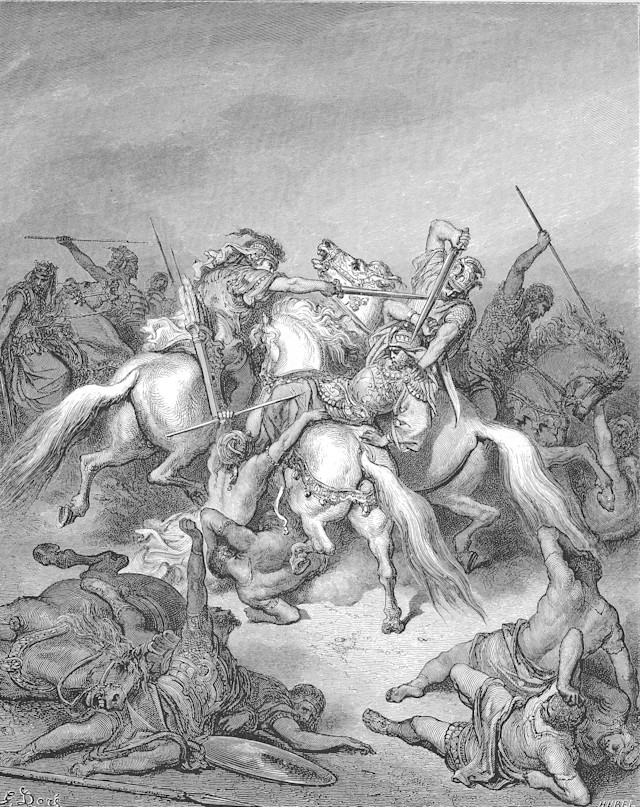
Gustave Doré - Abishai Saves the Life of David - 1866
Once again there was a battle between the Philistines and Israel. David went down with his men to fight against the Philistines, and he became exhausted. And Ishbi-Benob, one of the descendants of Rapha, whose bronze spearhead weighed three hundred shekels and who was armed with a new sword, said he would kill David. But Abishai son of Zeruiah came to David’s rescue; he struck the Philistine down and killed him. Then David’s men swore to him, saying, “Never again will you go out with us to battle, so that the lamp of Israel will not be extinguished." (2 Sam 21:15-17, NIV)
The passage points out that this enemy, Ishbi-Benob, was a “descendant of Rapha.” Why is that detail significant? Because the name “Rapha,” which appears six times in the Bible (2 Samuel 21:16, 18, 20, 22; 1 Chronicles 20:6, 8), is linked to the race of the giants, the Nephilim. These giants were abominations born of human women and the fallen angelic powers mentioned in Genesis 6. The Book of Enoch elaborated on these giants and powers more fully, and the Bible directly and indirectly referenced them. On many occasions, the Israelites fought against such creatures, or at least their descendants. The most famous of these encounters is the battle between David—when he was a young boy, before he became king—and the mighty Philistine warrior Goliath.
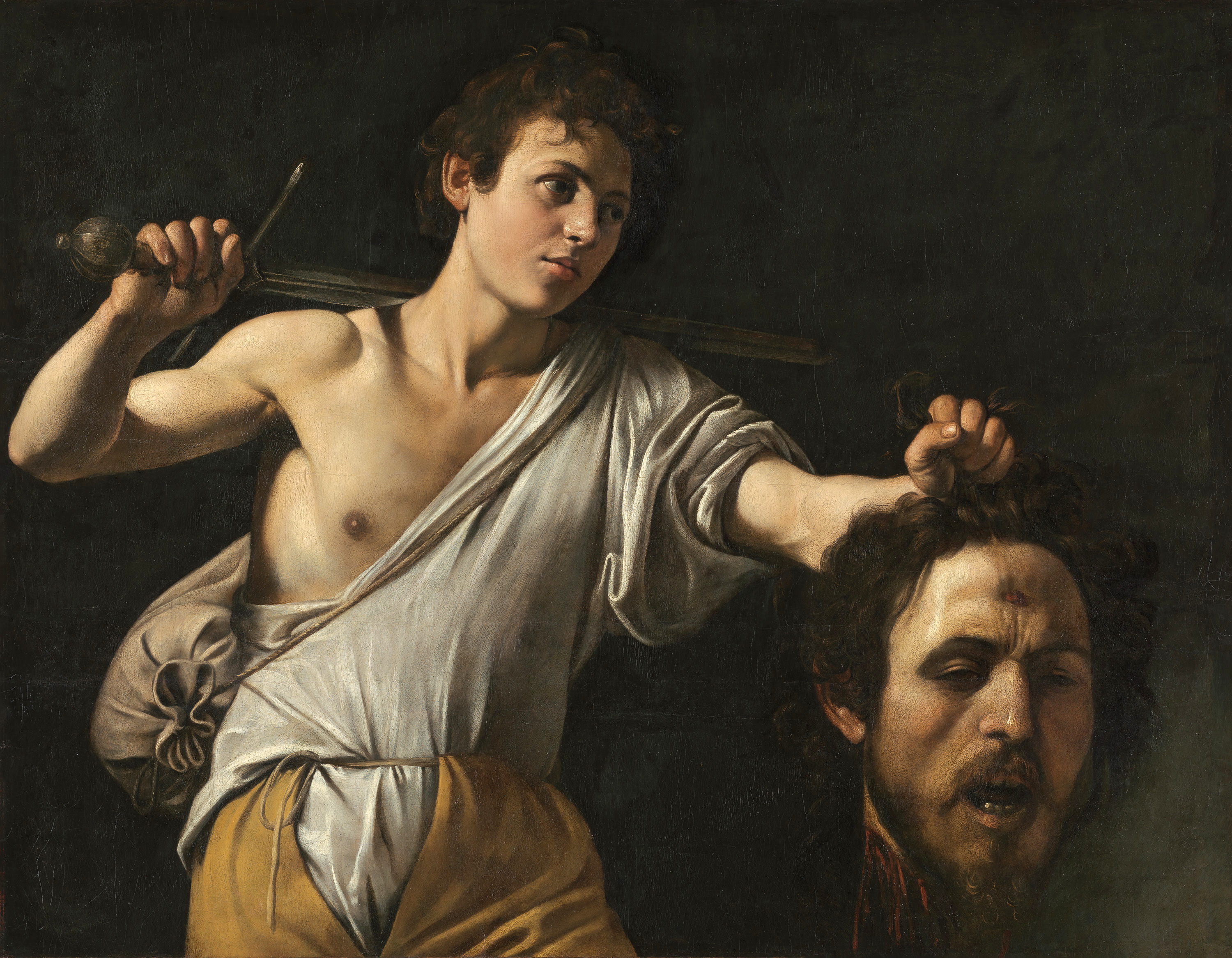
Caravaggio - David with the Head of Goliath - circa 1600
The passage from Samuel describing the fight between Abishai and Ishbi-Benob presented another confrontation with a descendent from that race of giants, which is why the passage mentioned that his spearhead, made of bronze, weighed three hundred shekels. Though three hundred shekels was only about 6 lbs, that was heavy for a spearhead, and was a sign of his status as a warrior. Keep in mind that a full suit of armor and weapons was expensive, equivalent to the purchase of a car for a modern person. They weren’t things every person had access to. As such, Abishai’s defeat of Ishbi-Benob was an impressive and mighty deed.
How did Abishai die? The curse of King David
It is not clear what happened to Abishai or how he died, as it is not mentioned in the text. One clue comes from something like a curse put on him by King David. In a conflict between the sister nations of Judah and Israel, Abishai collaborated in the murder of a man named Abner, one of Saul’s cousins. David had not authorized or condoned the act, and he declared himself and his people innocent of the murder. Indeed, he went to Abner’s funeral, followed in the procession, wept at his tomb, and fasted in mourning. David, ever the proponent of the path of mercy, condemned the murder. The chapter ends thus:
“Then the king said to his men, “Do you not realize that a commander and a great man has fallen in Israel this day? And today, though I am the anointed king, I am weak, and these sons of Zeruiah [meaning Abishai and his collaborator] are too strong for me. May the Lord repay the evildoer according to his evil deeds!” (2 Samuel 3:38-39)
How was the deed repaid? The text doesn’t say, but some scholars speculate that Abishai died at some point before the next-generation struggle between Adonijah and David’s son Solomon, as he was a prominent military figure but was not mentioned in the account of the battle. Given his more bloodthirsty proclivity, it would not be surprising if he perished in one of the many conflicts that led up to the conflict with Adonijah.
What is the meaning of Abishai?
Finally, people may be curious what Abishai means. The meaning of his name is “Father of a gift.” Abishai was the brother of Joab and Asahel, the son of Suri.
Subscribe
Life-giving writing by Christian scholars sent to your inbox once per month

Zachary Porcu has a PhD in church history from the Catholic University of America in Washington DC, with additional degrees in philosophy, humanities, and Classics (Greek and Latin). He is an Eastern Orthodox Christian.
Keep reading
Who was Hushai the Archite in the Bible? A friend of David


Why stay away from the Book of Enoch
Hineni in Hebrew: “Here I am” from God and Man
Who was Jotham, king of Judah?
What are the prophetic books of the Bible?