What is the Month of Abib?
The short answer
“Abib” was the Hebrew name of the first month of the Jewish ecclesiastical year, roughly towards the end of March. Its significance for ancient Israel was as the month that the Israelites fled Egypt, during which the first Passover was celebrated. After Christ, Passover became Easter and was filled with new glory.
While you won’t find the word “Abib” in English translations of the Bible, it was the Hebrew name for the first month of the year. In our modern Gregorian calendar, it corresponds roughly to April. The Hebrew calendar is more connected to the moon than our modern solar calendar, and the dates of the months roughly correspond to the new moons.
Are Nisan and Abib the same month? Yes: Nisan is what this month was called when the ancient Israelites were exiled in Babylon.

A field of ripe grain.
The significance of the month Abib
Abib was the month that the ancient Israelites made their famous exodus from Egypt, and was therefore the month in which the Passover meal was held. Passover was a traditional meal that the ancient Israelites performed, partly in preparation for their flight from Egypt, and also as a ritual with spiritual significance. The spiritual significance at the time had to do with their trust in God to deliver them from their slavery to the Egyptians and fulfill his promise to their forefather Abraham to give them their own land.
But, like many things in the Bible, the Passover had one meaning in the Old Testament and an additional, expanded meaning in the New Testament. This feature of the Bible makes it unique among other documents. The Bible was written by many different authors over a period of thousands of years. For the older authors, there was spiritual significance to the things that happened at the time, and there was also a hidden, deeper meaning that was only clear to those who came later—the writers who authored the New Testament.
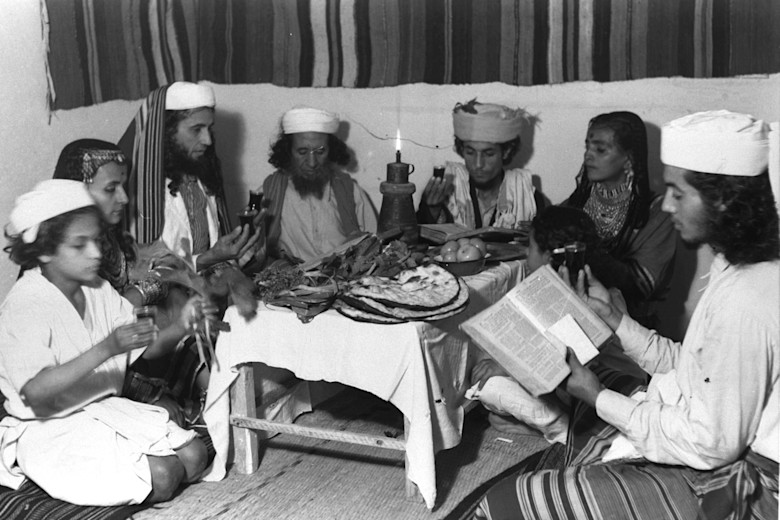
A Tel Avivian family celebrates the Passover Seder in 1946.
Christ is the reason for this expansion of meaning. The Old Testament was written by people who had encountered God in various ways and had a portion of wisdom and insight revealed to them. But there was a double meaning (at least) to all of these events. After Christ came and “opened the scriptures” to his disciples (Luke 24:45), they began to realize that everything that had happened in the Old Testament was also a foreshadowing—in real history!—of the coming of Christ and His Church.
In some ways, the religion of the ancient Israelites was the early stage of what would become the full Christian religion later. The missing ingredient for the Old Testament authors was the incarnation of Christ. Jesus was present in the Old Testament—He is, after all, the one “by whom all things were made,” but before He became incarnate as a man, the Old Testament authors could only see and understand him partially. After his coming, people began to see him more fully and more clearly and could understand the true significance of the various rituals in the religion of ancient Israel.
Passover foreshadowed Jesus’ resurrection from the dead. It’s celebrated as the “feast of feasts,” the most important event in the Christian calendar. In the West we call it “Easter,” but the older name for it is “Pascha,” the Greek version of the Hebrew word for “passover.”
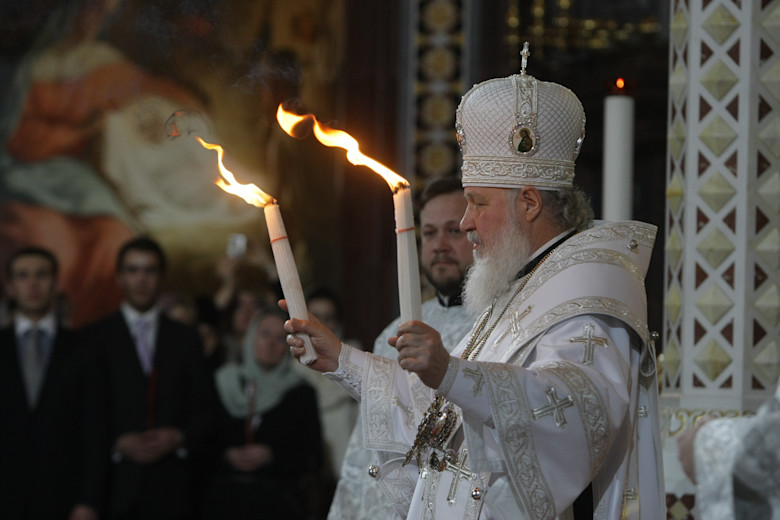
A 2010 Easter celebration in Moscow.
Pascha takes place at roughly the same time as Passover in what would be the month of Abib. It’s not exactly the same day, because of the long and complicated ways in which different calendars evolved over the last twenty-something centuries. You can read more about that here if you like, but ultimately it’s less important to have an argument about the calendar than it is to understand the spirit of what’s going on. The early Christians understood that passover was a “prefigurement” of the Lord’s Pascha: Passover was the beginning of the ancient Israelite’s freedom from enslavement to Egypt and its gods; Pascha is the beginning of all mankind’s freedom from enslavement to death and the devil. In other words, what started as an act of worldly freedom for a particular people group became an act of cosmic freedom for the whole world!
If you’d like to read more about this cosmic freedom and how ancient Christians celebrated the feast of Pascha, you can check out our other article, “Did Jesus Go to Hell?”
Subscribe
Life-giving writing by Christian scholars sent to your inbox once per month

Zachary Porcu has a PhD in church history from the Catholic University of America in Washington DC, with additional degrees in philosophy, humanities, and Classics (Greek and Latin). He is an Eastern Orthodox Christian.
Keep reading
The Trinity: Are God and Jesus the same person?


Jesus went to Hell for 3 days as seen in Scripture
Hineni in Hebrew: “Here I am” from God and Man
Who was Jotham, king of Judah?
What are the prophetic books of the Bible?