
Who was Agur son of Jakeh in the Bible?
The short answer
Agur son of Jakeh is an author of a section of Proverbs in the Old Testament. His identity is a mystery, with different theories saying he is a lesser sage or even King Solomon himself. But where mystery exists in scripture, we are invited to read more deeply.
Proverbs chapter 30 begins by saying that the following text is “sayings of Agur, son of Jakeh” and – depending on which translation – that it is “an inspired utterance” (NIV), a “prophecy” (KJV), that he is “the oracle” (ESV), and so on. Whatever translation you consult, some sort of word will be used to indicate that these words are in some way inspired or prophetic.
The Book of Proverbs, as a whole, is traditionally understood to be written by Solomon. However, because of this introduction, people assume that chapter 30 was not in fact written by Solomon, but instead by this mysterious and prophetic figure named Agur. But who is Agur?
Who is Agur in the Bible?
The exact identity of this character is unknown and has been widely disputed over the centuries. If you consult different Biblical commentators, you’ll get a wide range of answers. The simplest explanation is that he was another wise sage around the time of Solomon. This is the position of the Jamieson-Fausset-Brown biblical commentary, which states:
“Agur the son of Jakeh; a person so called, as appears from the designation of his own and his father’s name, who lived either in Solomon’s time, or rather afterwards, and was famous in his generation for wisdom, and piety, and prophecy; and therefore his proverbs were thought fit to be added to those of Solomon.”
Because there was no internet – indeed, even books were exceedingly rare in the ancient world as well – it’s quite believable that the wise sayings of another sage would have been compiled in something like the book of Proverbs. Because paper was difficult and expensive to make, it’s easy to imagine someone deciding to write down the wisdom of a sage on the same scroll or in the same place as that of another sage like Solomon – either by Solomon himself or by whoever compiled the book of Proverbs together.
Was Agur simply King Solomon?
There is another idea that the compiler was actually just Solomon himself. Jewish commentaries – like the Aggadah – have suggested that this passage is not a reference to another person named “Agur”, but that “Aguer, the son of Jakeh” was a poetic or cryptic way of referencing Solomon. The reason this is plausible is that names in Hebrew can have many meanings. “Agur” can mean “compiler”, suggesting that these passages weren’t composed by Solomon himself but were compiled by him. “Son of Jakeh” could mean “the one who despised the words of God”, which is supposedly a reference to Solomon’s marrying of many foreign wives. Confusingly, “son of Jakeh” could also signify “he who is free from sin”, and so could be a reference to the righteousness of David. In other words, it might be argued that you could translate “Agur, son of Jakeh” as “the compiler, who is free from sin”.
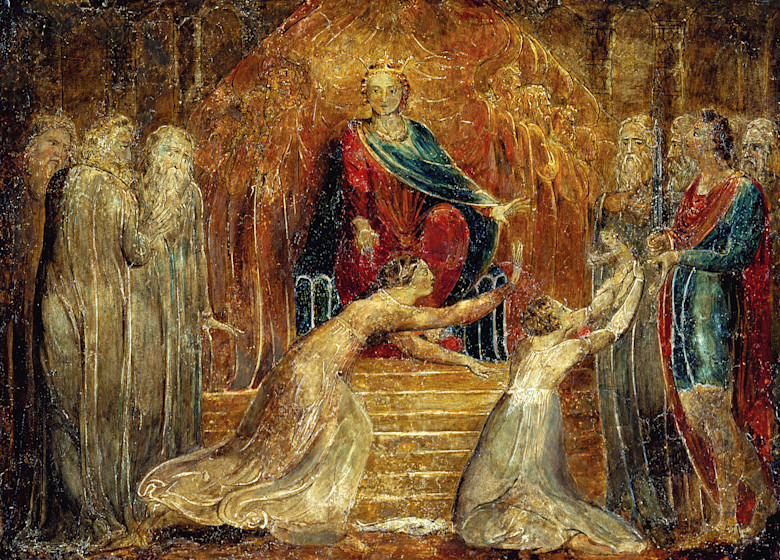
Solomon commands the baby to be cut in half in William Blake's 1799 painting
What might that mean? If Solomon was already understood as the author, what would be the point of him announcing that in the middle of the book of Proverbs? The idea is that Solomon, being a wise sage himself, would be interested in wise sayings himself, and (we might suppose) took an interest in collecting and preserving pieces of wisdom that he had heard from others. The the point of giving a special introduction to chapter 30 of Proverbs might, therefore, be a way for Solomon to state that the following lines were not his own but that he was simply a “compiler” of them.
Was "Agur son of Jakeh" not his real name?
Ellicott’s Commentary considers this possibility but takes the position that it’s somewhat far-fetched to think that this translation of “Agur, son of Jakeh” doesn’t refer to a person. Instead, that commentary assumes it was an unknown Jewish sage of some kind. The commentary argues, "But they [the sections in Proverbs 30] in all probability belong to some otherwise unknown sage, whose utterances were thought not unworthy of being joined with those of the wise King of Israel himself”, and suggests the alternative translation of “the words of Agur the son of Jakeh the Massan”, where “Massan” means a descendent of Massa, one of the sons of Ishmael (Gen 25:14).
Again, the reason for all this confusion has to do with the many possible meanings of ancient Hebrew words, which can be taken in different ways. One of the major reasons for this is that Hebrew words were originally written without vowels – they only wrote the consonants. It was only later that Hebrew began adding vowels to the writing system, mainly as a way to help non-native Hebrew speakers learn the language. But this means that ancient texts could have many possible translations. It’s like if you wrote the word, “Big” with only consonants. It would be “BG”. So what consonant do you add? If you add an “i” it would be “big”, but if you add a “u” it would be “bug”, and if you add an “a” it would be “bag”!
Another reason is that Hebrew words all had deeper meanings to them. The word “Mary”, for example, doesn’t mean anything in English, but the Hebrew word “maria” means “bitter”. We have some names like that in English, often with girl’s names like “Hope”, “Faith”, or “Rosemary”, or even boys names like “Hunter” or “Will”. All of those names are also English words that mean other things. But in Hebrew and most ancient languages, the names also had their own meanings. It would be like reading the word “hope” in an English book, but because the context was unclear, you might not know if the book was referring to the concept of having hope in something or if it was referring to a person named “Hope”.
Mysterious passages need mysterious meanings
Rather than getting caught up in the exact identity of this character, it’s better to understand what the significance of the passage is. Many people have notice that there is a style difference between this section of the proverbs and the section that precedes it. Cornelius a Lapide – a Flemish Catholic priest – calls it “as difficult and obscure as it is elegant and beautiful”, and that while the preceding passages “contain clear proverbs”, this passage “contains enigmas” (my translation).
When things become murky and unclear, they’re probably supposed to be read spiritually.
What about this passage in the Proverbs? When you read it over, it’s not hard to see these line as prophetic images of Jesus’ life and ministry:
“Who has ascended to heaven and come down? Who has gathered the wind in his fists? Who has wrapped up the waters in a garment? Who has established all the ends of the earth? What is his name, and what is his son's name? Surely you know!”
Agur son of Jakeh, Proverbs 30:4
That’s not to say this entire passage is about Jesus, as wisdom and prophecy are generally interwoven in the Old Testament, but prophetic images about Jesus can be found everywhere in the Old Testament, and it’s that content that’s really what makes the Old Testament important and relevant for Christians today.
Subscribe
Life-giving writing by Christian scholars sent to your inbox once per month

Dr. Zachary Porcu has a PhD in church history from the Catholic University of America in Washington DC, with additional degrees in philosophy, humanities, and Classics (Greek and Latin). He is an Eastern Orthodox Christian.
Keep reading

What is Gilgal in the Bible?

Who were Jannes and Jambres in the Bible?

Where is Mazzaroth and the Zodiac in the Bible?
What is Cabul in the Bible?

Why stay away from the Book of Enoch
