Did Jesus have a tattoo? Revelation 19 and tattoos
The short answer
In Revelation 19, Jesus has the words “King of Kings and Lord of Lords” written on his thigh. These words are tremendously important, but they are not a tattoo, as Revelation is more of a dreamlike vision than normal life.
In an apocalyptic vision in the final book of the Bible, St. John offers one of the most awesome and powerful depictions of Jesus in holy scripture. He is riding on a white horse, his eyes are like flame, he wears multiple crowns on his head, “out of his mouth goes a sharp sword,” and, curiously, he seems to have a marking on his body: “And he has on his robe and on his thigh a name written: king of kings and lord of lords” (Rev 19:11-16). Does this mean Jesus had a tattoo?
What does the Bible say about tattoos?
Should Christians have tattoos? What does the Bible say about tattooing? Are tattoos “sinful”? While these are common questions, they are the wrong place to start. Many people who ask these kinds of questions—as with most moral questions about Christianity—are trying to live a modern, consumer lifestyle, and they’re checking with the Bible or their tradition to make sure it doesn’t get in the way of what they already want to do.
Christianity is not a modern religion but an ancient one. It’s very common to take some specific practice from today and try to read it back into the ancient world with a different understanding than those people originally had. The most common example is when people take Bible verses and interpret them without context—either without the context of the rest of the Bible, or without the cultural context of the ancient world, or even without the tradition of the church at large. So, to sort out this question we need to explore the answer in parts.
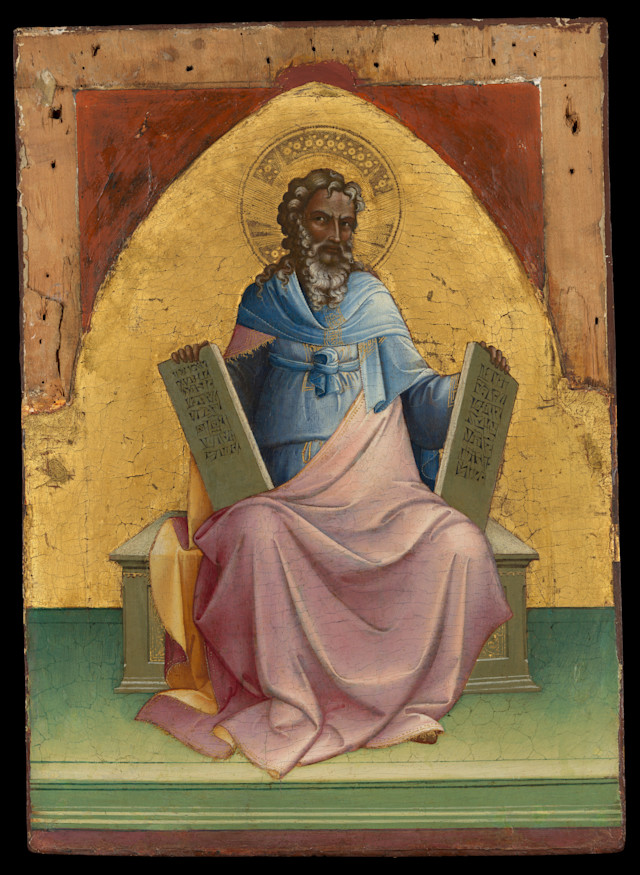
Lorenzo Monaco - Moses - circa 1408
You could have a few reactions to this verse. On the one hand, you could say, “the Bible says ‘no tattoos,’ therefore, no tattoos!” On the other hand, you could say, “Well, that was the law of Moses, and Christians aren’t under the law anymore, so you can do whatever you want as long as it’s in the right spirit.” Both of these are overly simple answers that don’t really address the issue because misunderstand the spiritual significance of tattoos.
Revelation 19: “King of Kings” and Isaiah 44
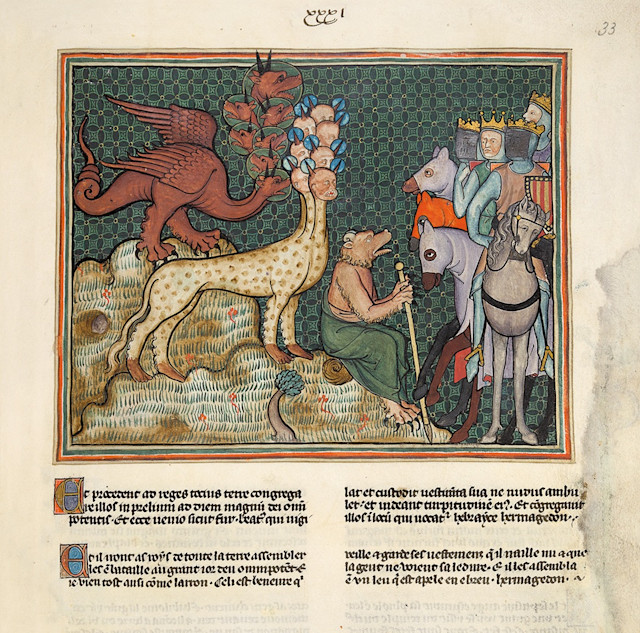
A page from the Val-Dieu Apocalypse, an illuminated manuscript of the Book of Revelation from the 1320s.
There is also a passage from the prophet Isaiah (44:5), where he writes:
This one will say, “I am the Lord’s,”
another will be called by the name of Jacob,
yet another will write on the hand, “The Lord’s,”
and adopt the name of Israel.
A marking on the hand was a common way that people were tattooed in the ancient world. The context was slavery. The idea that someone would mark on his hand, “The Lord’s” is really about someone willingly making himself a bonded servant of God. But again, this is a piece of imagery, likely metaphorical, in a book of the Bible that is already full of metaphorical, symbolic imagery. So we cannot say that this passage says tattoos are okay. More likely the author was trying to explain our relationship to God through an analogy that would be easily recognizable to his readers—that of a slave being branded with the name of his master.
Should Christians get tattoos?
Trying to use the Bible to prove that tattoos are “okay” or, conversely, to prove that they’re “not okay” is not actually a Christian way to think about the Bible. It’s more of a lawyer's way to think about it. What’s important is acquiring an authentic Christian way of viewing the world, and then consider tattoos from that perspective. To give a better answer to a question like, “should Christians have tattoos?” we need to take a step back and understand the idea of the body and the idea of markings in the context of the way ancient people thought about the world.
So, what is a tattoo? Tattoos in the ancient world were not about consumerism, that is, they were not about decorating yourself with images of your favorite companies or brands. We do casual things like get tattoos of a favorite video game character because we don’t think much of the body. In the modern West, we tend to think of the body as just a shell for our souls, and treat alterations to our bodies as though they were trivial or matters for casual decoration.
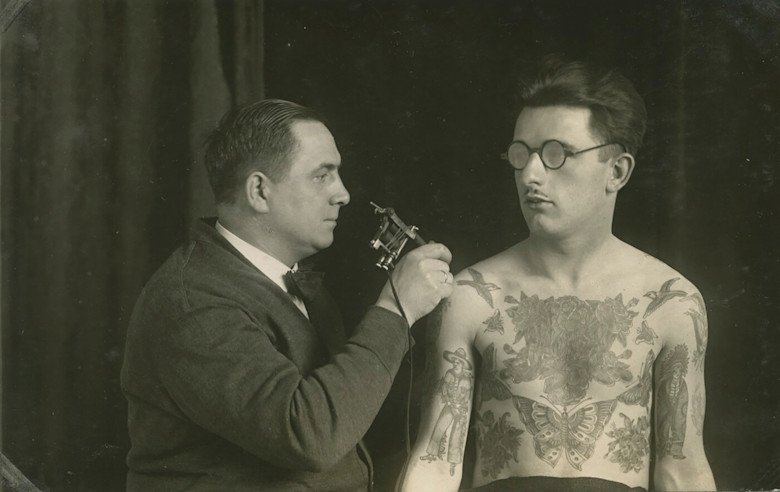
A 1930 photograph of the "King of Tattooists," Christan Warlich, tattooing Karl Oergel.
But that is not how ancient Christians—or any ancient people, for that matter—thought about the body. For the ancients, the body was an intrinsic part of who and what you were. You were just as much a body as you were a mind or a spirit: all three together. No one of these three was really “less you” than the other two, especially for Christians. This principle is apparent in St. Paul's admonishment of the Corinthians about sexual immorality:
“Or do you not know that your body is the temple of the Holy Spirit who is in you, whom you have from God, and you are not your own? For you were bought at a price; therefore glorify God in your body and in your spirit, which are God’s” (1 Cor 6:19-20).
He wasn’t being metaphorical. St. Paul was speaking to the early Christian idea—seen in the New Testament and the writings of the earliest Christians—that the body was meant to be a literal dwelling place of the Holy Spirit. In the same way that pagans used to summon the spirits of various gods and demons into idols, the Christian was supposed to offer his or her body as the literal, physical temple of the Holy Spirit, that is, God himself. This account changes our understanding of what to do with (and to) the body. The body isn’t a throwaway thing that we should take lightly. How we dress, present, and conduct ourselves now becomes a sacred, holy thing for Christians, because the body is actually part of a sacred ritual: the lifelong ritual of making your body a dwelling place for the Holy Spirit.
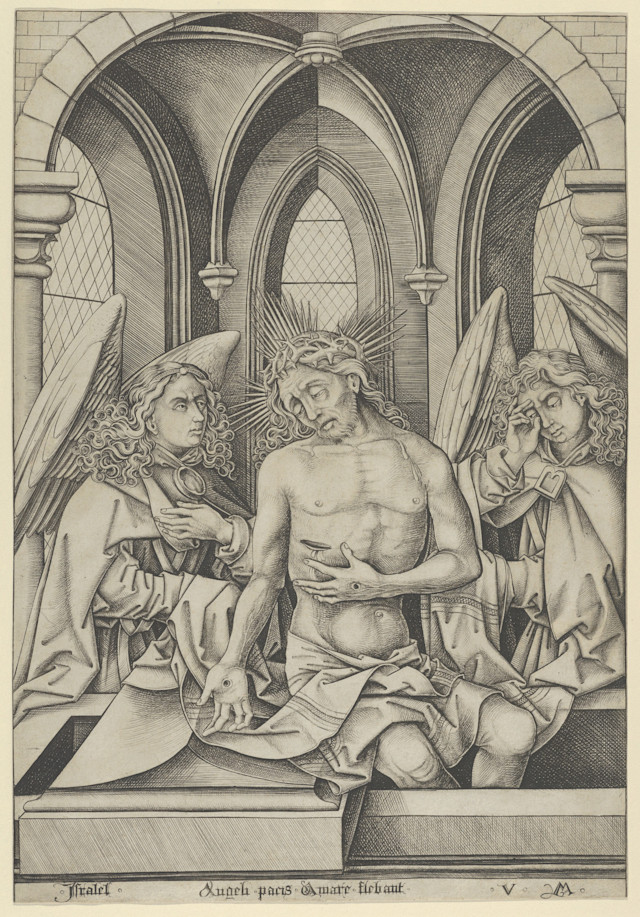
Israhel van Meckenem - Christ as the Man of Sorrows between Two Angels - circa 1500
There is one exception to this general rule: Coptic and Ethiopian Christians once tattooed their children with a cross, usually on the wrist. This practice ensured that their bodies could be identified—and specifically identified as belonging to Christians—if they happened to be kidnapped and killed by Muslims. Another reason was that, in a Muslim-controlled world, they could clearly stand out from among their Muslim neighbors and stay separated from them in their conduct and beliefs.
Today it’s not uncommon to find people who identify as Christians but who believe all sorts of things along with their Christian identities, including getting or having tattoos. But this was not the case for most of Christian history. It’s telling that the only exception to this was a small, modest mark of the cross on the hand, for the sole and express purpose of identifying the bearer as belonging to Christ.
Subscribe
Life-giving writing by Christian scholars sent to your inbox once per month

Zachary Porcu has a PhD in church history from the Catholic University of America in Washington DC, with additional degrees in philosophy, humanities, and Classics (Greek and Latin). He is an Eastern Orthodox Christian.
Keep reading
Jesus and the Syrophoenician Woman: Gentile Salvation

Who was the first woman preacher in the Bible?
Was Jesus a Rabbi?
Who was Phanuel? Archangel or Father of Anna?

Is “love conquers all” in the Bible?