What is the prayer to put on the full armor of God?
The short answer
The “full armor of God” comes from a passage in St. Paul’s letter to the Ephesians in which he explains the spiritual life through an analogy about putting on physical armor for battle.
Saint Paul’s letter to the Ephesians ends with a powerful chapter filled with memorable exhortations. Central to this passage is his long analogy about putting on “the armor of God,” in which he describes a variety of spiritual qualities in terms of adorning oneself with armor and weaponry as if for a great battle. He writes,
Wherefore take unto you the whole armour of God, that ye may be able to withstand in the evil day, and having done all, to stand. Stand therefore, having your loins girt about with truth, and having on the breastplate of righteousness; And your feet shod with the preparation of the gospel of peace; Above all, taking the shield of faith, wherewith ye shall be able to quench all the fiery darts of the wicked. And take the helmet of salvation, and the sword of the Spirit, which is the word of God. (Ephesians 6:13-17, KJV)
Saint Paul is not merely being poetic, as it might seem to modern people who are removed historically from this sort of attire. Most people reading this passage will never put on a suit of armor from the Greco-Roman period. But each of the elements in such an outfit had an important function, and you should think about each of these pieces of attire in terms of its symbolism. I might suggest reading it in the following way:
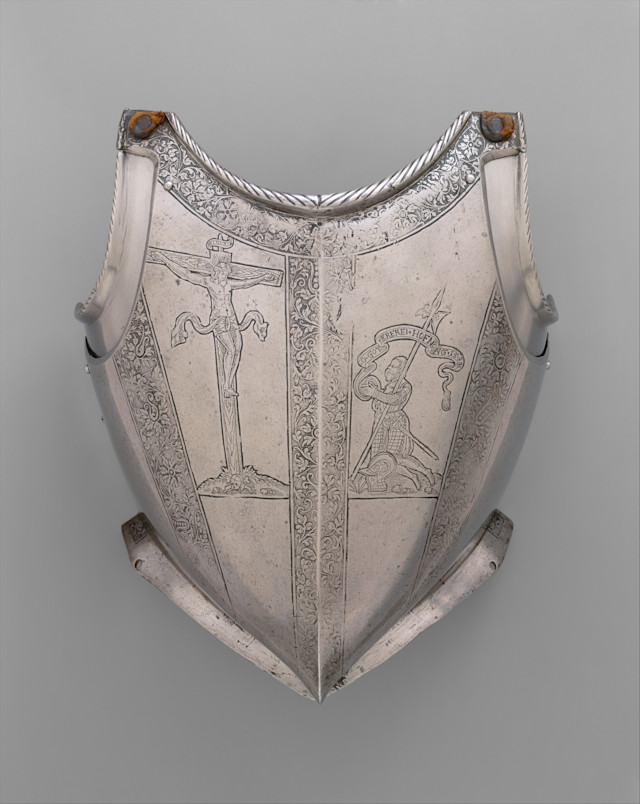
Breastplate - 1580 - The Metropolitan Museum of Art
The feet are clothed with the “gospel of peace,” indicating that our journey (which we take with our feet) is towards the kingdom of heaven. You should remember that some of the first beings to announce the gospel were the angelic powers, who wished for peace among men: “Glory to God in the highest, and on earth peace, good will toward men” (Luke 2:14).
You might hear “darts” and think of something more like throwing-darts used for games, but word refers to arrows and other lethal projectiles. The shield that protects against such attacks is the shield of faith, because staying faithful to God will keep you unharmed by the actions of the wicked. Because Christ has overcome the world, Christians cannot ultimately be harmed by it: “In the world you will have tribulation. But take heart; I have overcome the world” (John 16:33). Several other passages in the Bible reinforce this idea: for example, John 1:5, where the darkness could not overcome the world, and Psalm 23, “Yea, though I walk through the valley of the shadow of death, I will fear no evil: for thou art with me...Thou preparest a table before me in the presence of mine enemies.”
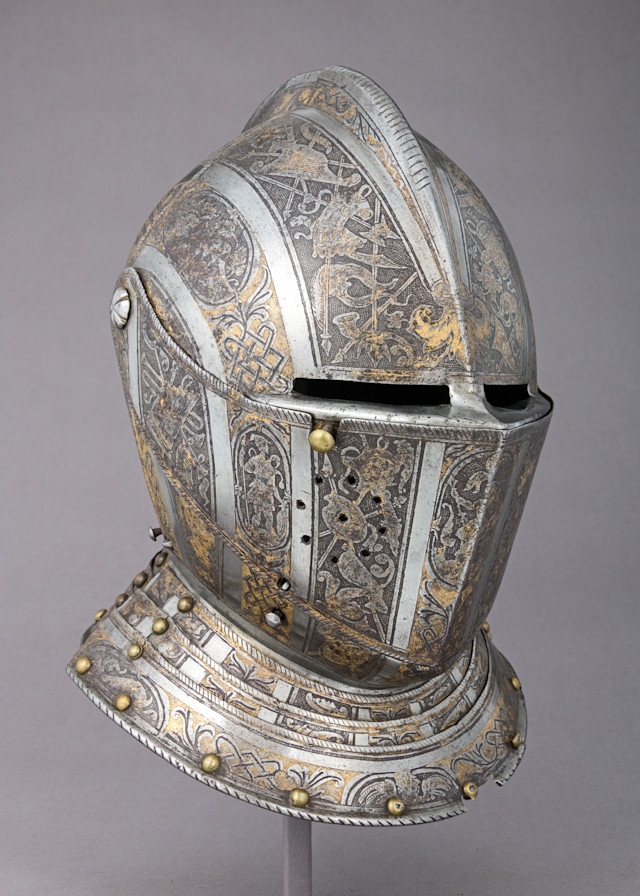
Close Helmet - circa 1585 - Attributed to Pompeo della Cesa
Finally, the weapon that we arm ourselves with is a sword, specifically the “sword of the spirit,” which St. Paul says “is the word of God.” This part could be taken in a few ways, but one common misunderstanding is that St. Paul meant the Bible when he wrote the “word of God.” While people often read the passage in this way, it doesn’t make a lot of sense. First, there was no such thing as the Bible at this time. The Gospels probably hadn’t been written at the time St. Paul wrote this letter to the Ephesians, and it would be two to three hundred more years before the major writings of the apostles were collected and designated as “the New Testament.” Therefore, many churches did not have access to these writings, and certainly the Ephesians didn’t have them. It’s not clear that they even had St. Paul’s other letters to, say, the Corinthians or the Galatians, so there’s no way they could have read his letter and concluded that he meant the specific set of writings that we now call the New Testament.

Andreas Bloch - Sigurd Entering Constantinople - Late 1800s or early 1900s
If not the Bible, what might Paul have meant by “the word of God”? Something much better than a truthful book—he was talking about Truth Himself, who is Christ. Remember that the main understanding of the “word of God” in the early Church was Jesus himself. Not for nothing did Jesus say that he was the truth: “I am the way, the truth, and the life” (John 14:6). He wasn’t saying, “the things I say are true”; he was being literal: “I am the truth.” There is another passage where St. Paul talks about the “word of God” in which it’s much more obvious that he’s referring to Christ:
For the word of God is living and active, sharper than any two-edged sword, piercing to the division of soul and of spirit, of joints and of marrow, and discerning the thoughts and intentions of the heart. And no creature is hidden from his sight, but all are naked and exposed to the eyes of him to whom we must give account. (Hebrew 4:12-13)
Notice how St. Paul compares the “word of God” to a sword, but clearly has a person in mind. He describes this person as “discerning,” as having “sight,” and being someone to whom we “give account.” The “word of God” is Christ himself. What better weapon to arm ourselves with?
The need for spiritual warfare
And who are we fighting, exactly? Right before this passage, St. Paul explains that our enemy is the devil and the demons. He writes,
Put on the whole armour of God, that ye may be able to stand against the wiles of the devil. For we wrestle not against flesh and blood, but against principalities, against powers, against the rulers of the darkness of this world, against spiritual wickedness in high places. (Ephesians 6:11-12)
His understanding was that the world was ruled by fallen angelic beings, in other words, demons. He warned that our enemies are these demonic entities, and that we need to arm ourselves against them. You can read more about this concept in the articles on The Book of Enoch and Tartak.
Subscribe
Life-giving writing by Christian scholars sent to your inbox once per month

Zachary Porcu has a PhD in church history from the Catholic University of America in Washington DC, with additional degrees in philosophy, humanities, and Classics (Greek and Latin). He is an Eastern Orthodox Christian.
Keep reading

Jesus and the Syrophoenician Woman: Gentile Salvation

Who was the first woman preacher in the Bible?
Was Jesus a Rabbi?
Who was Phanuel? Archangel or Father of Anna?

Is “love conquers all” in the Bible?