
Where is Mazzaroth and the Zodiac in the Bible?
The short answer
Mazzaroth is a word that appears only once in the Bible and seems to refer to the ancient practice of astrology. But in Christ we are empowered far beyond the clumsy charms of the Zodiac, and thus have no real threat from it.
Mazzaroth (or mazaroth) is a weird word that occurs exactly one time in the Bible. It appears in the Book of Job when God is chastising Job about his lack of knowledge of the true, inner workings of the world, and is translated as “constellation”: “Can you bring forth the constellations [mazzaroth] in their seasons or lead out the Bear with its cubs?” (Job 38:32). In the King James version of the Bible, and a few others, the word is left untranslated: “Can you lead the Mazzaroth in their season?” Rather than referring to a specific constellation, the word is generally thought to refer to the set of constellations that we would call the Zodiac—the belt of twelve constellations that turn as the Earth orbits the sun. As you might expect, the word Mazzaroth became associated with astrology, and is the root of the Hebrew term “mazel tov”—an expression which means “good fortune."
But the moral commands to the ancient Israelites that we see in the Bible generally forbid interaction with astrology and constellations. The text usually categorizes such behavior with worship of fallen gods and idolatrous religious practice, as in 2 Kings / 3 Kingdoms:
“Then he removed the idolatrous priests whom the kings of Judah had ordained to burn incense on the high places in the cities of Judah and in the places all around Jerusalem, and those who burned incense to Baal, to the sun, to the moon, to the constellations, and to all the host of heaven.” (NKJV, 2 Kings 23:5)
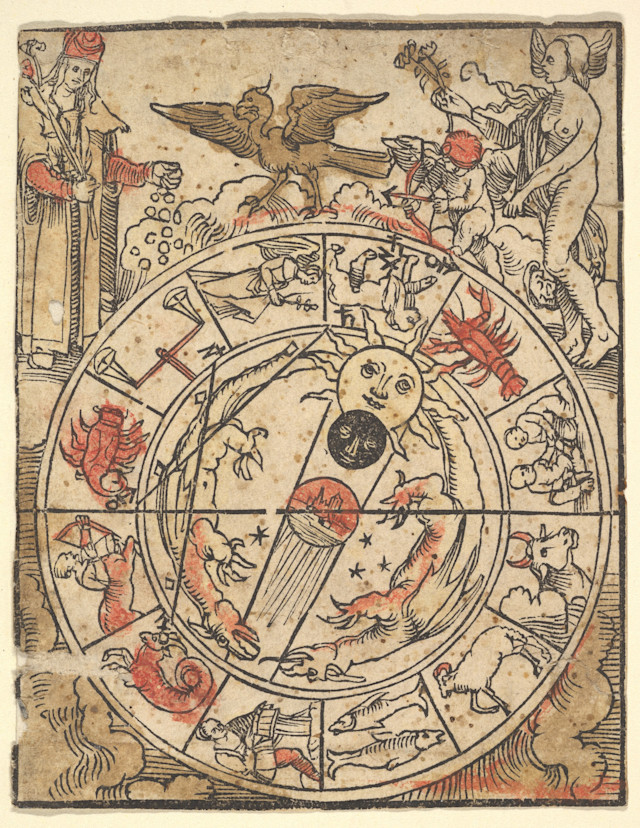
Chart of the Signs of the Zodiac with Venus Cupid, and a Bishop Saint, woodcut print by Hans Baldung, circa 1500s.
Probably the most famous example of this principle is the story of the star of Christ in Matthew’s gospel account. Matthew describes how the Magi—pagan wise men and star gazers—learned that Christ was going to be born on Earth because they saw a sign in the sky: “we have seen his star in the East and have come to worship him” (Matthew 2:2). Almost all ancient cultures had some developed art of looking at the stars to interpret or predict things happening on the Earth, a practice that came to be known as astrology.
Astrology and horoscopes worked, but not anymore
Most people today associate the Zodiac, astrology, and horoscopes with fortune-telling. In the Western Zodiac system, we use the month that you were born and connect that to which constellation was in the sky at the time in order to determine your luck. The Chinese Zodiac is instead based on the year you were born in a rotating twelve-year cycle, but the basic principle is the same.
Modern people tend to be skeptical about this sort of thing, despite the fact that ancient people almost universally believed in one or another model for astrology—no matter what culture they came from. It’s easy, as modern people, to dismiss the ancient idea that the stars could influence our lives on the basis that ancient people were not as “sophisticated” or didn’t have access to telescopes, but many modern people still continue to believe in astrology because the idea that the world is enchanted and full of meaning makes a lot of intuitive sense. Which camp did the early Christians fall into? Surprisingly, they neither trusted astrology nor said that it was unreal: they said that astrology was real but had stopped working. Why? Because of the coming of Christ.
Every culture has its cosmological story, most of which feature a variety of gods and spiritual beings. Most people think that Christianity believes in only one God and claims that all the pagan gods were fake, but that is not what the Biblical authors and the early Christians believed. They believed in the existence of these other deities, but that their God was the “God of gods” and “Lord of kings” (Daniel 2:47). He is also called the “Lord of hosts” (Isaiah 19:25, 29:6, 37:16, 1 Samuel 1:3, 15:2), meaning the Lord of all the hosts of heaven—in other words, the lord of the angelic powers or “lower gods”. However, some of these “lower gods” rebelled and fell to Earth, creating the whole system of pagan religions as imposter religions, as we’ve covered in . This rebellion led to a period of time when humans were ruled over by these fallen gods, who taught them to worship in very specific ways, often through use of astrology and other omens. These gods indeed ruled over humans and had real power to determine their destiny.
That is, until Christ came. The early Christians saw Christ’s coming into the world as the dawn of a new age (that’s why the dating system started over with the birth of Christ, and why almost everyone in the world now uses a dating system based on this world-changing event). It wasn’t merely a change to society or government, but a cosmic change, a change to how the universe was governed. The old cosmic era—the era where the lower gods ruled over humanity through a mixture of fear, punishment, and reward—had come to an end. Christ dethroned those fallen gods and took the fate of humans out of their hands.Christ dethroned those fallen gods and took the fate of humans out of their hands.
Another important element in ancient people’s fascination with astrology and other forms of fortune-telling is the widespread pagan belief in fate. Prior to Jesus, most people saw themselves as small and relatively weak in the face of the grandeur of the universe and the awesome power of the gods. It was very natural to believe that your fate could be determined by when and where and to whom you were born, as ancient man found himself in a world largely outside of his control, where he was not the center of the universe but dependent on the protection and aid of his older cousins, the gods. As a result, ancient people put a lot of emphasis on trying to learn their fate.
The new era of Christ as Lord
With the incarnation of God as a man, everything changed. Instead of being bound by fate, as determined by the old gods, humans now had freedom in Christ—not just freedom from death, as is usually emphasized in Christianity, but freedom from fate as well, including the fate that the stars exercised over us. The early Christian thinker Tertullian explained it in this way: “that science [astrology] has been allowed until the Gospel, in order that after Christ’s birth no one should thenceforward interpret any one’s nativity by the heavens” (Tertullian, Against Idolatry, chapter 9).
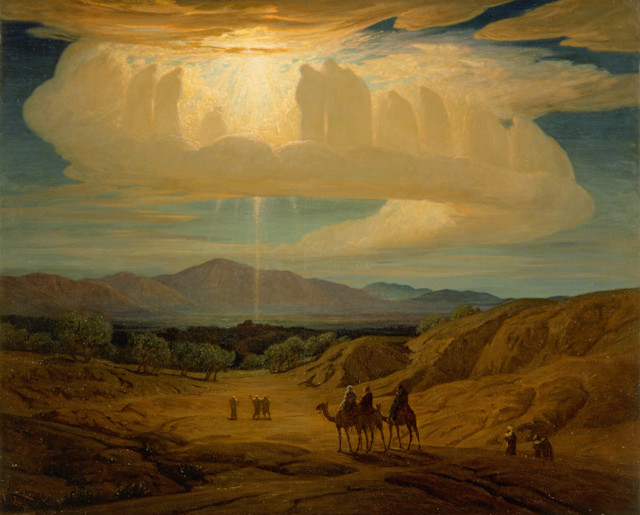
Elihu Vedder, Star of Bethlehem, 1879
As the God of gods, Christ is higher than the gods. But man is still lower, which is why God asks Job rhetorically if he can “bring forth the Mazzaroth in their seasons”, because of course he cannot. One of the central ideas of Christianity, however, is that Jesus is both God and man. God became “incarnate”: literally, he took on human flesh. When God took on human nature, he united human nature to his divine nature, meaning that man now has the ability to share in the power and glory of God himself. “God became man so that man might become God”, as St. Athanasius put it. And if man can be a participant in God’s power and glory, he is definitely no longer subject to the rule of the fallen gods nor bound by fate through the stars. So is astrology real? The answer, it used to be!
Subscribe
Life-giving writing by Christian scholars sent to your inbox once per month

Dr. Zachary Porcu has a PhD in church history from the Catholic University of America in Washington DC, with additional degrees in philosophy, humanities, and Classics (Greek and Latin). He is an Eastern Orthodox Christian.
Keep reading

What is Gilgal in the Bible?


Who were Jannes and Jambres in the Bible?
What is Cabul in the Bible?

Who was Amoz father of Isaiah in the Bible?

What is algum wood in the Bible?
