Who was Tartak in the Bible? The idol of the Avites
The short story
Tartak is probably a fallen "god" or angel (that is, a demon) in the Old Testament who was worshiped by the Avites. In contrast, Christians worship the one Supreme God who is above all, even His created angels.
Tartak is mentioned in the second book of Kings (also called “4th Kingdoms” in older Bibles) as one of the idols that was set up in Samaria by the people who were living there. 2 Kings chapter 17 describes the religious confusion developed when the priests of the Israelites tried to teach the people how to practice proper worship of the Lord God, but the people persisted in building idols. The text describes the various gods that they built idols of, including Sukkoth-Benoth, Nergal, Ashima, and Tartak.
What do we know about Tartak, specifically? Very little, other than Tartak was the god set up by the Avites. There has been some scholarly debate about this figure, but none of it has been very conclusive. It’s been suggested that he was a form of the Egyptian god Typho, or that he was some sort of hero of the underworld, or that he was related to the worship of Mars. If the name is Persian, as some believe, it might mean “intense darkness” or “hero of the underworld,” but other sources suggest that it might have something to do with being “chained” or “bound”—which could be a connection to the dungeon Tartarus, a place in the Greek underworld of suffering and chains. But the exact meaning of the name is not clear.

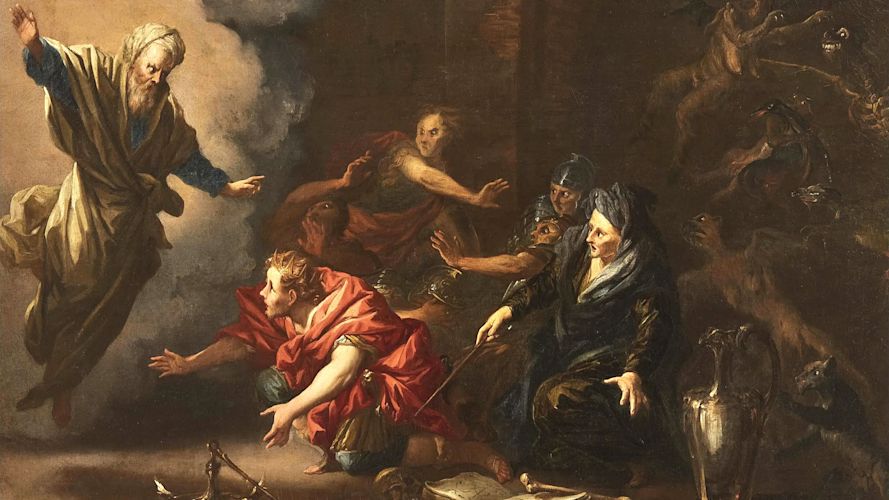
Ludwig Mack - The Underworld - 1829
Ultimately, the identity of this god is insignificant. More important for us is understanding the broader context of how ancient people thought about religion. Many of the things that modern people say about ancient religion is misleading, so the correct context will help you get a better understanding of what’s happening in these sorts of biblical episodes.
Monotheism vs. henotheism
One of the major misconceptions many people have about the ancient world is the idea that ancient Israelites and early Christians were “monotheistic”—meaning that believed in the existence of only one God—while ancient pagans were “polytheistic”—meaning that they believed in many gods.
However, this idea is not strictly correct. The Old Testament makes constant reference to other spiritual entities that we might call gods. Moses writes, “Who is like You, O LORD, among the gods? Who is like You, glorious in holiness, fearful in praises, doing wonders?” (Exodus 15:11). Later, he records that, “they sacrificed to demons, not to God, To gods they did not know, to new gods, new arrivals that your fathers did not fear” (Deuteronomy 32:17, emphasis mine). And the psalmist writes, “God stands in the congregation of the mighty; He judges among the gods” (Psalm 82:1, emphasis mine). It’s clear that scriptures acknowledge other spiritual entities and refer to them as “gods.”
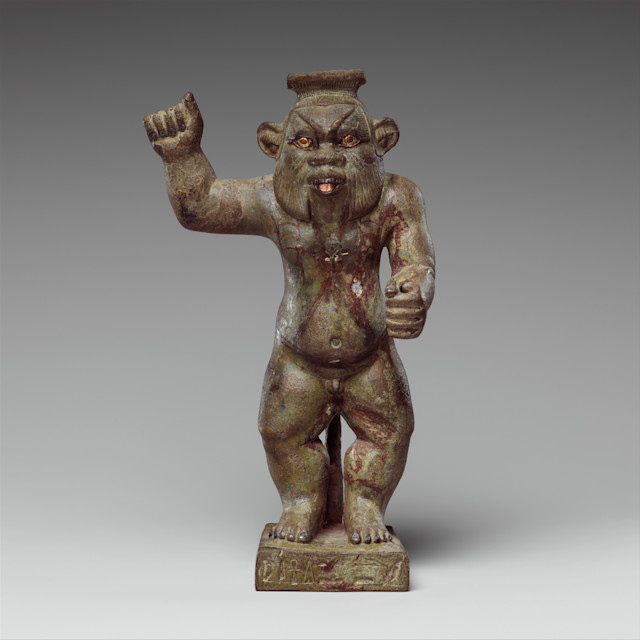
An Egyptian image of the god Hor-Asha-Khet, 4th–2nd century B.C.
Does this idea take away the dignity or otherwise undermine the glory of the one God of Israel or the God who is the Father of Jesus? Not at all. The problem is that we use the same word, god, in both cases, but these two cases are entirely different. When we use the word “god” with a lower-case “g,” what we’re referring to are superhuman spiritual entities. If you look at the Biblical texts, the Jewish literature written during the second temple period, and the writings of the early Christians, you’ll notice that they all have a shared understanding that the universe is full of a vast multitude of incredibly powerful spiritual beings: cherubim, seraphim, demons, angels, and a whole myriad of ancient pagan deities who are presented as being real and having real power. However, despite being superhuman, these entities are still a part of the universe, so their power is limited.
The God of gods like Tartak
On the other hand, all the great religious traditions of the ancient world realized that there had to be something higher than even the highest of the created beings. For the universe to exist and have order, there had to be some principle, power, or force that was the source of life and being, that gave order to reality. It had to be something akin to “being itself,” “reality itself,” or the “principle of being.” Every great culture had a name for this power, and it had many names across many languages. In ancient Greek, it was called the “logos,” in Chinese it was called the “Tao,” in Hindi it was called “Ṛta,” and so forth. All these cultures understood the difference between the things in the created universe and the power or principle by which those things had their being.
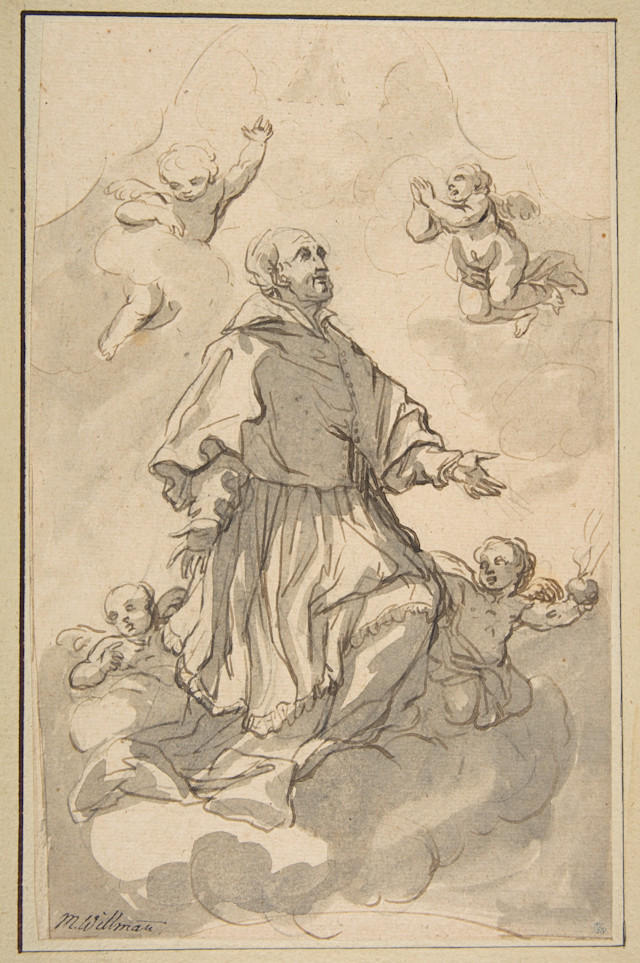
Johann Eybelwieser - Saint Augustine on Clouds Surrounded by Angels - between 1667 and 1744
Early Christians understood this distinction very well. St. Augustine, writing in the early church period, observed that the pagans used the word “gods” to refer to the entities that Christians called “angels.” He saw no problem with these words being synonymous, so long as everyone understood the difference between the “lower” or “petty” deities that we call “gods” and the one God who is the source and author of all things.
J.R.R. Tolkien, a devout Catholic writer, made the same distinction in his own mythology. In the creation story in his text, The Silmarillion, the God of gods is called Eru. Eru creates the Ainur, who are the “little gods.” Eru includes the Ainur in his work of creating the world. But it is always understood that these little gods are his creations as well, regardless of the superhuman, cosmic power they wield over the created world. One of these Ainur went bad and “fell,” just the way Lucifer fell, and he collected a group of rebel spirits to assist him in his attempt to usurp the God of gods and take over creation for himself. But his efforts ultimately fail (and could never have succeeded) because his very nature proscribes him from overthrowing Eru, his creator.
The fall of the little gods
The same story of the gods being appointed to steward creation but ultimately “going bad” is present in the Biblical narrative as understood by the ancient Israelites and the early Christians. Old Testament scholar Dr. Stephen de Young, in his book Religion of the Apostles, explains that the tower of Babel incident is a story about how a group of little gods ended up corrupting humanity. The effort to build a tower of Babel was an incident where human beings attempted to create a “mountain of assembly” as a way of “drawing God down from heaven in order to manipulate and control Him” (de Young, p.70). God subsequently divided the nations into different groups based on language, so that, presumably, they are no longer able to cooperate. Most interpretations of this story emphasize the scattering of the nations as the origin of the world’s different languages, but there is a later, important passage in Deuteronomy that clarifies what happened. Deuteronomy 32:8 reads, “When the Most High divided their inheritance to the nations, When He separated the sons of Adam, He set the boundaries of the peoples according to the number of the children of Israel.”
What does this passage mean? First, de Young clarifies that this translation, though common, is misleading. “In addition to making little to no sense in context,” he writes, “nowhere do the Scriptures number the nations at twelve. The Greek text of Deuteronomy translates an earlier form of the Hebrew, stating that God divided them ‘according to the number of his Angels.’ Recently, among the Dead Sea Scrolls, the original Hebrew wording has been recovered, which indicates that they had been divided ‘according to the number of the sons of God’” (de Young, p.70). In other words, when God scattered the nations after the tower of Babel, he divided up the nations according to the angelic powers—the gods. He put the fledgling nations under the supervision of local gods.
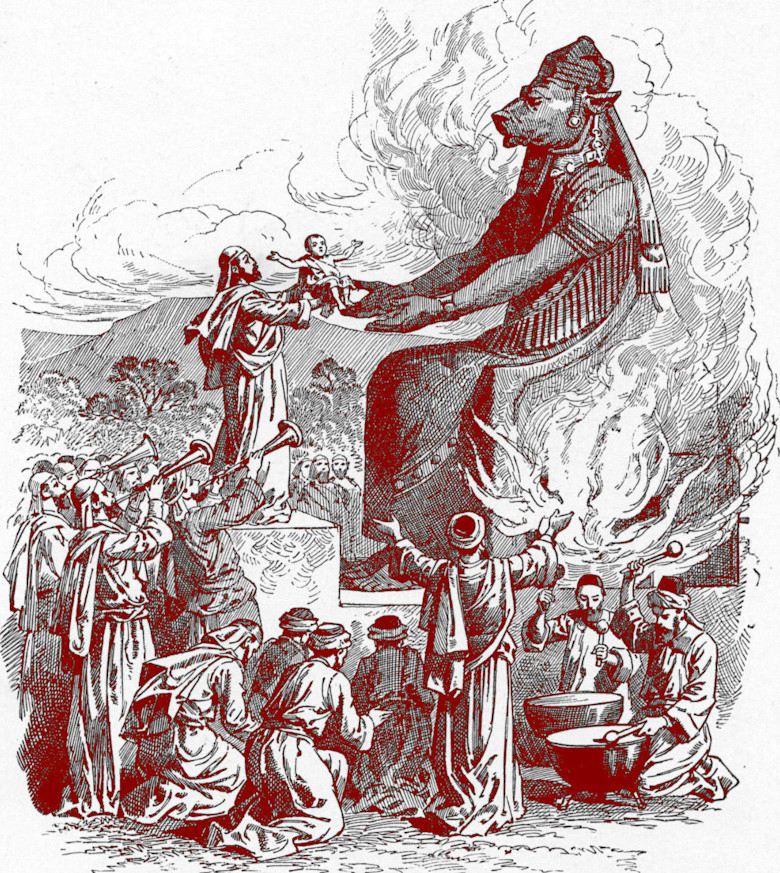
Foster Bible Pictures - Sacrificing a child to Molech - 1897
The problem is that these angels became corrupt and desired worship from the people they were supposed to steward. According to the early church fathers, this corrupt desire for worship was the foundation of the pagan religions. And throughout the Bible there is a constant identification of “gods of the nations” with demons—in other words, fallen angels or corrupt gods (Deut. 32:17, Ps. 96/95:5; 1 Cor 10:20).
What can we say about Tartak?
Most likely he (or it) was a real creature, one of those spiritual creatures that became corrupt in its mission to guard and steward the nations. Ancient people built idols in order to interact with and please these gods, so that they could offer sacrifice to them and perhaps receive their blessings and aid. But if these creatures were corrupt, then worshiping them and asking for their help would be to follow them down their dark path of corruption and evil.
And this corruption is exactly what we see in 2 Kings chapter 17. The text mentions abhorrent religious practices that people performed, specifically listing child sacrifice among them. Indeed, child sacrifice is mentioned in the very same verse as Tartak (2 King 17:31). Whoever Tartak and these other gods were, they were fallen gods, corrupt and wicked. And if that was the state of all these rebel angels, no wonder the Old Testament so frequently repeats, “Do not worship other gods” (2 Kings 17:37).
Subscribe
Life-giving writing by Christian scholars sent to your inbox once per month
Zachary Porcu has a PhD in church history from the Catholic University of America in Washington DC, with additional degrees in philosophy, humanities, and Classics (Greek and Latin). He is an Eastern Orthodox Christian.
Keep reading
Hineni in Hebrew: “Here I am” from God and Man
Who was Jotham, king of Judah?
What are the prophetic books of the Bible?
Who is Esaias in the Bible? Answered by a Christian Scholar

Peor: The Mountain and God of the Moabites