
What does the Bible say about the Antichrist?
The short answer
There is not a single specific figure with the title of Antichrist in the Bible. The books 1 and 2 John do mention antichrists (in the plural), but only as a type of person who opposes Christ. That said, antichrists are serious threats.
What is the Antichrist?
There is not a specific person with the title “The Antichrist” in the Bible. Instead, the term “antichrist” is used in the Bible to refer to anybody who opposes Christ. This is often surprising for people to hear, since popular conceptions of the Antichrist are of a single figure of supreme evil who will oppose God. This idea is more a result of popular fiction over the last hundred years, like Damien in the Omen series, Nicolae Carpathia in Left Behind, or Randall Flagg in Stephen King’s The Stand. These kinds of stories popularized the idea that “the antichrist” is the title of a specific, singular figure—often the incarnate son of Satan in the same way that Jesus is the incarnate son of God. But these kinds of portrayals are clumsy and misleading. The idea of a particular figure appearing at the end of history is a combination of many different passages in the Bible, which have been interpreted differently over the centuries in relation to the end of the world. The theological study of the end of the world or “the end times” is called “eschatology.”
Antichrist Bible verses
Only four verses in the Bible explicitly use the word “antichrist,” all of which are in the writings of the apostle John. The references are as follows (NKJV):
1 John 2:18: “Little children, it is the last hour; and as you have heard that the Antichrist is coming, even now many antichrists have come, by which we know that it is the last hour.”
1 John 2:22: “Who is a liar but he who denies that Jesus is the Christ? He is antichrist who denies the Father and the Son.”
1 John 4:3: “and every spirit that does not confess that Jesus Christ has come in the flesh is not of God. And this is the spirit of the Antichrist, which you have heard was coming, and is now already in the world.”
2 John 1:7: “For many deceivers have gone out into the world who do not confess Jesus Christ as coming in the flesh. This is a deceiver and an antichrist.”
In these passages, John says an antichrist is someone who:
Denies that Jesus is the Christ, and therefore also denies the rest of the Trinity.
Denies that Christ has “come in the flesh,” that is, that Christ had a real human body.
Is a deceiver.
John also indicates that there is more than one antichrist, or that being an antichrist is something that anyone can become if he denies the deity of Christ. As for relation to the “end times,” only one verse discusses this, 1 John 2:18, in which St. John explains that the antichrist is both coming and has already come, indeed, that several have already come, and that the arrival of these antichrists means that “it is the last hour.”
If we were to take only these verses, we could conclude that the antichrist is really a general term for anyone who opposes Christ. Specifically, an antichrist is someone who opposes the truth of Christ’s deity and incarnation by denying it or deceiving others about it. One of John’s concerns in these letters is staying faithful to Christ and not being led astray by false teachers and immoral actions. Even though he references “the last hour”, he does not really elaborate on what the last hour means.
Other Bible verses traditionally seen as the Antichrist

Luca Signorelli - The Deeds of Antichrist - 1501
The “Antichrist” in the Book of Daniel
The prophecies of Daniel include multiple descriptions of a powerful, wicked king who shall one day rise up and take control over the world—including over religious life, doing things that Daniel describes as wicked and “abominations,” and that he will persecute “the saints” (Daniel 7:25, 8:23, 9:27, 11:31, 11:26, 12:11). But the term “antichrist” is never used.
The “Antichrist” in Matthew and Mark
Jesus makes direct reference to the above passages in Daniel, warning people about the things that will happen in those days and telling the people to flee Judea when they see the signs (Matt 24:11-17; Mark 13:12-18). Jesus mentions that there will be “many false prophets” and that they will “rise up and deceive many” (Matt 24:11), in keeping with St. John’s description of the many antichrists and deceivers. He reiterates warnings from the Book of Daniel about a single, powerful ruler of particular wickedness. But Christ also never uses the word “antichrist”.
The “Antichrist” in 2 Thessalonians
In 2 Thessalonians chapter 2, St. Paul also writes about a wicked ruler who, like the figure described in Daniel, will set himself up as a rival to God. St. Paul describes him as a “lawless” man, who will “exalt himself over everything that is called God or is worshiped”, even to the point of setting himself in God’s temple and proclaiming himself to be God (2 Thess 2:4). St. Paul describes the time that this will occur and the sequence of events briefly, but vaguely:
“Don’t you remember that when I was with you I used to tell you these things? And now you know what is holding him back, so that he may be revealed at the proper time. For the secret power of lawlessness is already at work; but the one who now holds it back will continue to do so till he is taken out of the way. And then the lawless one will be revealed, whom the Lord Jesus will overthrow with the breath of his mouth and destroy by the splendor of his coming.” (NIV, 2 Thess 2:5-12)
Given that St. Paul describes Christ coming and overthrowing this ruler, it makes sense that this passage has been interpreted as describing the events of the “end times.” But Paul never uses the word “antichrist.”
The “Antichrist” in the Book of Revelation
All of these passages are usually read together with the general content of the Book of Revelation (also known as John’s Apocalypse). The Revelation is the last book of the Bible, authored by the same St. John who authored the letters where the antichrists are described. St. John records a vision he’s had that is generally interpreted as a description of the end of the world and the second coming of Christ. In this vision there are various descriptions of powerful enemies of Christ who, by all accounts (wickedness, deception, rule of the world) fit the description St. John gives in his letters of what an antichrist does, as well as the figures in Daniel and Paul. These passages seem to describe specific figures who oppose Christ that will appear in some form in the future, seemingly at the end of history. But like St. Paul and Jesus, John does not use the word “antichrist.”
The Antichrist and the Roman Empire
Early Christians sometimes took all of the above passages, put them together, and used them to describe events of their time. St. Iranaeus was one of the earliest interpreters, writing in the A.D. 200s, and he considered the above passages in his book Against Heresies (book V, chapters 25-30). However, it seems St. Iranaeus was mostly talking about the end of the Roman empire, which would fall several centuries later. That said, he may have been talking about both the fall of Rome and the end of history.
Antichrists in Christian history
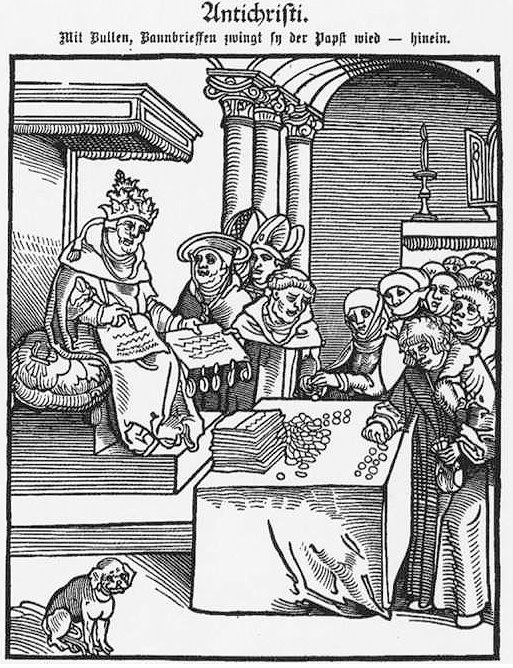
Lucas Cranach the Elder's - the Catholic Pope as an Antichrist
After the rise of denominations within Christianity (A.D. 1500 and onward), “antichrist” was a frequent condemnation used by those who had opposing theologies, as when Protestants like Martin Luther called the Catholic Popes antichrists during the Reformation.
The Antichrist as an abstract concept of poetry
There is not a specific, single figure with the title “The Antichrist” in the Bible.
However, many depictions in the Biblical canon do discuss a singular figure who is wicked, powerful, and opposes Christ specifically. These figures fit John’s description of an antichrist, and the early Christians made this association. They thought that all these different descriptions in the Bible were describing the same event that would take place at some future point in history.
Whether the events described in these visions and prophecies have already happened has been a matter of discussion among Christian thinkers. There are good reasons to believe that these authors were predicting things that—by our present-day perspective—have already happened, such as the collapse of the Roman empire. However, such predictions can also be about an ultimate collapse of all worldly empires with the final return of Christ. Ancient Christians did not think of prophecy in the Bible as having one single message that simply needed to be “de-coded”. They understood that a that could all be true at the same time. Daniel’s prophecies, therefore, could be about the fall of the pagan empires of his own day, and about the Roman rulers and the fall of the Roman empire in Christ’s day, as well as the ultimate fall of the devil’s rule of the world at the end of history.
What about this mysterious end of history? For now, it’s difficult to say. Though Christians have been discussing how and when Christ will return for thousands of years, the matter remains disputed, and Christians do not have a consensus about it. But this should not be surprising, for Christ himself says, “but of that day and hour no one knows, not even the angels of heaven, but My Father only” (Matthew 24:36, NKJV).
Future reading
Writing by St. Iranaeus
1 and 2 John
The Book of Daniel
2 Thessalonians
John’s Apocalypse (The Book of Revelation)
Against Heresies, Book V (https://www.newadvent.org/fathers/0103.htm)
Writing by St. Athanasius, namely Discourses Against the Arians, Discourse 1, chapters 1 and 4 (https://www.newadvent.org/fathers/28161.htm)
Subscribe
Life-giving writing by Christian scholars sent to your inbox once per month

Dr. Zachary Porcu has a PhD in church history from the Catholic University of America in Washington DC, with additional degrees in philosophy, humanities, and Classics (Greek and Latin). He is an Eastern Orthodox Christian.
Keep reading
The Sigil of Baphomet and the Satanic Pentagram


Samyaza and the fall of the angels

Where is Amenadiel in the Bible?
Who was Saint Longinus and what is his story?

Judas ate too: An essay on the love of Christ
