What is Gilgal in the Bible?
The short answer
There are a variety of references to a place called Gilgal in the Old Testament. Though it is not clear that they were all the same location, we can still learn important spiritual lessons from one of these episodes.
Gilgal, mentioned in the Old Testament, is difficult to pin down. It’s mentioned all throughout the history of ancient Israel.
Here are the passages in the Bible that mention Gilgal:
Book of Joshua, chapters 4 and 5
Book of Deuteronomy, chapter 11
Book of 1 Samuel, chapter 15
Book of 2 Samuel, chapter 19
Book of Hosea, chapter 9
Book of 2 Kings, chapter 2
It’s difficult to determine whether these passages refer to the same place, and modern archeological evidence seems to reveal several candidates for the exact spot, although all of them are in a similar range in modern-day Israel.
Where is Gilgal today?
Figuring out the exact location isn’t very meaningful. Locations (and even kinds of or animals) are notoriously difficult to pinpoint in any ancient text, and even in the modern day, names for locations carry on for reasons that may be lost to time.
For example, imagine an American town founded in the mid-1800s, where the central feature was an orchard planted by a wealthy landowner. Over time, the dirt path next to the orchard started to get called “orchard lane” by the locals, and by the 1900s, when paved roads and street signs were implemented, the street might have been officially named “Orchard Lane.”
In time, the exact story might be lost all together.
I’m not saying this process is exactly what happened with the different locations named Gilgal. There could be many different reasons why there were multiple locations with the same name, but it’s useful to have a sense of why names for locations can change—and especially how their original meaning can be obscured. With the example of Orchard Lane, the original meaning could easily become obscured in a couple hundred years. With Gilgal, we’re talking about locations several thousand years old.
Gilgal and crossing the Jordan River
As with most details of the Old Testament, it’s less important to figure out the exact technical facts about the situation than it is to understand its spiritual significance. Facts, while important, are not edifying unless we put them in a moral framework that can speak to us. Gilgal is a good example of an Old Testament story that is useful in expanding how we think about the world.
Perhaps the most interesting passage about the location of Gilgal is in Joshua, chapters 3-5. Joshua describes Gilgal as the place where the ancient Israelites encamped after they had miraculously crossed the Jordan river. Joshua, the successor to Moses, was leading the Israelites through the desert, when they encountered the Jordan river, which could not normally be passed. The Jordan was no mere trickle of a stream; it was a large river, and at the time it was the flooding season, when the river’s current would have been at its strongest—a non-trivial obstacle in their journey.
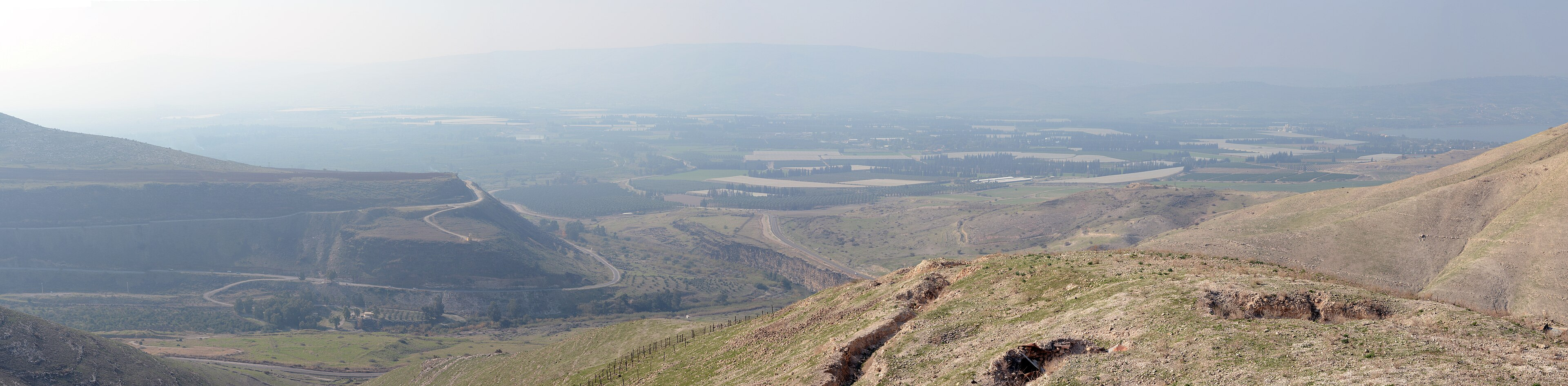
A contemporary photograph of the Jordan River Valley.
Joshua chapter 3 gives the full account of how this happened. Joshua instructed the priests who were carrying the ark of the covenant to wade into the water, and when they did, the flow of the river stopped upstream, and all the water piled up “in a heap” (Josh 3:16). The water continued to accumulate upstream as though it were dammed up. Joshua ordered them as follows:
Now therefore, take for yourselves twelve men from the tribes of Israel, one man from every tribe. And it shall come to pass, as soon as the soles of the feet of the priests who bear the ark of the Lord, the Lord of all the earth, shall rest in the waters of the Jordan, that the waters of the Jordan shall be cut off, the waters that come down from upstream, and they shall stand as a heap. So it was, when the people set out from their camp to cross over the Jordan, with the priests bearing the ark of the covenant before the people, and as those who bore the ark came to the Jordan, and the feet of the priests who bore the ark dipped in the edge of the water (for the Jordan overflows all its banks during the whole time of harvest), that the waters which came down from upstream stood still, and rose in a heap very far away at Adam, the city that is beside Zaretan. (Joshua 3:12-16)
The priests bearing the ark of the covenant stood in the midst of the river until all of the Israelites crossed over the now-dry riverbed. But then Joshua instructed the Israelites to do something interesting. While the priests were still standing in the middle of the dry riverbed, and before the waters had returned, Joshua appointed twelve men—one from each of the twelve tribes of Israel—to come into the riverbed, pick up a large stone from the place where the priests were standing, and bring the stones out of the riverbed to the place where the Israelites were camping.
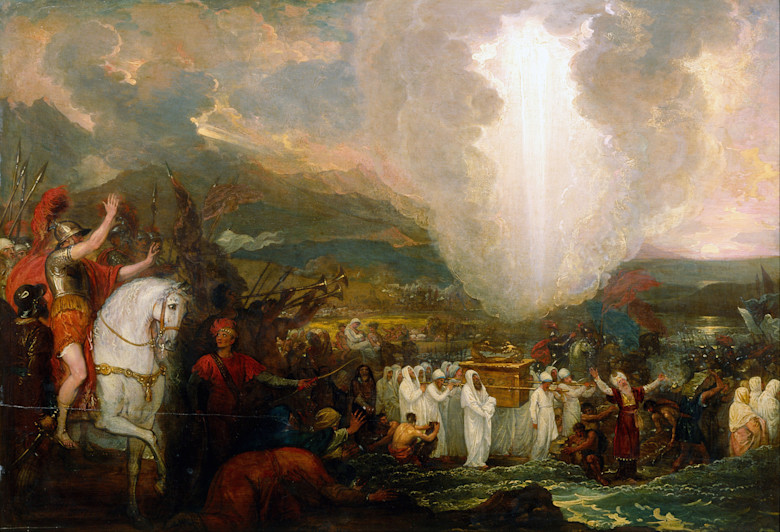
Benjamin West - Joshua Passing the River Jordan with the Ark of the Covenant - 1800
What does Gilgal mean spiritually?
But there’s more to it than a simple memorial. The very next thing that happened is that Joshua ordered all of the males to be circumcised. Circumcision is an odd thing for modern people to wrap their heads around, and deserves its own discussion, but the short answer is that it was both a kind of physical sacrifice (cutting off a part of your body and offering it as a sacrifice) and a kind of permanent marking, like a tattoo. The reason the Israelites needed another round of circumcision was because after decades of travel through the desert, the generation born in the wilderness had yet to be circumcised, while the old generation—which had been circumcised—had died in the wilderness.
This is probably how Gilgal got its name.
But there are two additional layers of imagery if you want to read this passage in a Christian way. First of all, the crossing of the Jordan River is a spiritual symbol for baptism, since it establishes a separation between the old life in Egypt and the new life in the promised land—very like the difference St. Paul makes between the “old man” and the “new man” (Ephesians 4:22-24). That this separation between old and new involves circumcision also lines up with baptismal imagery: early Christians viewed baptism as the new circumcision, taking the place of and fulfilling the role that circumcision previously played as the rite of initiation into the people of Israel. Instead, baptism was the Christian's initiation into the life of Christ.
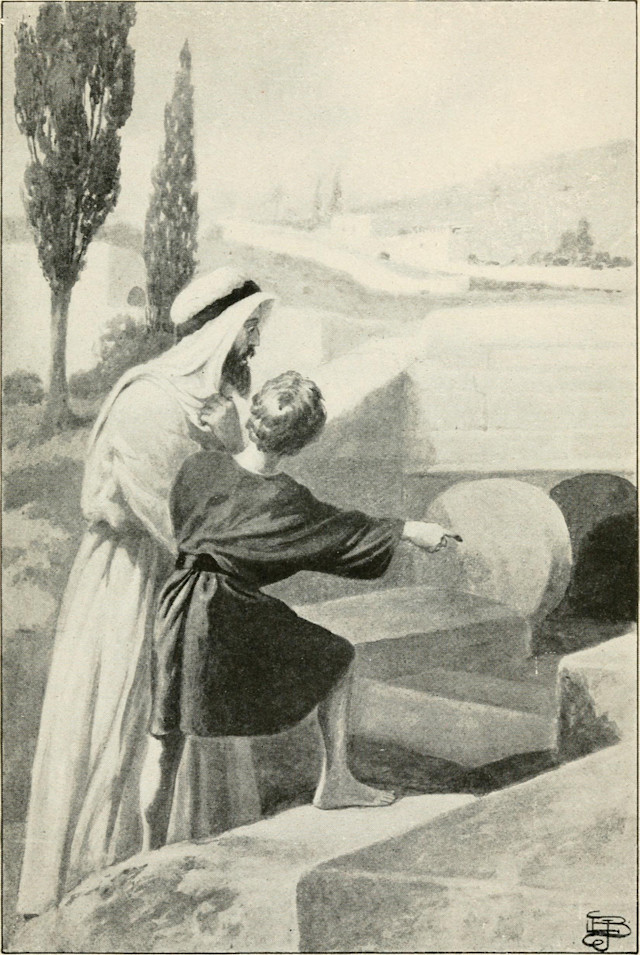
A twentieth-century illustration of the stone rolled away from the tomb of Christ. From the book Joel: A Boy of Galilee, illustrated by L.J. Bridgman.
This way of reading the Old Testament is how the early Church read it, but it would be a mistake to think that they thought of the Old Testament as “just symbolism,” even if it was symbolism for Jesus. They believed that these ancient events really did happen, but they also believed that real, historical events could have spiritual meaning and cosmic significance. That’s because they viewed the world differently from us: they believed that the physical and the spiritual world were not really . This way of thinking was called “sacramental” thinking by the early church (if you’re interested, you can read more about this in my short book, Journal to Reality: Sacramental Life in a Secular Age). Sacramental thought is one of the major reasons that the early Christians kept the Old Testament as a part of their scriptures, even though the Jewish converts of the early church rapidly became the minority. Early Christians viewed history and historical events as having a sacred character: historical events could be prophetic images for things that came later. And when early Christians examined the Old Testament from this angle, they saw image after image connected to the life of Jesus. In sacramental thought, arguing about the factual details of the Old Testament is less important than understanding its true spiritual meaning.
Subscribe
Life-giving writing by Christian scholars sent to your inbox once per month

Dr. Zachary Porcu has a PhD in church history from the Catholic University of America in Washington DC, with additional degrees in philosophy, humanities, and Classics (Greek and Latin). He is an Eastern Orthodox Christian.
Keep reading

Who were Jannes and Jambres in the Bible?


Where is Mazzaroth and the Zodiac in the Bible?
What is Cabul in the Bible?

Who was Amoz father of Isaiah in the Bible?

What is algum wood in the Bible?
