Merari: Son of Levi and Ancestor of Judith
The short story:
Merari is the name of one of the sons of Levi. He had his own people group with its own sub-families and tribes. Their main duty seems to have been taking care of certain elements of the temple. One of the women of the tribe of Merari, the one called “a daughter of Merari” in the Bible was the famous woman Judith, who killed an Assyrian general by decapitating him.
According to the Abarim Publications website (a dubious theological source but good for etymology), the name Merari (מררי), means “bitter” or “strong” (as in having a strong taste) in Hebrew:
“The name Merari, like other Levites names, is probably of Egyptian origin and may have originally meant Beloved. In Hebrew, however, it looks like it has to do with the verb מרר (marar) meaning be bitter, strengthen, strong...The verb מרר (marar) means to be strong or bitter and can be used to describe tastes and smells, and hard or difficult situations.”
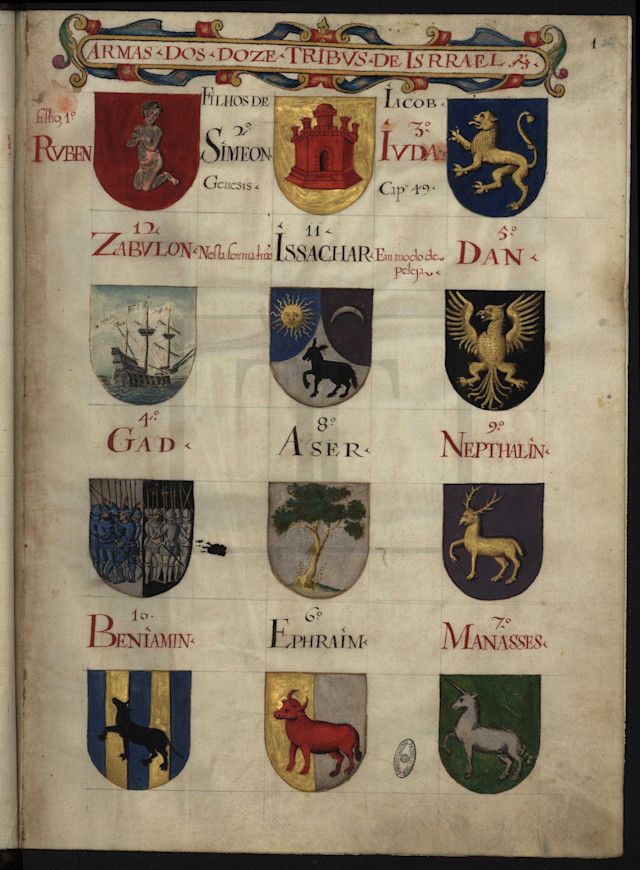
A 1675 depiction of the coats of arms of the twelve tribes of Israel by Francisco Coelho.
“Now these were the names of the children of Israel, Jacob and his sons, who went to Egypt: Reuben was Jacob’s firstborn. The sons of Reuben were Hanoch, Pallu, Hezron, and Carmi. The sons of Simeon were Jemuel, Jamin, Ohad, Jachin, Zohar, and Shaul, the son of a Canaanite woman. 11 The sons of Levi were Gershon, Kohath, and Merari.” (Genesis 46:8-11)
Just as each of the twelve sons of Israel became one of the Twelve Tribes of Israel, so too did each of their sons become his own mini-tribe, or household, out of which were born subsequent families like the Mahlites and Mushites:
“From Merari came the family of the Mahlites and the family of the Mushites; these were the families of Merari. And those who were numbered, according to the number of all the males from a month old and above, were six thousand two hundred. The leader of the fathers’ house of the families of Merari was Zuriel the son of Abihail.” (Numbers 3:33-35)
Like most of the different tribes and families within the people of Israel, the Merarites had a particular job appointed to them with regard to caring for the tabernacle of God:
“These [the Merarites] were to camp on the north side of the tabernacle. And the appointed duty of the children of Merari included the boards of the tabernacle, its bars, its pillars, its sockets, its utensils, all the work relating to them, and the pillars of the court all around, with their sockets, their pegs, and their cords.” (Numbers 3:36-37)
Who is the daughter of Merari?
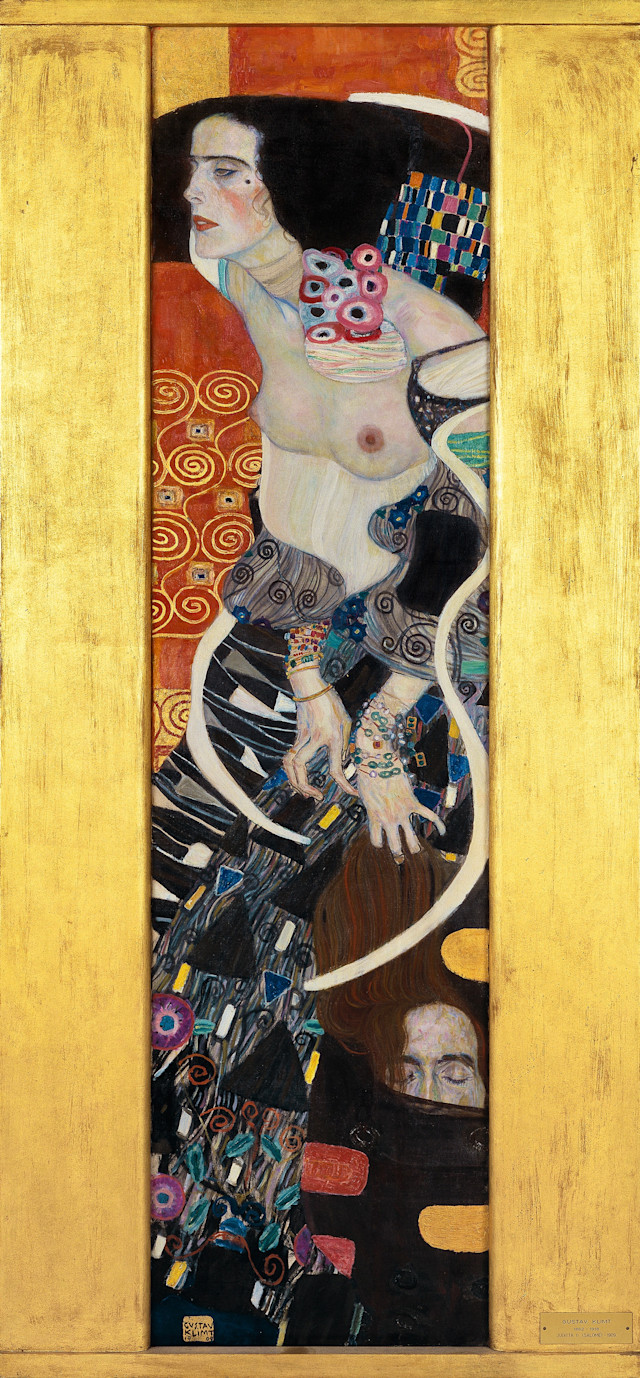
This 1909 painting by Gustav Klimt depicts Judith with the decapitated head of Holofernes. The stylized background may represent the dreamlike stupor of Holofernes, while the gold border recalls iconography.
The Assyrians had laid siege to the Israelite city of Bethulia, where they had cut off the water supply and prevented anyone from leaving the city. Since they were at risk of dying of thirst, the leaders of the city vowed that they would surrender in five days if no help came to them.
Impatient with her countrymen’s unwillingness to trust in God’s deliverance, Judith began visiting the camp of the Assyrian commander Holofernes where he was stationed outside of the city. Using her great beauty to her advantage, she began to gain the trust of the Assyrians, allowing Holofernes to think he was winning the favor of a beautiful lady. Her repeated visits led the Assyrians to trust her, until one night she was allowed to enter Holofernes’ tent while he was drunk—presumably with the implication that she would sleep with him. Instead, she decapitated him while he was in a drunken stupor and took his head back to her countrymen. Without their leader, the Assyrians fled, and Israel was saved from the siege.
Subscribe
Life-giving writing by Christian scholars sent to your inbox once per month

Zachary Porcu has a PhD in church history from the Catholic University of America in Washington DC, with additional degrees in philosophy, humanities, and Classics (Greek and Latin). He is an Eastern Orthodox Christian.
Keep reading
Hineni in Hebrew: “Here I am” from God and Man

Who was Jotham, king of Judah?
What are the prophetic books of the Bible?
Who is Esaias in the Bible? Answered by a Christian Scholar

Peor: The Mountain and God of the Moabites