Hineni in Hebrew: “Here I am” from God and Man
The short story:
Hineni is a word in Hebrew that literally means “I am here” or “here I am.” The word is significant because it is often uttered by people in response to God's call, including famous figures like Isaiah and Moses.
The word “Hineni” literally means “Here I am.” It is generally used as a response to someone who calls for you. In the context of the Old Testament, some people interpret it as a response of total surrender, but it can’t quite mean that in every context: God uses it himself in Isaiah Chapter 58.
Another major biblical figure who uses this word is Abraham. Abraham was the father of the ancient Israelites and the first person to make the covenant with God that led to the existence of the ancient Israelite peoples and ultimately to the birth of Jesus. After God made a covenant with Abraham, Genesis recounts that God tested Abraham with the episode of the sacrifice of Isaac:
“Now it came to pass after these things that God tested Abraham, and said to him, ’Abraham!’ And he said, ’Here I am.’” (Genesis 22:1, NKJV)
Abraham was willing to take drastic action, from upending his whole life and moving, to trying to conceive an heir even though both he and his wife were quite old, to demonstrating a willingness to sacrifice his own son because he trusted God.
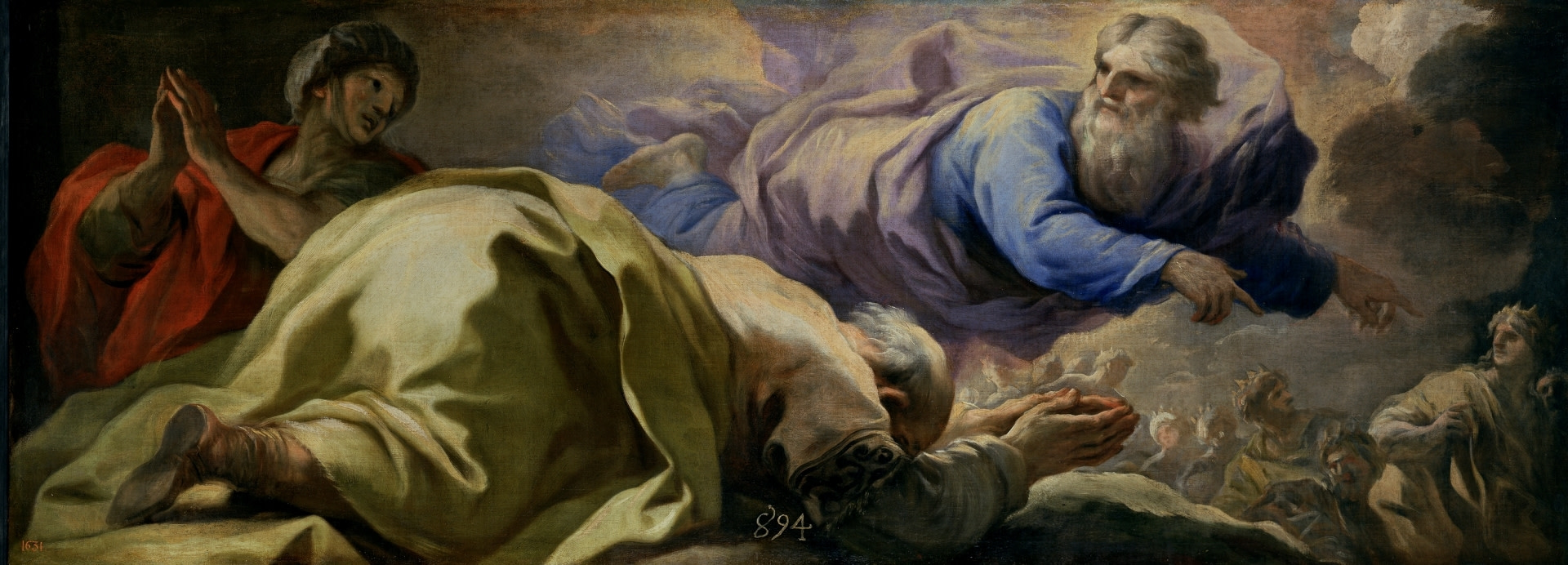
Luca Giordano - Abraham Hears the Promises of God - 1696
After Abraham, the most important moment in which God called somebody is probably Moses. Moses, who is traditionally called the “Law Giver” and the “Godseer,” was at first trying to live a humble life after escaping Egypt. He was tending his flocks one day when he saw the famous Burning Bush, which was a plant that was on fire but was not being consumed because it contained God's presence:
“Now Moses was tending the flock of Jethro his father-in-law, the priest of Midian. And he led the flock to the back of the desert, and came to Horeb, the mountain of God. And the Angel of the Lord appeared to him in a flame of fire from the midst of a bush. So he looked, and behold, the bush was burning with fire, but the bush was not consumed. Then Moses said, ‘I will now turn aside and see this great sight, why the bush does not burn.’ So when the Lord saw that he turned aside to look, God called to him from the midst of the bush and said, ‘Moses, Moses!’ And he said, ‘Here I am.’” (Exodus 3:1-4, NKJV)
Like that of Abraham, the calling of Moses began a significant era in the history of ancient Israel, one which God initiated by calling out a specific person to lead the Israelites. But it all started with a simple calling which Moses certainly could have refused.
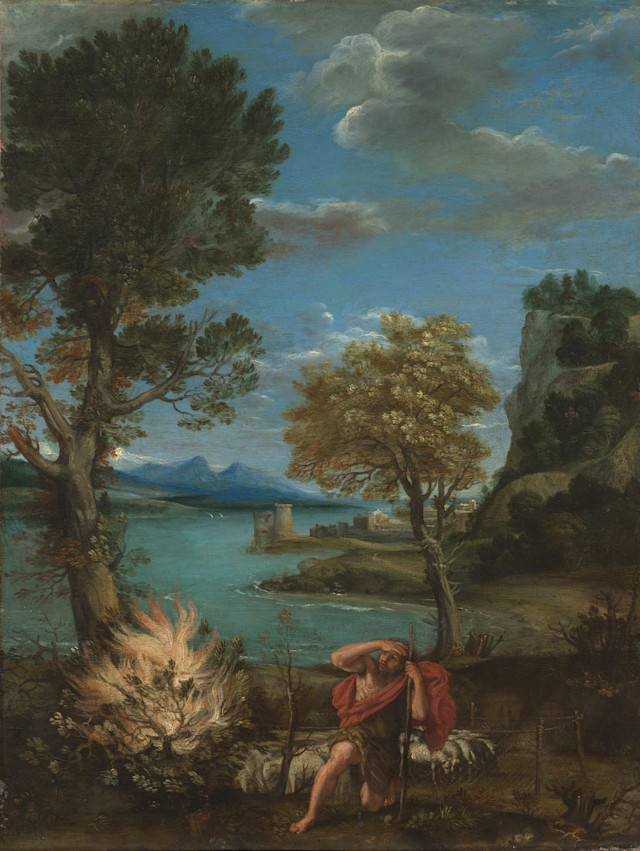
Domenico Zampieri - Landscape with Moses and the Burning Bush - 1616
“Now the boy Samuel ministered to the Lord before Eli. And the word of the Lord was rare in those days; there was no widespread revelation. And it came to pass at that time, while Eli was lying down in his place, and when his eyes had begun to grow so dim that he could not see, and before the lamp of God went out in the tabernacle of the Lord where the ark of God was, and while Samuel was lying down, that the Lord called Samuel. And he answered, ‘Here I am!’” (1 Sam 3:1-5, NKJV)
One of the greatest prophets of all time, the prophet Isaiah, also makes the same response when he is called by God:
“Also I heard the voice of the Lord, saying: 'Whom shall I send, And who will go for Us?' Then I said, 'Here am I! Send me.’” (Isaiah 6:8, NKJV)
Isaiah needs almost no introduction; he is incredibly famous as a holy man of God who brought God's prophetic word to the people.
Because there are so many examples of people responding to God with this word, it’s tempting to interpret them with an emphasis on total surrender or utter humility. Later in Isaiah's adventures, however, we find an example of God himself making the same response to those who are faithful (Isaiah 58:8-9):
Then your light shall break forth like the morning,
Your healing shall spring forth speedily,
And your righteousness shall go before you;
The glory of the Lord shall be your rear guard.
Then you shall call, and the Lord will answer;
You shall cry, and He will say, ‘Here I am.’
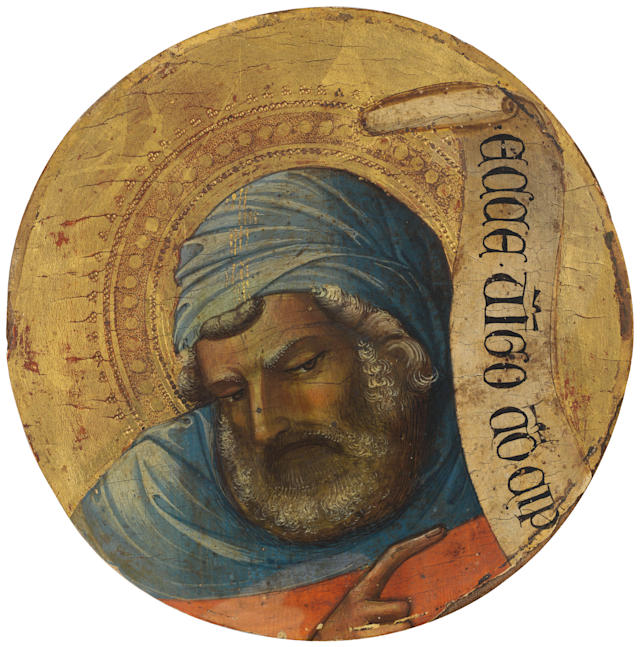
Lorenzo Monaco - The Prophet Isaiah - 1300s-1400s
It's difficult and probably unwise to give one absolute way of interpreting a particular word throughout the entire biblical canon. Part of the power of the biblical literature, however, especially prophetic books like Isaiah, is that they can be taken in a number of ways that are all true and powerful.
Here’s one way that you might interpret this passage in Isaiah where God is the one who replies with “here I am”: when you become united to God, you have some ability to dialogue with him. In the Old Testament, this unity meant something like being “a friend of God,” which people generally did by being righteous and keeping God's commandments. In the New Testament, it also means that kind of friendship, but it shifts to more intimate and even physical language about participating in Christ himself. One major example is when Jesus explains communion: “He who eats My flesh and drinks My blood abides in Me, and I in him” (John 6:55-57, NKJV). Notice this incredibly intimate language about how Christ abides in us and we abide in him.
Similarly, in St. Paul's letter to the Galatians, he mentions that baptism involves our physical participation in becoming Christ: “For as many of you as were baptized into Christ have put on Christ” (Galatians 3:26-28, NKJV).
When we achieve this sort of total intimacy with Christ, we can ask and he will respond to us:
“And whatever you ask in my name, that I will do, that the Father may be glorified in the Son. If you ask anything in my name, I will do it.” (John 14:13-15, NKJV)
How do you pronounce the Hebrew word Hineni?
The word is pronounced phonetically, though people put the stress in slightly different places, depending on their English accent. Most commonly I’ve heard hih-neh-ni, as in this video or this one.
Subscribe
Life-giving writing by Christian scholars sent to your inbox once per month

Zachary Porcu has a PhD in church history from the Catholic University of America in Washington DC, with additional degrees in philosophy, humanities, and Classics (Greek and Latin). He is an Eastern Orthodox Christian.
Keep reading

Prophetic parents: Who was Amoz father of Isaiah?

Who is Esaias in the Bible? Answered by a Christian Scholar
What are the prophetic books of the Bible?
Who was Jotham, king of Judah?

Peor: The Mountain and God of the Moabites