Necromancy in the Bible: Fallen Spirits, Ancient Religion
The short story:
Traditionally, necromancy is the art of summoning a spirit of the dead in order to do divination or prophecy—not the literal raising of zombies to do your bidding. Necromancy is always discussed as an immoral act in the Bible, most famously in the passage where King Saul visits a necromancer. Why? Because it’s one of the magical arts derived from fallen angelic beings.
Because of fantasy novels, zombie movies, and games like Dungeons and Dragons, a “necromancer” has come to mean someone who raises and commands the dead. In popular culture, a necromancer is commonly pictured as an evil warlock walking around with hordes of zombies acting as his servants. Like most things in popular culture, this image is an exaggeration of the far more tame (though arguably more sinister) understanding that ancient people had of this power.
Necromancy is an old word, derived through Latin from Greek. The “necro” part comes from the Greek word nekros, which means “dead”—as in a dead person. “Mancy” comes from the Greek word manteia which means divination. Many English words come from manteia, including “mania” and “mantis.” A mantis is a divine seer or prophet, someone inspired by a god or spirit. Mantids, the order of insects that includes the praying mantis, get their name because they were believed to be prophetic by ancient peoples.
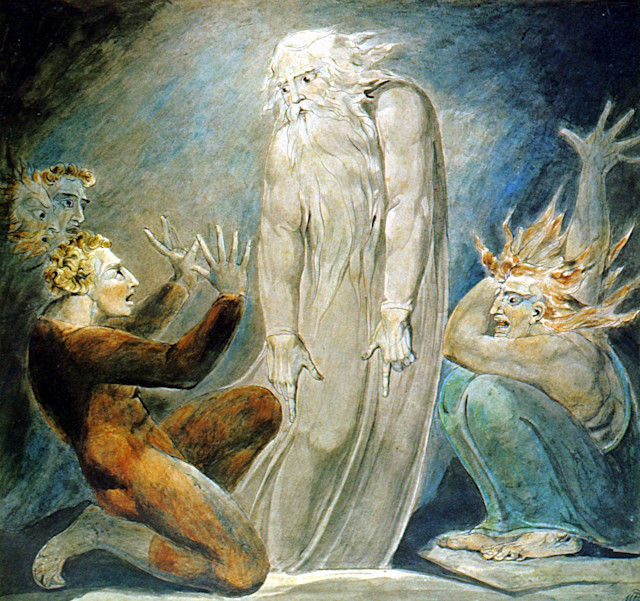
William Blake - The Witch of Endor - circa 1800
Where is there necromancy in the Bible?
This ancient understanding of necromancy appears in Deuteronomy, where the law forbids the Israelites from certain practices:
“When you come into the land that the Lord your God is giving you, you shall not learn to follow the abominable practices of those nations. There shall not be found among you anyone who burns his son or his daughter as an offering, anyone who practices divination or tells fortunes or interprets omens, or a sorcerer or a charmer or a medium or a necromancer or one who inquires of the dead.” (Deut. 18:9-11)
Notice how this translation (the English Standard Version) says, “one who inquires of the dead,” not “one who summons zombies to do his bidding.”
The most famous necromancer passage is in the book of Samuel. In this story, Israel is in a bad spot, as is often the case. King Saul seeks guidance from the Lord, but when he gets no answer, he turns to necromancy:
“When Saul saw the army of the Philistines, he was afraid, and his heart trembled greatly. And when Saul inquired of the Lord, the Lord did not answer him, either by dreams, or by Urim, or by prophets. Then Saul said to his servants, ‘Seek out for me a woman who is a medium, that I may go to her and inquire of her.’ ...So Saul disguised himself and put on other garments and went, he and two men with him. And they came to the woman by night. And he said, ‘Divine for me by a spirit and bring up for me whomever I shall name to you.’ The woman said to him, ‘Surely you know what Saul has done, how he has cut off the mediums and the necromancers from the land. Why then are you laying a trap for my life to bring about my death?’ But Saul swore to her by the Lord, ‘As the Lord lives, no punishment shall come upon you for this thing.’ Then the woman said, ‘Whom shall I bring up for you?’ He said, ‘Bring up Samuel for me.’ When the woman saw Samuel, she cried out with a loud voice. And the woman said to Saul, ‘Why have you deceived me? You are Saul.’ The king said to her, ‘Do not be afraid. What do you see?’ And the woman said to Saul, ‘I see a god coming up out of the earth.’ He said to her, ‘What is his appearance?’ And she said, ‘An old man is coming up, and he is wrapped in a robe.’ And Saul knew that it was Samuel, and he bowed with his face to the ground and paid homage.” (1 Sam. 28:5-14)
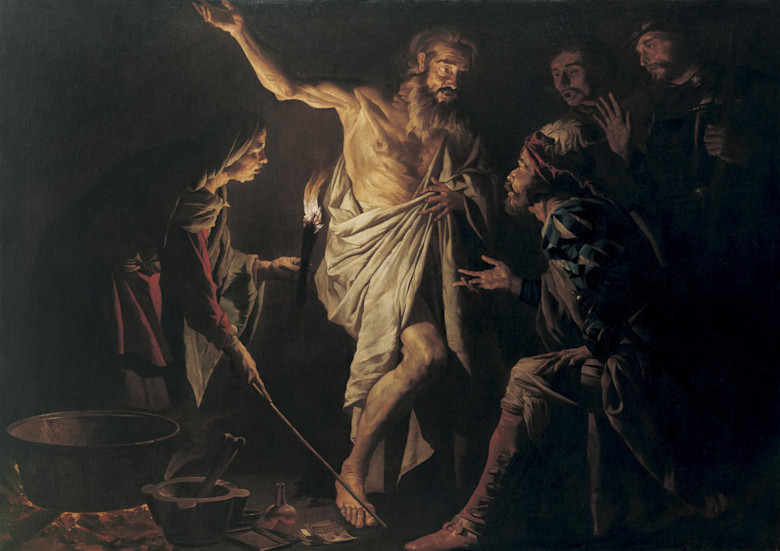
Matthias Stom - Saul and the Witch of Endor - circa 1635
Unfortunately, things don’t go well for him, as Samuel informs Saul that he will have no help, but is going to lose his kingdom because he turned away from God:
“Then Samuel said to Saul, 'Why have you disturbed me by bringing me up?' Saul answered, 'I am in great distress, for the Philistines are warring against me, and God has turned away from me and answers me no more, either by prophets or by dreams. Therefore I have summoned you to tell me what I shall do.' And Samuel said, 'Why then do you ask me, since the Lord has turned from you and become your enemy? The Lord has done to you as he spoke by me, for the Lord has torn the kingdom out of your hand and given it to your neighbor, David. Because you did not obey the voice of the Lord and did not carry out his fierce wrath against Amalek, therefore the Lord has done this thing to you this day. Moreover, the Lord will give Israel also with you into the hand of the Philistines, and tomorrow you and your sons shall be with me. The Lord will give the army of Israel also into the hand of the Philistines.’” (1 Sam. 28: 15-19)
All throughout the Old Testament we see bans on necromancy, sorcery, divination, and the like, and these practices as always associated with evil and impiety. For further examples, see Isaiah 8:19 and 19:3, 2 Chronicles 33:6, 2 Kings 21:6 and 23:24, and Leviticus 20:6 and 20:27.
Is necromancy a sin?
Necromancy is a wicked act, not because it doesn’t work—it can, as the book of Samuel records—but because of its deep connection to pagan religion. The problem with pagan religion, in the eyes of the early Church, is that it is the direct creation of evil spirits. Let’s unpack that idea a little.
First, notice how the Deuteronomy passage we looked at earlier groups necromancy with the “abominable practices” of the other nations, including divination or omen-reading. Some of these practices are quite intense, such as burning your son or daughter as an offering to deity.
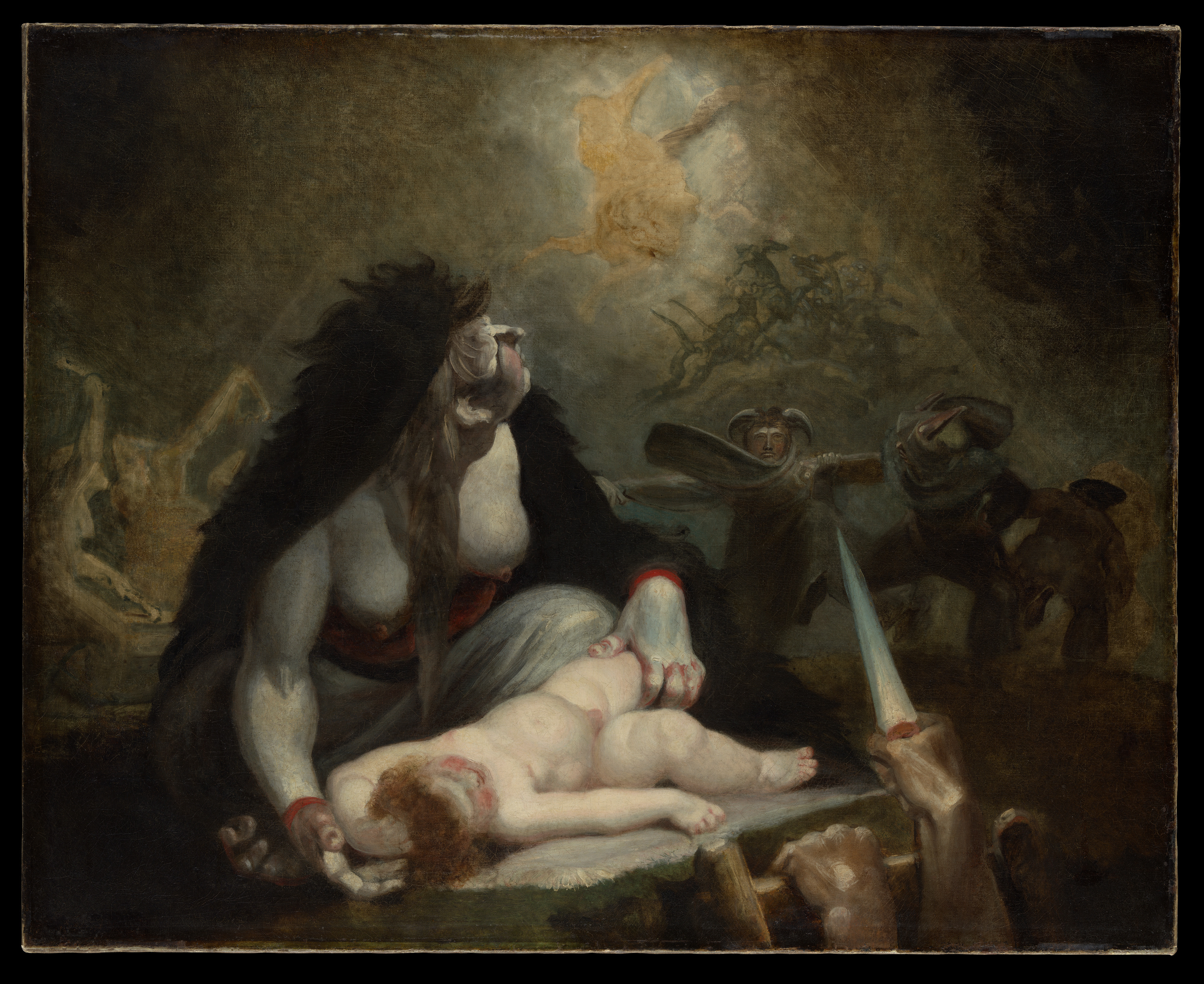
In this 1796 illustration of a simile from John Milton's Paradise Lost, the Greek goddess Hecate appears at a scene of witchcraft and human sacrifice, “Lured with the smell of infant blood.”
While difficult for us modern people to wrap our heads around, these depraved acts were nearly-universal practices of the pagan religions of the ancient world. Everyone, in just about every culture, was ruled by some group of spirits or gods and had similar practices for how to interact with these rulers. One of the distinctive marks of the early Church was that it provided context for how these gods arose.
As we talk about often here at Holy Ground, neither the early Christians nor the ancient Israelites alike disbelieved in the pagan gods. They recognized these creatures as fallen spiritual beings. You could call them fallen angels or evil gods or corrupted spirits; it’s all the same idea. They were originally spiritual beings with real power and authority over creation. Above them all was the God of gods and Lord of lords—the Most High God, the one to whom all glory, honor, and worship is due. The God of gods, in this account, is of a higher order than the other spiritual beings, and for that reason shouldn’t (and ultimately couldn’t) be confused with them.
According to the ancient Israelites and early Christians, when these “lower” gods fell, they created their own religions, imposter religions meant to rule over mankind and steal the worship due to the One God. Pagan figures like Zeus or Thor, therefore, were fallen spirits who invented mythology as propaganda for themselves.
Where does the necromancy come in? A prominent feature of these pagan religions was that the fallen spirits taught men how to use magical arts. These arts were thought to manipulate nature, and they often involved ritual sacrifice for the fallen gods to consume and enjoy. The magical teachings of the fallen spirits resulted in horrible religious practices like human sacrifice—which, as you now see, is literally demonic.
Use of magical arts that contacted, manipulated, or served these fallen gods was collaboration with demons—literally. Even if you were able to contact a righteous person like Samuel and receive prophecy from him, the use of necromancy was necessarily the use of a demonic art.
Subscribe
Life-giving writing by Christian scholars sent to your inbox once per month
Zachary Porcu has a PhD in church history from the Catholic University of America in Washington DC, with additional degrees in philosophy, humanities, and Classics (Greek and Latin). He is an Eastern Orthodox Christian.
Keep reading
Who was Phanuel? Archangel or Father of Anna?
Is Sachiel a real angel?
Barachiel and Baraqiel: Angels named outside Scripture
Hineni in Hebrew: “Here I am” from God and Man
What are the prophetic books of the Bible?