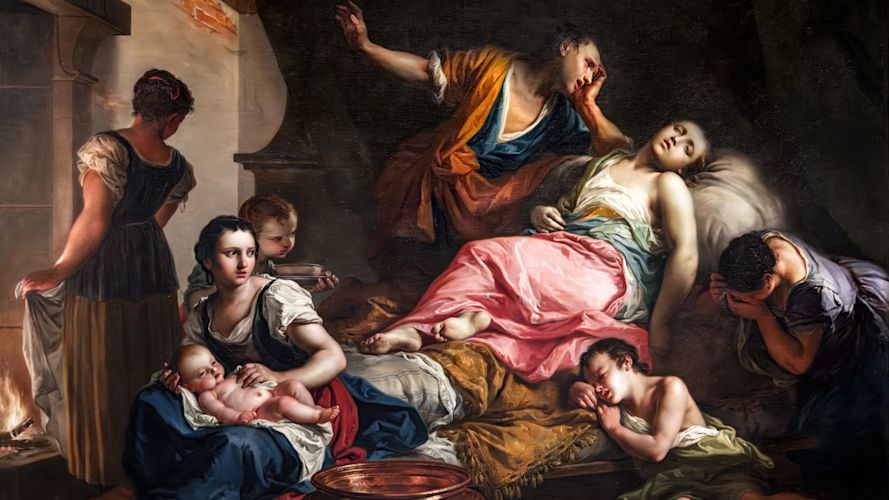
Peor: The Mountain and God of the Moabites
The short story:
Peor was the name of a mountain that seems to have been holy to the Moabites, on the basis that they worshipped a deity of the same name at that location. The location matters because it was the place where the prophet Balaam was brought to curse the people of Israel and the place where Israelite men fornicated with Moabite women and worshiped the god of Peor.
Peor was the name of a mountain in the land of Moab. It is significant as the final place that the prophet Balaam visited when he was being pressured by the king of Moab to curse Israel.
The Israelites had recently conquered Sihon, king of the Amorites, and Og, king of Bashan. Balak, the king of Moab, became concerned that he and his kingdom would be next, so he summoned Balaam, a prophet. Balaam was not an Israelite, so he wasn’t a prophet in the line of Elijah or Ezekiel, but he was nevertheless a prophet and a diviner: one who does divination. Balaam insisted that he could only speak the words that Lord God gave him to say.
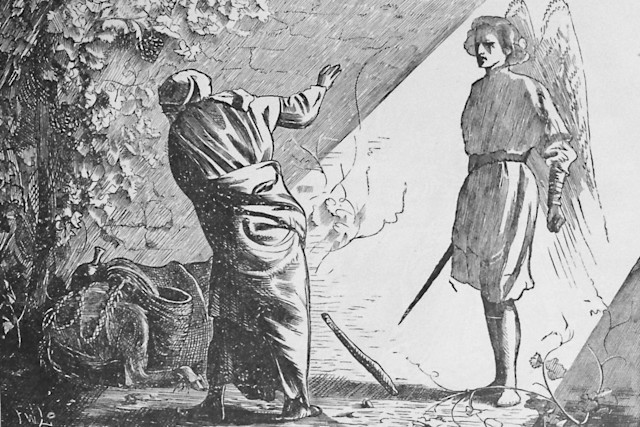
Unknown artist - Balaam and the Angel - 1890
Balak wanted Balaam to curse Israel, so that things would not go well for them—and, presumably, so that they wouldn’t conquer his nation. He brought in Balaam because if a prophet curses someone, it has a powerful effect, and Balak thought that such a powerful curse would guarantee the defeat of the Israelites. In order to facilitate this divine curse, Balaam told Balak to offer sacrifices on seven altars—seven bulls and seven rams. After he did so, Balaam received a vision from the Lord and repeated it to Balak, as recorded in Numbers 23:7-11:
Balak brought me from Aram,
the king of Moab from the mountains of the east.
‘Come,’ he said, ‘put a curse on Jacob for me;
come and denounce Israel!’
How can I curse what God has not cursed?
How can I denounce what the LORD has not denounced?
For I see them from atop the rocky cliffs,
and I watch them from the hills.
Behold, a people dwelling apart,
not reckoning themselves among the nations.
Who can count the dust of Jacob
or number even a fourth of Israel?
Let me die the death of the righteous;
let my end be like theirs!
Balak became furious, because Balaam had blessed Israel rather than cursing them. Balak replied, “What have you done to me? I brought you here to curse my enemies, and behold, you have only blessed them!” So Balak insisted that the process be repeated. They went to another place, farther away from the Israelites, and built another seven altars with seven sacrifices of a bull and a ram each, and again, Balaam received a vision from the Lord, but the result is the same (Numbers 23:18-24):
Arise, O Balak, and listen;
give ear to me, O son of Zippor.
God is not a man, that He should lie,
or a son of man, that He should change His mind.
Does He speak and not act?
Does He promise and not fulfill?
I have indeed received a command to bless;
He has blessed, and I cannot change it.
He considers no disaster for Jacob;
He sees no trouble for Israel.
The LORD their God is with them,
and the shout of the King is among them.
God brought them out of Egypt
with strength like a wild ox.
For there is no spell against Jacob
and no divination against Israel.
It will now be said of Jacob and Israel,
‘What great things God has done!’
Behold, the people rise like a lioness;
they rouse themselves like a lion,
not resting until they devour their prey
and drink the blood of the slain.
Balak was again furious but commanded a third attempt. Balak and Balaam went to Peor, a mountain overlooking a wasteland, and built an altar there, but again Balaam blessed Israel rather than cursing them.
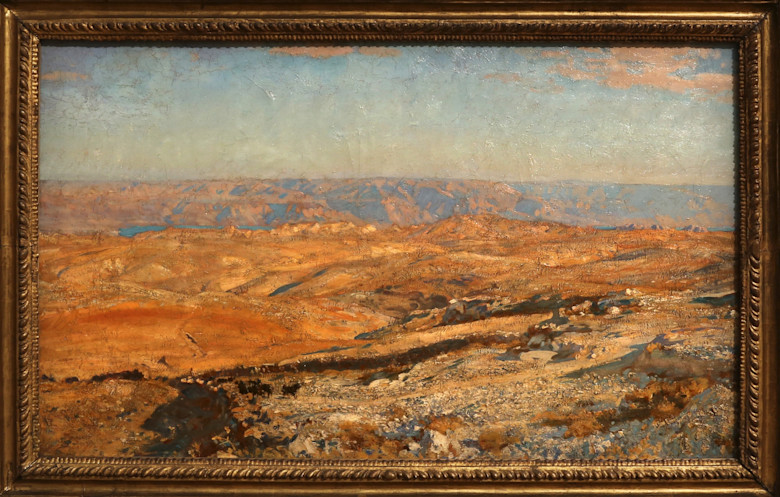
John Singer Sargent - The Mountains of Moab - 1905
What was the sin of Peor?
The sin of Peor has to do with the events that happened between the Moabites and the Israelites. The next chapter of Numbers explains that the Israelite men began to have sex with the women of Moab. These relations led to (or were a part of) the Israelites worshipping the gods of the Moabites. The chief god of the Moabites was the “Baal of Peor,” a deity who was associated with mountain peak called Peor (a “Baal” is a title that means something like “Lord” and in the context of the ancient near-east generally refers to a deity).
“Now Israel remained in Acacia Grove, and the people began to commit harlotry with the women of Moab. They invited the people to the sacrifices of their gods, and the people ate and bowed down to their gods. So Israel was joined to Baal of Peor, and the anger of the Lord was aroused against Israel.” (Numbers 25:1-3, NKJV)
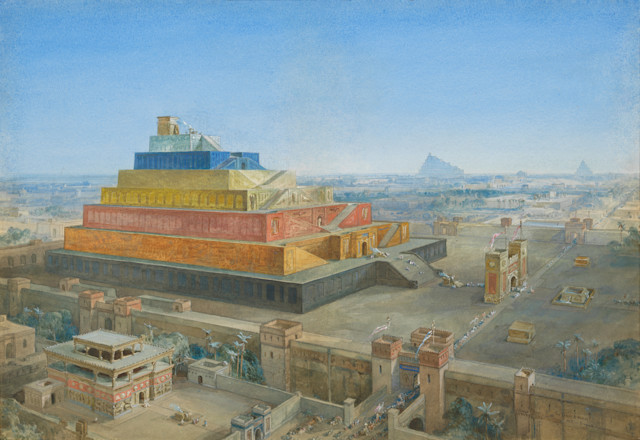
William Simpson - The Tower of Babel or Birs Nimrud Restored - circa 1885
While not part of the chronological narrative, there is a passage later in Numbers 31 that indicates that the suggestion to tempt the Israelite men was made to Balak by Balaam:
“Look, these women caused the children of Israel, through the counsel of Balaam, to trespass against the Lord in the incident of Peor.” (Numbers 31:16, NKJV)
The subtext seems to be that Balaam gave Balak this idea as a way to placate him, even though Balaam was unable to fulfill Balak’s request in cursing Israel. Balaam was a prophet who could only say what the Lord told him to say, so that explains why he couldn’t do what Balak asked. But he wasn’t an Israelite and apparently didn’t have any loyalty, so he offered Balak what he could: information on the fact that the God of Israel didn’t allow them to mix with other peoples and other religions.
What is the meaning of Peor?
Besides referring both to the physical location (the mountain) and the god that was worshipped there, the Hebrew word Peor (פְּעוֹר) seems to mean “opening.”
Subscribe
Life-giving writing by Christian scholars sent to your inbox once per month

Zachary Porcu has a PhD in church history from the Catholic University of America in Washington DC, with additional degrees in philosophy, humanities, and Classics (Greek and Latin). He is an Eastern Orthodox Christian.
Keep reading
Hineni in Hebrew: “Here I am” from God and Man

What are the prophetic books of the Bible?
Who was Jotham, king of Judah?
Who is Esaias in the Bible? Answered by a Christian Scholar
Necromancy in the Bible: Fallen Spirits, Ancient Religion