Is Sachiel a real angel?
The short answer:
Sachiel is the name of an angel that is not in the Bible, nor any of the extra-Biblical sources that the early Christians and ancient Israelites held to be authoritative. The name is from a medieval grimoire, which influenced subsequent occult books before making its way into modern pop-culture and New Age practices.
During the Medieval period there was a minority interest in producing grimoires, which were magical texts with instructions on how to do things like interact with various spiritual beings, performs spells, and create magical objects. One of the most famous of these texts was called the “Oathbound Book of Honorius,” supposedly created when a group of magicians came together to compile their magical knowledge. A major part of the text involves contacting, summoning, and commanding demons and various other angelic powers. As such it includes lists of the names and properties of such angelic beings. This book is where the name “Sachiel” first became popularized, as far as I can tell.
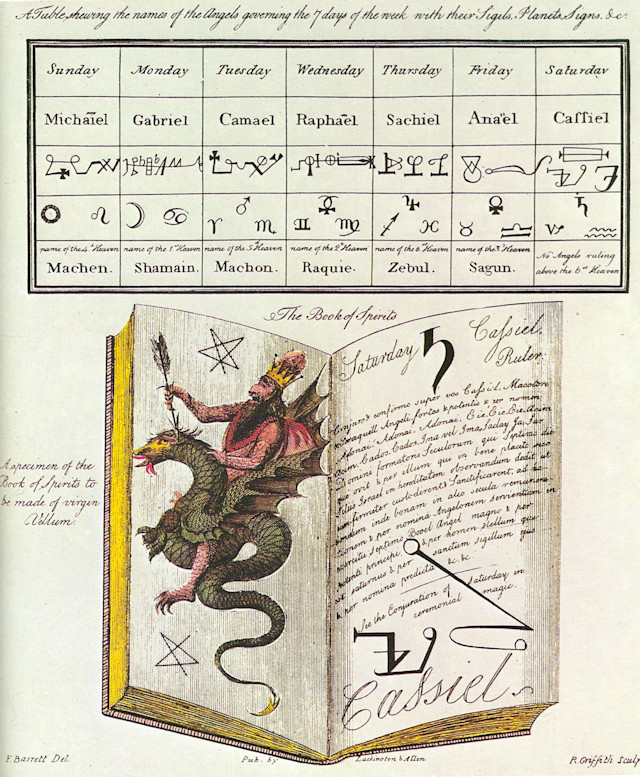
An 1801 illustration from The Magus by Francis Barrett.
It’s important to understand this evolution in the context of the time period in which these sorts of grimoires emerged. It’s common for contemporary people to believe that the Medieval era (500-1500 A.D.) was an irrational age of faith and mysticism, while the modern era that followed it (1500-present day) was a world of science and rationalism. In fact, the medieval era was much more complicated than that.
The Medieval world was famously rationalistic. Medieval thinkers pioneered math, science, and literacy, and they invented the university system as a way to organize and transmit their knowledge. While it’s true that the modern era made huge leaps in certain scientific fields, the early modern period also featured renewed interest in magical arts and occultism. Medieval grimoires that may have been simple compilations of data (the medievals loved collecting and organizing knowledge) later influenced the creation of esoteric and magical traditions as part of a long and complicated history that culminated in the eclectic practices of twentieth-century New Age spirituality—the ultimate esoteric collection of different religions and magical traditions.
Who is the angel of water?
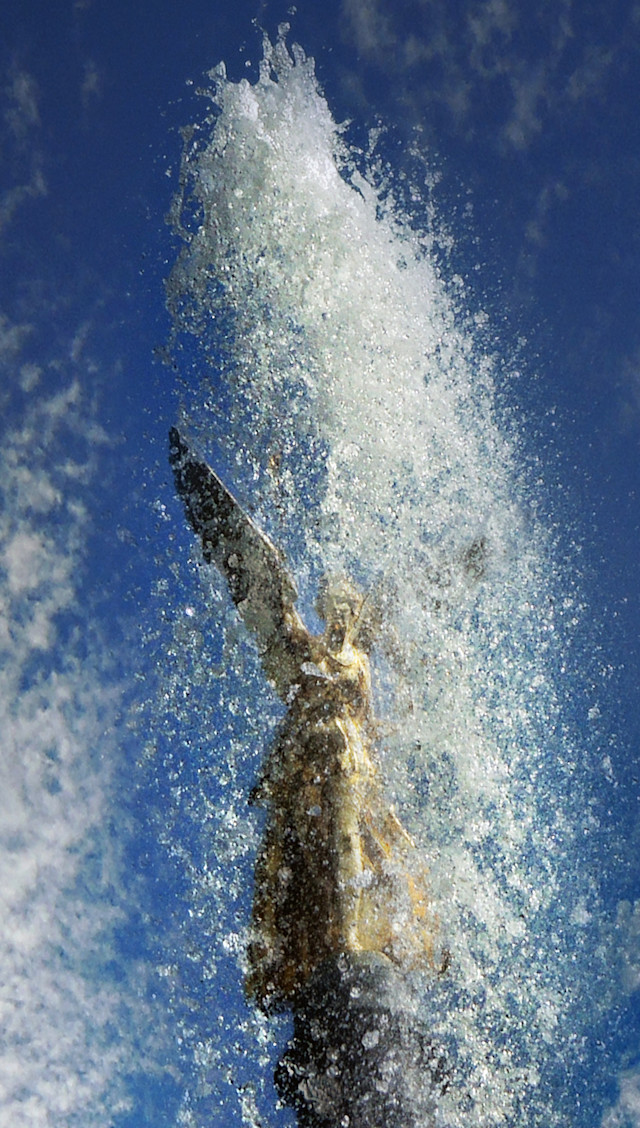
A monument in Munich called The Angel of Peace, photographed by H.D. Klein.
The closest identification comes from A Dictionary of Angels, a book published in the 1960s, which attempts to compile a complete dictionary of all the places where various angels were mentioned in ancient and medieval texts. In the book, he identifies the “angel of water insects” from the Book of Enoch as “Shakziel,” which may be a form of “Sachiel,” but the connection is dubious at best. In the same book, the author identifies “Ssakmakiel” as governing the “sign of the Water Bearer (Aquarius) in the Zodiac.” Once again, the name is similar, but we don’t know if it’s actually connected. The inconsistent spellings of the ancient and especially the Medieval world make these kinds of identifications difficult or even impossible.
What is the power of the angel Sachiel?
Again, New Age sources list a bewildering variety of powers and abilities for angelic beings. You can see examples of such pages for Sachiel here and here. But the original sources are less exhaustive. In his Dictionary of Angels, Gustov Davidson lists the following,
“Sachiel ("covering of God”)—an angel of the order of hashmallim (cherubim). Sachiel is resident of the 1st Heaven (in some sources, the 6th Heaven). He is a Monday (or Thursday or Friday) angel, invoked from the south (also from the west). In addition, he is a presiding spirit of the planet Jupiter. In goetic lore, he is called a servitor of the 4 sub-princes of the infernal empire. His sigil is shown facing p. 105 of Barrett, The Magus 11.”
While an authoritative answer to the question of Sachiel’s powers or abilities would require a dissertation-level amount of scholarly work to track down and verify, Davidson’s Dictionary of Angels is not a terrible source in that he certainly did scholarly work to track down information about angels from ancient and medieval sources.
However, the issue with a work like the Dictionary of Angels is that it’s not an authoritative text from any religious perspective, it’s just a compilation of every (or almost every) instance in which these names appear in older texts. There are sources from pagan, occult, Muslim, and Christian sources—all worldviews that tend to be incompatible with one another. Yet Davidson simply compiles them all together as though all these different religions operate along the same lines. While this compiling work is helpful, it doesn’t indicate which of these religions you should trust and whether their texts are authoritative.
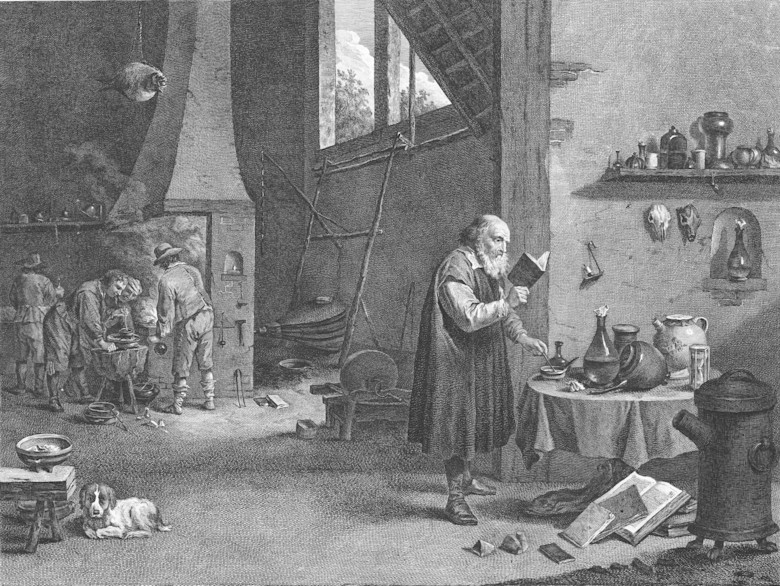
Pierre François Basan - The Grimoire of Hippocrates - 1700s
Meaning and pronounciation of Sachiel
“Sachiel” probably translates to “covering of God.” The suffix “El” is a common suffix among angelic names that you may recognize from names like “Gabriel,” “Michael,” and “Raphael,” as it means “God” in Hebrew. Angelic names often have some relationship to God or describe some aspect of God.
Sachiel is an old word and doesn’t have a standardized spelling, let alone a standardized pronunciation. Some commonly accepted ways to pronounce the name is “sah-CHEE-EL” or “sah-KEE-EL.”
Should Christians pray to Sachiel?
While devotion to the angels is as old as Christianity and many Christians today ask angels like Michael and Gabriel to pray for them and watch over them, I would not endorse doing the same for Sachiel. Even (or especially) for those Christians who believe in spiritual beings (as everyone in the early church did), it’s clear that not all angelic or spiritual beings are good. Many are fallen, enslaved by their desires and vices, and not to be trusted. For example, the early Church fathers like Justin Martyr, explain that the pagan gods really exist, but that they are in fact rebel angels pretending to be more powerful than the One God who created them, and who trick people by creating fake religions so that they can get worship and service from people. That Sachiel’s name first appears in Medieval grimoires—written by magicians trying to summon and control spirits—or New Age religions which try to show such spiritual beings in a good light—should make anyone who knows the history of angelic beings more than a little wary.
Subscribe
Life-giving writing by Christian scholars sent to your inbox once per month
Zachary Porcu has a PhD in church history from the Catholic University of America in Washington DC, with additional degrees in philosophy, humanities, and Classics (Greek and Latin). He is an Eastern Orthodox Christian.
Keep reading

Why stay away from the Book of Enoch

Who was Tartak in the Bible? The idol of the Avites
How Hot is Hell? Biblical Ideas vs. Pop Culture Depictions
The Problem with Sexual Sin

The Baptism of Poland: Unification and Christianization