Are soul ties a Christian idea? A scholar responds
The short answer:
“Soul ties” are a modern pseudo-spiritual idea that is not found in the Bible. Like all ancient people, the authors of the Bible believed in an enchanted world where everything physical had a spiritual component, but the idea of a “soul tie” that has specific signs, attributes, properties, or ways to break it—as though it were a particular spiritual phenomenon—is not a traditional Christian idea.
What does God say about breaking soul ties? Nothing. Because soul ties—as a specific concept and not a general sense that physical things have spiritual content—are a modern idea, there is nothing in the Bible, the writings of the church fathers, church tradition, or even the various authoritative extra-Biblical texts like Enoch, Jubilees, or the Didache that mentions anything about soul ties, how to break them, and so on. People who believe in soul ties as a specific concept tend to cite the friendship between Jonathan and David in the Old Testament or the Biblical idea that marriage “knits” two people together, but the specific concept of “soul ties” isn’t present in any of these examples—or anywhere else in the Bible.
What is a soul tie, spiritually?
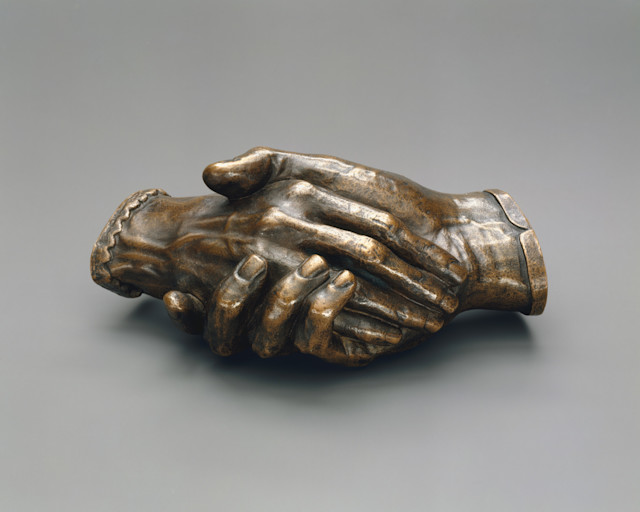
Harriet Goodhue Hosmer - Clasped Hands of Robert and Elizabeth Barrett Browning - 1853

Torii Kiyonaga - The Love Letter - 1700s
People generally cite powerful emotional connections as examples of soul ties. Common examples include close friendship, marriage, and sexual intimacy, but generally include any intense emotional relationship.
What is the significance of soul ties?
It’s easy to pick on the modern idea of soul ties as an emotionalized, pseudo-scientific, and pseudo-spiritual belief, too vague to be much good and too new to belong properly to Christian tradition. However, I think modern people tend to latch on to these sorts of concepts because they resonate with our lived experience as humans. We form connections with all sorts of people throughout our lives, and we certainly experience the kinds of symptoms that are identified as soul ties. I think it’s normal to be aware of the connections we make with others and to view these connections as having deeper spiritual significance. So how should we understand these experiences in the context of traditional Christian beliefs?
It may surprise you to learn that ancient people believed in something bigger and more powerful than a “soul tie”. Ancient people across virtually every culture held the general belief that the physical world and the spiritual world were inseparable. They believed that everything physical had spiritual significance, and that almost every spiritual thing had some physical component.
Some scholars have called this idea an “enchanted” way of viewing the world, in contrast to how modern people tend to see the world as “disenchanted.” In the disenchanted view, physical things are “just” physical, lacking spiritual content. We might have emotional associations with different physical things: one person might associate negative emotions with the ocean because he lived through a terrible boating accident, while another person might associate positive emotions with the ocean because she used to go fishing with her father when she was a girl. But in a disenchanted view, the ocean has no spiritual meaning; its meaning is whatever we feel on the inside and project onto the physical object.
But ancient people saw everything as spiritual. They believed that all objects had or could have spiritual significance independent of what people thought or felt about them. This account included their relationships with each other, their homes, their objects, the land itself, the planets—everything. Some scholars now call this account an enchanted view of the world.
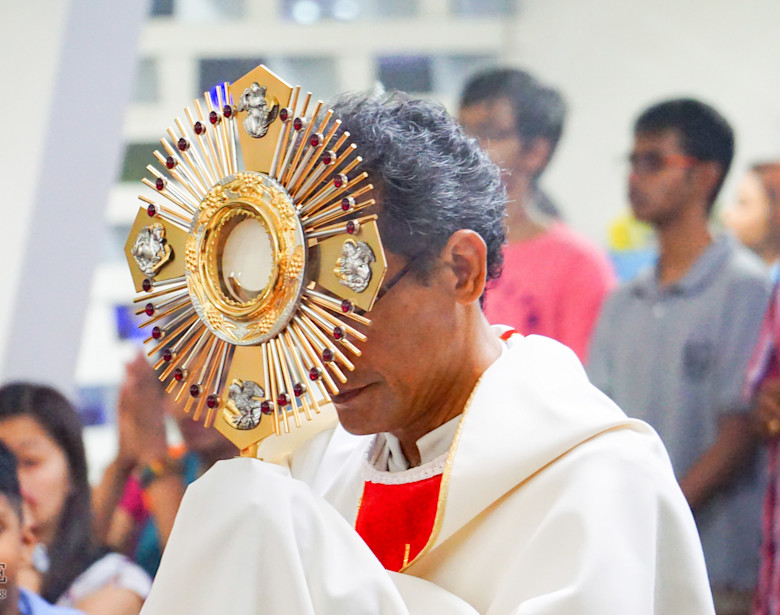
Father Paulino Miranda carries a monstrance in a procession.
When you start looking at the world this way, a lot of things make more sense. The reason that a lot of people think there is evidence for “soul ties” in the Bible is because it seems like there are examples in which the Bible depicts people having spiritual connections with one another. And the Bible does depict such spiritual connections, but not because the Biblical authors believed in the idea of a “soul tie” the way that modern people do. It’s because the Biblical authors—like everyone in the ancient world—believed that everything had spiritual significance. Almost everything in the Bible has some sort of spiritual significance, including human relationships with every object in the world, every spiritual being, and of course, God himself.
Another way of saying this idea is that ancient people all believed that the world was enchanted. Their daily experience of reality was as a world where everything had a spiritual “tie” to everything else and in which everything had spiritual content. Because our modern world is disenchanted, however, people subconsciously long for that older, more basic type of spirituality, and so they latch onto beliefs like soul ties or karma (at least, what modern Western people mean by karma) because those ideas resonate with the idea that the physical world has spiritual content.
However, Christians have always viewed the world as full of spiritual content. From the very beginning, the early Church affirmed this intense connection between the physical and the spiritual, and it informed everything that they did—especially the way they worshipped. It formed the basis of how the early church conducted its spiritual life, what came to be called “sacramental theology.” Sacramental theology is what you might call an “enchanted” Christianity—it’s a way of viewing the world such that everything has real spiritual significance, such that what you do with your bodies, for instance, has spiritual meaning. The enchanted view is how the ancient Christians looked at the world and how all traditional forms of Christianity look at it still. You can read more about this enchanted, sacramental theology in my short introduction to the topic, Journey to Reality: Sacramental Life in a Secular Age.
Subscribe
Life-giving writing by Christian scholars sent to your inbox once per month

Zachary Porcu has a PhD in church history from the Catholic University of America in Washington DC, with additional degrees in philosophy, humanities, and Classics (Greek and Latin). He is an Eastern Orthodox Christian.
Keep reading

Why stay away from the Book of Enoch

How Hot is Hell? Biblical Ideas vs. Pop Culture Depictions
The Problem with Sexual Sin

The Baptism of Poland: Unification and Christianization
What is a Pastor Emeritus? Should they exist?