Jesus and the Syrophoenician Woman: Gentile Salvation
The short story:
Matthew and Mark's Gospel accounts describe Jesus debating with a foreign woman who requested that Jesus heal her daughter. Matthew’s Gospel refers to her as a Canaanite, a term which probably just meant that she was a non-Israelite, while Mark's account refers to her as a Syrophoenician, a more specific term for someone from Phoenicia at that period in Roman history.
Syrophoenician is the word for someone who lived in Phoenicia during the time in which it was part of the Roman province Syria, as it was during the time of Jesus's ministry. It's a combination of the words Syria and Phoenicia.
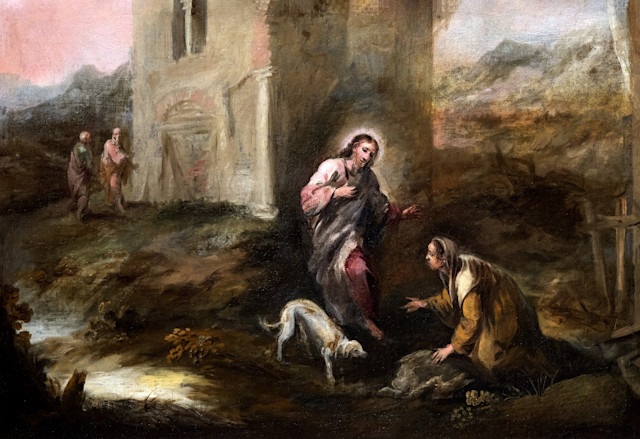
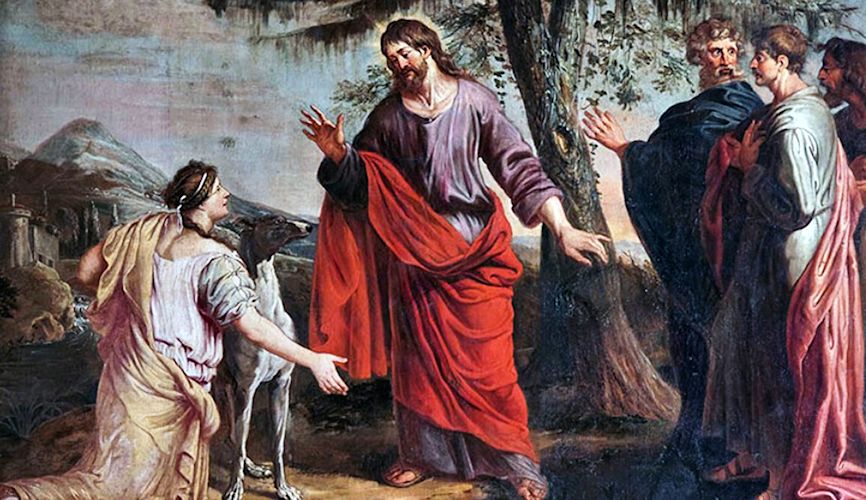
Francisco Antolínez - Jesus and the Canaanite Woman - 1600s
That said, it's doubtful that the woman was actually a Canaanite. Scholars have suggested that, since there wasn't really a Canaanite people group by the time of the first century, St. Matthew might simply have been using the term to distinguish her as a non-Israelite, which is certainly the focus of the story. Syrophoenician is almost certainly the more accurate term, but that's not the point of this episode.
The point of the episode is much deeper than that: It's about the faith of someone who was not an Israelite, but nevertheless understood and acknowledged who Christ was, about the fact that while salvation comes from the Jews, it also goes out into the whole world. Jesus explain this fact to another gentile woman, the Woman at the Well, when he tells her that, “You worship what you do not know; we know what we worship, for salvation is of the Jews. But the hour is coming, and now is, when the true worshipers will worship the Father in spirit and truth; for the Father is seeking such to worship Him” (John 4:22-23, NKJV).
Henri de Toulouse-Lautrec - Two Dogs - The Metropolitan Museum of Art
Who are the Syrophoenicians in the Bible?
The main Syrophoenician in the Bible is this woman who comes to Jesus as a non-Israelite and asks him to heal her daughter who is possessed by a demon. The story is remarkable in that Jesus initially turns her away, seemingly refusing to help her, but entertains a dialogue with her in which he allows her to demonstrate her faith through her answers, before finally granting her request:
“Then Jesus went out from there and departed to the region of Tyre and Sidon. And behold, a woman of Canaan came from that region and cried out to Him, saying, ‘Have mercy on me, O Lord, Son of David! My daughter is severely demon-possessed.’ But He answered her not a word. And His disciples came and urged Him, saying, ‘Send her away, for she cries out after us.’ But He answered and said, ‘I was not sent except to the lost sheep of the house of Israel.’ Then she came and worshiped Him, saying, ‘Lord, help me!’ But He answered and said, ‘It is not good to take the children’s bread and throw it to the little dogs.’ And she said, ‘Yes, Lord, yet even the little dogs eat the crumbs which fall from their masters’ table.' Then Jesus answered and said to her, ‘O woman, great is your faith! Let it be to you as you desire.’ And her daughter was healed from that very hour.” (Matthew 15:21-28, NKJV)
The traditional reading of this account is not that Jesus was intending to refuse her, or that he was waiting for her to insist on her right to be healed, as some modern commentators have suggested. Instead, Jesus was trying to draw out her humility as a lesson for his disciples. You can read more about the interpretations of this passage in my article on the subject.
Subscribe
Life-giving writing by Christian scholars sent to your inbox once per month

Zachary Porcu has a PhD in church history from the Catholic University of America in Washington DC, with additional degrees in philosophy, humanities, and Classics (Greek and Latin). He is an Eastern Orthodox Christian.
Keep reading
Healing is the children's bread? Miraculous humility

Who was the first woman preacher in the Bible?
Was Jesus a Rabbi?
Who was Phanuel? Archangel or Father of Anna?

Is “love conquers all” in the Bible?