Who was the first woman preacher in the Bible?
The short story:
While the Bible mentions women who preach the gospel and were active in the early Church, this activity isn’t the same as being a “preacher” in the contemporary way we use that word—as the specific vocation of being a pastor, priest, deacon, and so on. So while there are examples of women involved in all kinds of important work in the early church, such examples don’t provide support for women’s ordination in a specific vocational sense today.
The Bible mentions a number of women who spoke in front of people. They include Priscilla, the wife of one of the Seventy Apostles named Aquilla; Mary Magdalene and the other Myrrhbearing Women who are the first to learn about the resurrection of Jesus; and even Deborah, the only female Judge of Israel in the Old Testament.
Women have had various important roles throughout the history of Christianity, speaking in front of people, teaching people doctrine, and proclaiming the gospel to audiences. However, this kind of activity doesn’t mean that they were church leaders in the same way that modern people (or even the early Christians) think about it.
Did Priscilla preach in the Bible?
Saint Priscilla was the wife of St. Aquila, who was one of the Seventy Apostles. She is referenced several times in the New Testament, always as part of a couple with her husband. Saint Paul met them when Claudius Caesar forced the Jews to leave Rome. He baptized them and personally mentored them in the faith:
“And he [St. Paul] found a certain Jew named Aquila, born in Pontus, who had recently come from Italy with his wife Priscilla (because Claudius had commanded all the Jews to depart from Rome); and he came to them….
So Paul still remained a good while. Then he took leave of the brethren and sailed for Syria, and Priscilla and Aquila were with him. He had his hair cut off at Cenchrea, for he had taken a vow.” (Acts 18:2, 18:18)
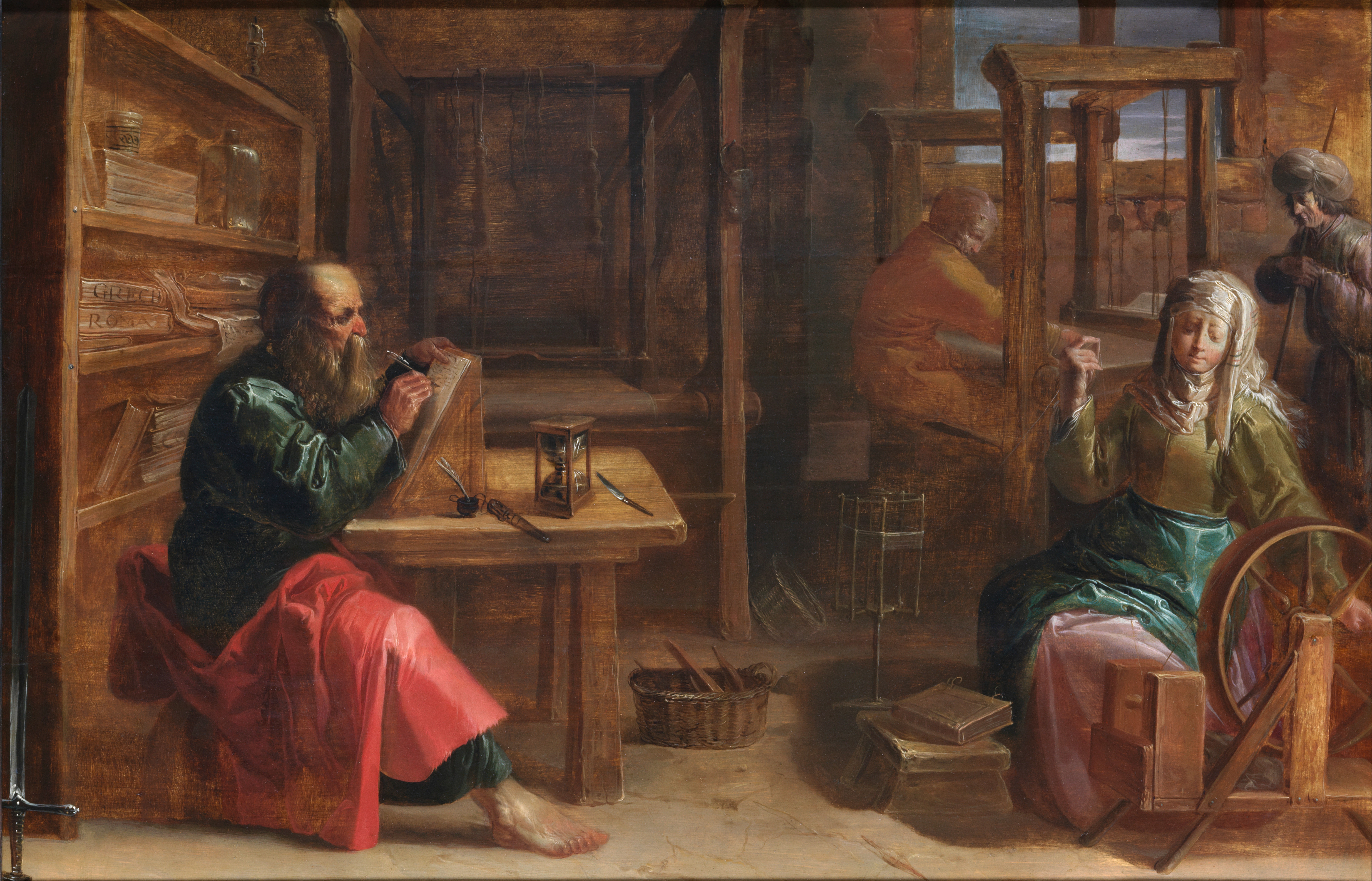
Jan van der Venne - Paul in the House of Saints Aquila and Priscilla - circa 1651
It becomes clear that Priscilla and Aquila worked with St. Paul in his missionary journeys. In his letters he occasionally sends the couple greetings or sends greetings on their behalf. For example, he addresses them in Romans 16:3:
“Greet Priscilla and Aquila, my fellow workers in Christ Jesus.”
And they send a greeting in 1 Corinthians 16:19:
“The churches of Asia greet you. Aquila and Priscilla greet you heartily in the Lord, with the church that is in their house.”
What did they do? Like most of the Seventy Apostles, there are sporadic mentions to them throughout the New Testament. We know from tradition that St. Aquila became a bishop and was martyred along with his wife, though we seem to know less about St. Priscilla. The main evidence that she was involved in explaining or teaching the Gospel—at least in the New Testament—is from Acts 18:26:
“So he began to speak boldly in the synagogue. When Aquila and Priscilla heard him, they took him aside and explained to him the way of God more accurately.”
In this passage, Priscilla and Aquila encounter Apollos, a newly baptized Jewish convert who had received the baptism of John the Baptist but wasn’t fully introduced into the doctrines or practices of Christianity. Aquila and Priscilla take him aside and (together, seemingly) correct his doctrine. You can also read between the lines and make the assumption that Priscilla was probably involved in this kind of work throughout the various labors she shared in with her husband as a disciple of St. Paul.
Certain kinds of scholars like to make a big deal out of this line and assume it sets the precedent for female clergy, but I think that’s a bit of jump, as we’ll get to at the end of the article.
Was Deborah a preacher in the Bible?
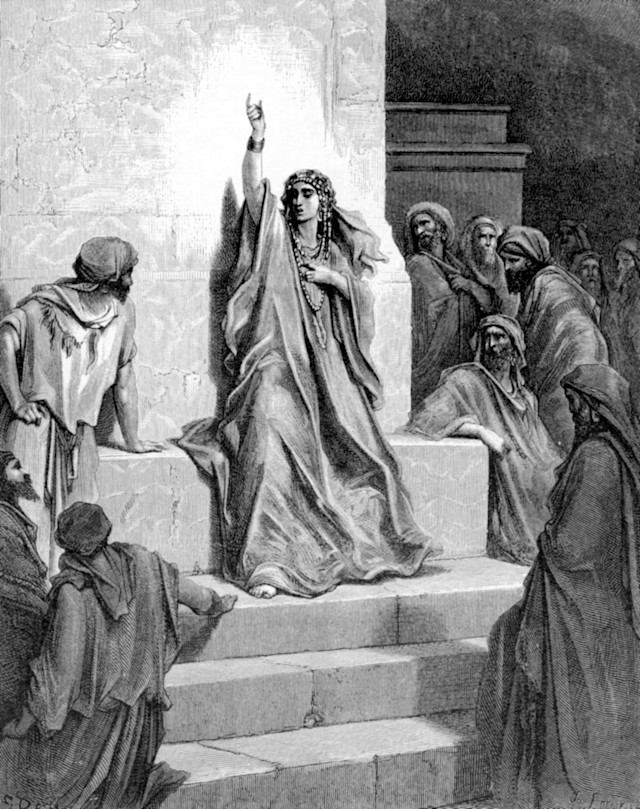
Gustave Doré - The Song of Deborah - circa 1866
So really, Deborah wasn’t a preacher, she was a Judge and a Prophetess. Yes, she was in a position of leadership, but the positions of Judge and Prophetess were positions of leadership that existed in the specific historical context of ancient Israel, but don’t exist today. Deborah holding those positions, therefore, doesn’t really address the questions modern people are asking about today, which are almost always about the possibility of female clergy.
Can a woman be a pastor according to the Bible?
The idea of female preachers is one of those conversations where the entire discussion can be derailed by a small mistake. It’s easy to look at the Bible and see examples of women who spoke about the Gospel and think that, because they performed the literal act of preaching, that they were preachers, and that therefore modern churches should ordain women. What’s wrong with this way of thinking?
There are two fallacies at work here, called “equivocation” and “anachronism.” Equivocation is when you equate two things that look the same but aren’t. The word “preacher” is often used in an equivocal way, especially with the question of ordaining women. In a literal sense, to preach means to speak in front of someone. It comes from the Latin prae (before) and dicare (to speak), which became précher in modern French and then preacher in modern English.
But in modern-day English, the word “preacher” doesn’t simply mean someone who talks in front of people. If it did, we’d use it for valedictorians, politicians, or comedians—since they all technically speak in front of people. But in a modern (especially American) context, being a preacher is understood as a specific vocation, like being a police officer or a school teacher. It means someone who runs a church, gives sermons, collects tithes, and so on.
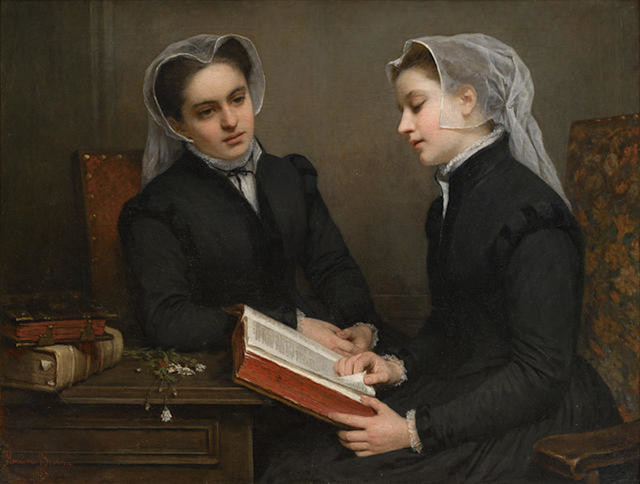
Henriette Browne - The Bible Lecture - 1857
In the same way, our concept of a “preacher” comes out of a modern European and American historical context: a preacher is a type of Protestant church leader with a specific cultural meaning. That means you can’t see the word “preach” or “preacher” in an English translation of the Bible and think that the ancient Christians had in mind the same set of responsibilities as modern American preachers.
So the short answer is, “No, the Bible doesn’t explicitly say anything about women being preachers.” Someone who talks about or explains the Gospel—even someone who is a disciple of St. Paul—isn’t the same as someone who holds a particular role in church leadership.
Where in the Bible does it say a woman cannot preach?
So what does the Bible say about women in positions of leadership? It’s relevant to bring up St. Paul in this discussion, as he was the person who mentored Priscilla and her husband in the faith directly, and also because he has some of the most extended passages in the New Testament explaining the proper relationships between men and women.
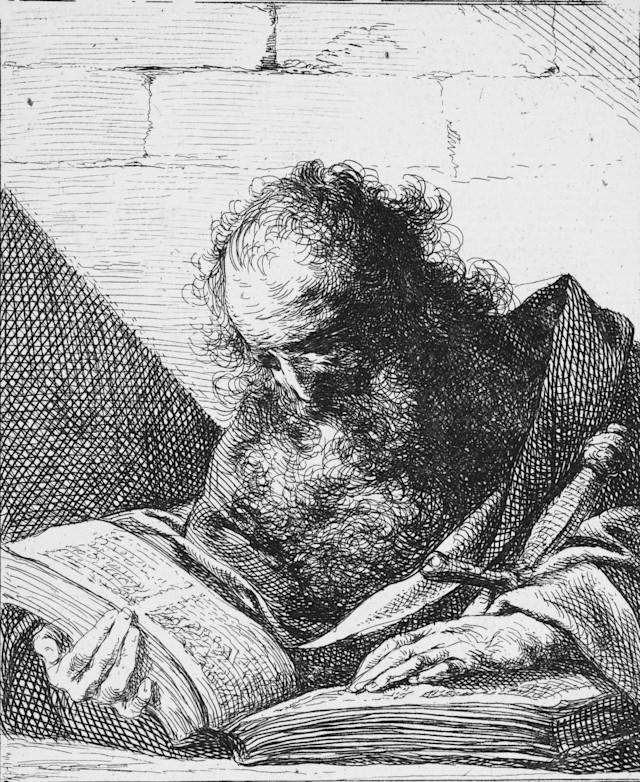
Laurent de La Hyre - St. Paul - 1600s
“And I do not permit a woman to teach or to have authority over a man, but to be in silence. For Adam was formed first, then Eve. And Adam was not deceived, but the woman being deceived, fell into transgression.” (1 Timothy 2:12-14, NKJV)
Perhaps his most famous passage on gender relationships comes out of Ephesians:
“Wives, submit to your own husbands, as to the Lord. For the husband is head of the wife, as also Christ is head of the church; and He is the Savior of the body. Therefore, just as the church is subject to Christ, so let the wives be to their own husbands in everything.
Husbands, love your wives, just as Christ also loved the church and gave Himself for her, that He might sanctify and cleanse her with the washing of water by the word, that He might present her to Himself a glorious church, not having spot or wrinkle or any such thing, but that she should be holy and without blemish. So husbands ought to love their own wives as their own bodies; he who loves his wife loves himself. For no one ever hated his own flesh, but nourishes and cherishes it, just as the Lord does the church. For we are members of His body, of His flesh and of His bones. ‘For this reason a man shall leave his father and mother and be joined to his wife, and the two shall become one flesh.’ This is a great mystery, but I speak concerning Christ and the church. Nevertheless let each one of you in particular so love his own wife as himself, and let the wife see that she respects her husband.” (Ephesians 5:22-33, NKJV)
However, people often point out that there are other places in St. Paul’s writings where he seems to say the opposite, for example, in 1 Corinthians 11-12:
“Nevertheless, neither is man independent of woman, nor woman independent of man, in the Lord. For as woman came from man, even so man also comes through woman; but all things are from God.”
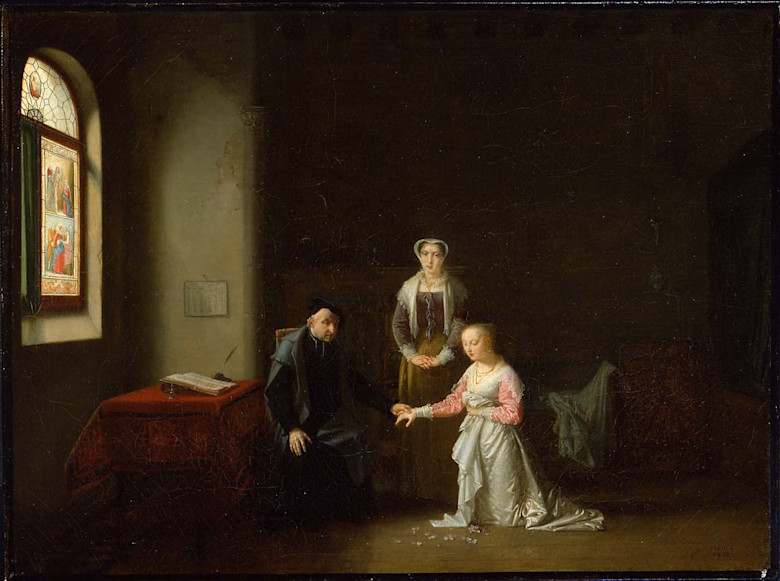
Jean-Baptiste Mallet - Young Woman Kneeling before a Priest - 1826
It’s clear that the Christian teaching is that there is a hierarchy among the sexes with regards to authority. Women are to obey their husbands as a rule (not that there aren’t exceptions, but generally speaking), and that within the context of church hierarchy, women don’t take the roles of clergy (bishops, priests, deacons).
We know this is the case from how the early Church organized itself. A good rule of thumb for understanding Christian doctrine is that, when we see things in the Bible that are ambiguous or could be taken in more than one way, it’s helpful to look at the context of the early church to see what the disciples of the Apostles were writing about. And when we look at these witnesses of early church doctrine, we see that women did not serve in these clergy roles or in church leadership.
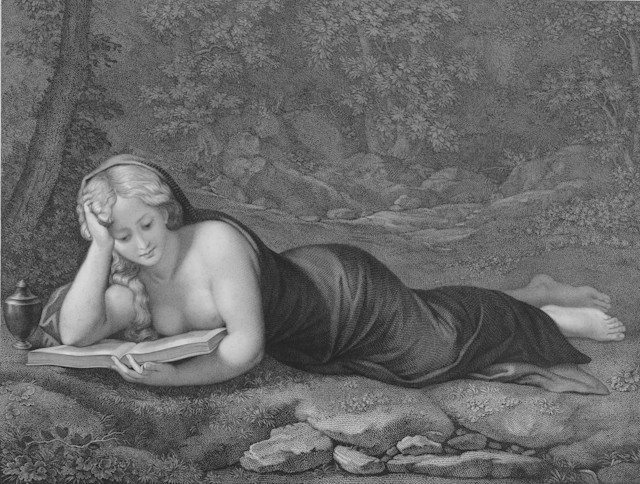
Guiseppe Longhi - Mary Magdalene in Penance in the Desert - circa 1810
So it depends on what sort of religion you want to follow. Traditional versions of Christianity, like Eastern Orthodoxy and Roman Catholicism, that are based on Apostolic Christianity, don’t include female clergy in their traditional structure. And even traditional Protestant groups, who don’t care about the standards of Apostolic teaching, are still going to be on the side that forbids female clergy because St. Paul is so explicit about it in the Bible.
What sorts of religions would advocate for female clergy? Only those who are both disconnected from Apostolic tradition and who take Biblical interpretation very loosely. In other words, religions that are largely secular in terms of their core values.
Subscribe
Life-giving writing by Christian scholars sent to your inbox once per month

Zachary Porcu has a PhD in church history from the Catholic University of America in Washington DC, with additional degrees in philosophy, humanities, and Classics (Greek and Latin). He is an Eastern Orthodox Christian.
Keep reading
Sosthenes of The Seventy Disciples - by a Christian PhD

Apollos in the Bible: Convert, Missionary, Bishop

Pastor vs. Priest: What are the differences?
Jesus and the Syrophoenician Woman: Gentile Salvation
Was Jesus a Rabbi?