Tychicus of the Seventy Apostles: The Bishop of Colophon
The short story:
Tychicus was one of the Seventy Apostles, the second-generation after Jesus’ original Twelve Disciples. He is mentioned frequently in the Epistles of St. Paul and was a bishop of the early Christian communities.
Tychicus was one of the Seventy Apostles mentioned in the New Testament. While you might call the Twelve Apostles Jesus’ “inner circle,” the Seventy were something of an outer circle that was nevertheless important in the ministry of Christ and in laying the groundwork of the early church. Almost all of the Seventy are mentioned at some point in the New Testament, such as Sosthenes, Apollo, and Timothy. Tychicus is mentioned many times in Acts and the letters of Paul. He is mentioned in Acts 20:4:
“And Sopater of Berea accompanied him to Asia—also Aristarchus and Secundus of the Thessalonians, and Gaius of Derbe, and Timothy, and Tychicus and Trophimus of Asia.”
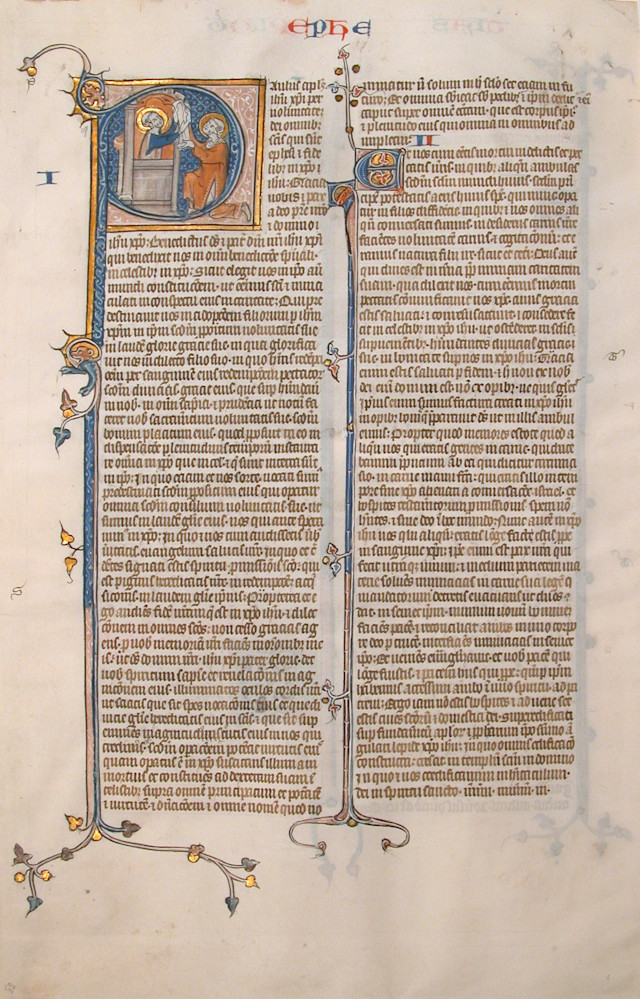
A leaf from a French manuscript, circa 1300, with the opening of the Epistle of St. Paul to the Ephesians.
“But that you also may know my affairs and how I am doing, Tychicus, a beloved brother and faithful minister in the Lord, will make all things known to you; whom I have sent to you for this very purpose, that you may know our affairs, and that he may comfort your hearts.”
Colossians 4:7:
“Tychicus, a beloved brother, faithful minister, and fellow servant in the Lord, will tell you all the news about me.”
Titus 3:12:
“When I send Artemas to you, or Tychicus, be diligent to come to me at Nicopolis, for I have decided to spend the winter there.”
And 2 Timothy 4:12:
“And Tychicus I have sent to Ephesus.”
You can see that Tychicus was intimately involved with the missionary travels of St. Paul and the administration of the communities that made up the early church.
What happened to Tychicus?
The life of Tychicus is not described in the New Testament, but we know from church tradition that Tychicus was a disciple of St. Paul and one of his traveling companions during his missionary journeys. We also know that he later became a bishop, as did most of the Seventy Apostles. Orthodox tradition holds that he succeeded Sosthenes as the bishop of Colophon, though scholars dispute whether he was the bishop of Calcedon or Neapolis.
According to tradition, St. Tychicus was the one who delivered the epistles to the Ephesians and Colossians while St. Paul was in prison. Remember that there was no mail at this time, so all letters had to be hand-written and hand-delivered by someone. It’s possible, therefore, that St. Paul dictated the letter to Tychicus, though there’s no evidence for this.
The Catholic church remembers Tychicus on April 29th, while in Eastern Orthodoxy his feast is on December 8th, where he is celebrated along with other members of the Seventy, such as Caesar, Epaphroditus, Onesiphorus, Cephas, and Apollos.
Who were the seventy apostles?
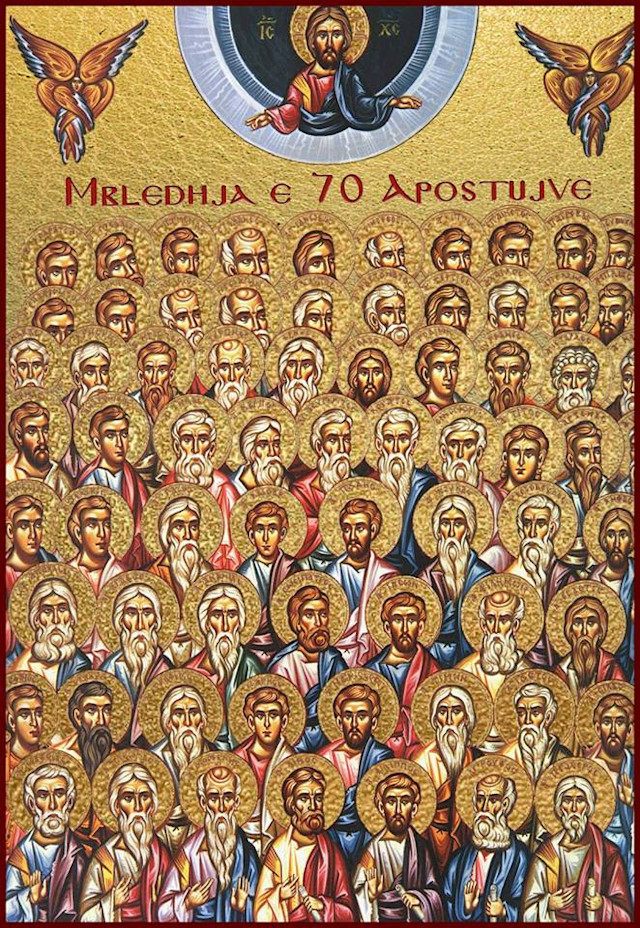
An icon of The Seventy Apostles.
The Seventy were also disciples of Jesus, but instead of staying with him, they were sent out into different cities. They preceded Christ everywhere he went, acting as heralds for the coming of Jesus, to prepare the people to receive him. You could make a parallel to the way that God sent prophets ahead of time to prepare the way for him—especially the final prophet, John the Baptist, who even started baptizing people to prepare them to receive the baptism of Christ.
Most of The Seventy became bishops over early church communities, and all of them became saints. But when we see them mentioned in the New Testament (and most of them are mentioned in the New Testament, at least once), you will usually see them in a subordinate position to one of the original apostles or to St. Paul. It’s clear from the way that St. Paul sends and instructs various members of the Seventy that there was a hierarchy. For example, he sends Tychicus to Ephasis and Colossians, and he wrote two letters to Timothy, who was his spiritual son, about how to shepherd the church.
We don’t know the Seventy Apostles as well as the Twelve, however. The New Testament authors don’t go into great detail about them, since most of the important things they did were after the timeline of the Gospel accounts but during the time that the epistles were being composed. As a result, St. Paul’s frequent references to members of the Seventy are either passing comments or part of larger logistical considerations about how he is directing them—that is, acting as their bishop. But the mentions in the New Testament correspond to accounts given by the second generation of apostles, the lists of bishops over churches that have been preserved from that time, and the witness of tradition itself.
Subscribe
Life-giving writing by Christian scholars sent to your inbox once per month

Zachary Porcu has a PhD in church history from the Catholic University of America in Washington DC, with additional degrees in philosophy, humanities, and Classics (Greek and Latin). He is an Eastern Orthodox Christian.
Keep reading
Sosthenes of The Seventy Disciples - by a Christian PhD

Apollos in the Bible: Convert, Missionary, Bishop
Jesus and the Syrophoenician Woman: Gentile Salvation
Who was the first woman preacher in the Bible?
Was Jesus a Rabbi?