
Is “love conquers all” in the Bible?
The short answer:
The phrase “love conquers all” is a line from the famous pagan poet Virgil, who predated Christ by several decades. Outside of its original context, however, it could be a good summary of a Christian understanding of love—though Virgil did not mean it in that way.
There are a lot of little catchy sayings that may seem like they’re from the Bible, but actually aren’t. A great example is “hate the sin, love the sinner” which comes from one of the letters of St. Augustine: “cum dilectione hominum et odio vitiorum.”
In the same vein, though the phrase “love conquers all” is a good summary of certain points in the New Testament, it does not appear in the Bible in any translation.

Gustave-Claude-Étienne Courtois - Dante and Virgil in Hell; The Circle of Traitors to the Fatherland - 1879
Virgil is traditionally said to have died around twenty years before Jesus was born, so it is impossible that there was any Christian influence on his writing. Nevertheless, Virgil was arguably the most famous Latin poet and continued to influence the development of Western civilization long after it ceased to be pagan.
It’s no wonder that a famous saying of a famous poet would capture the imagination of people for thousands of years after his death and continue to appear across popular culture, from Dante to sitcoms. And yet, one reason why this quote has been so enduring is because, if you take it out of its original context, it’s quite believable as a summary of a foundational Christian idea.
1 Corinthians 13: Letter on Love
The Bible passage that most people think Virgil’s line is from is in 1 Corinthians, chapter 13. It is a famous and staggeringly beautiful passage on love, worth quoting at length:
“Though I speak with the tongues of men and of angels, but have not love, I have become sounding brass or a clanging cymbal. And though I have the gift of prophecy, and understand all mysteries and all knowledge, and though I have all faith, so that I could remove mountains, but have not love, I am nothing. And though I bestow all my goods to feed the poor, and though I give my body to be burned, but have not love, it profits me nothing.
Love suffers long and is kind; love does not envy; love does not parade itself, is not puffed up; does not behave rudely, does not seek its own, is not provoked, thinks no evil; does not rejoice in iniquity, but rejoices in the truth; bears all things, believes all things, hopes all things, endures all things.
Love never fails. But whether there are prophecies, they will fail; whether there are tongues, they will cease; whether there is knowledge, it will vanish away. For we know in part and we prophesy in part. But when that which is perfect has come, then that which is in part will be done away.
When I was a child, I spoke as a child, I understood as a child, I thought as a child; but when I became a man, I put away childish things. For now we see in a mirror, dimly, but then face to face. Now I know in part, but then I shall know just as I also am known.
And now abide faith, hope, love, these three; but the greatest of these is love.”

In this 1877 illustration by Gustave-Claude-Étienne Courtois, Dante and Virgil look upon the hetaira Thaïs in Hell.
There is so much to unpack in this chapter of Corinthians that we can’t get into everything here, but there are few important things to point out.
A critical thing to notice about this passage is that the early Christians meant something very different by “love” than we do today. When we talk about love it’s easy to confuse it with desire, appetite, or taste. I could say, “I love ice cream” and I could say “I love my wife,” but if you think about it, you’ll realize that those two sentences can’t mean the same kind of love.
What I mean by “I love ice cream” is that I enjoy it, and it gives me pleasure. Therefore, I desire it, I seek after it, I have a longing for it. It’s primarily an emotion or a feeling of pleasure. And while I can also enjoy things about my wife in a similar way, I don’t love her in the same way. As a Christian, what I mean by “I love my wife” is a description of a state of being; it’s more than just a description of an emotional experience.
In Christianity, love is about how we relate to one another, how we are both our own individual persons and also united to one another. A man and a women are united as “one flesh”; they are two individual persons but actually, literally, physically, one body. They are both at once. It’s the same with the whole body of the church and our unity in Christ. It’s also similar to the Father, Son, and Holy Spirit in the Christian idea of the Trinity. You can read more about the way that the early Church understood marriage as a relationship of both two individuals and one body in my book Journey to Reality, but the point is that the Christian account of love is profoundly different (and higher) than a craving for something you like. Love doesn’t “bear all things” because it enjoys someone, it bears all things because we are the same body. And the ultimate nature of this reality is why St. Paul ends this passage by contrasting how we previously saw the world as children but later we will see “face to face.”
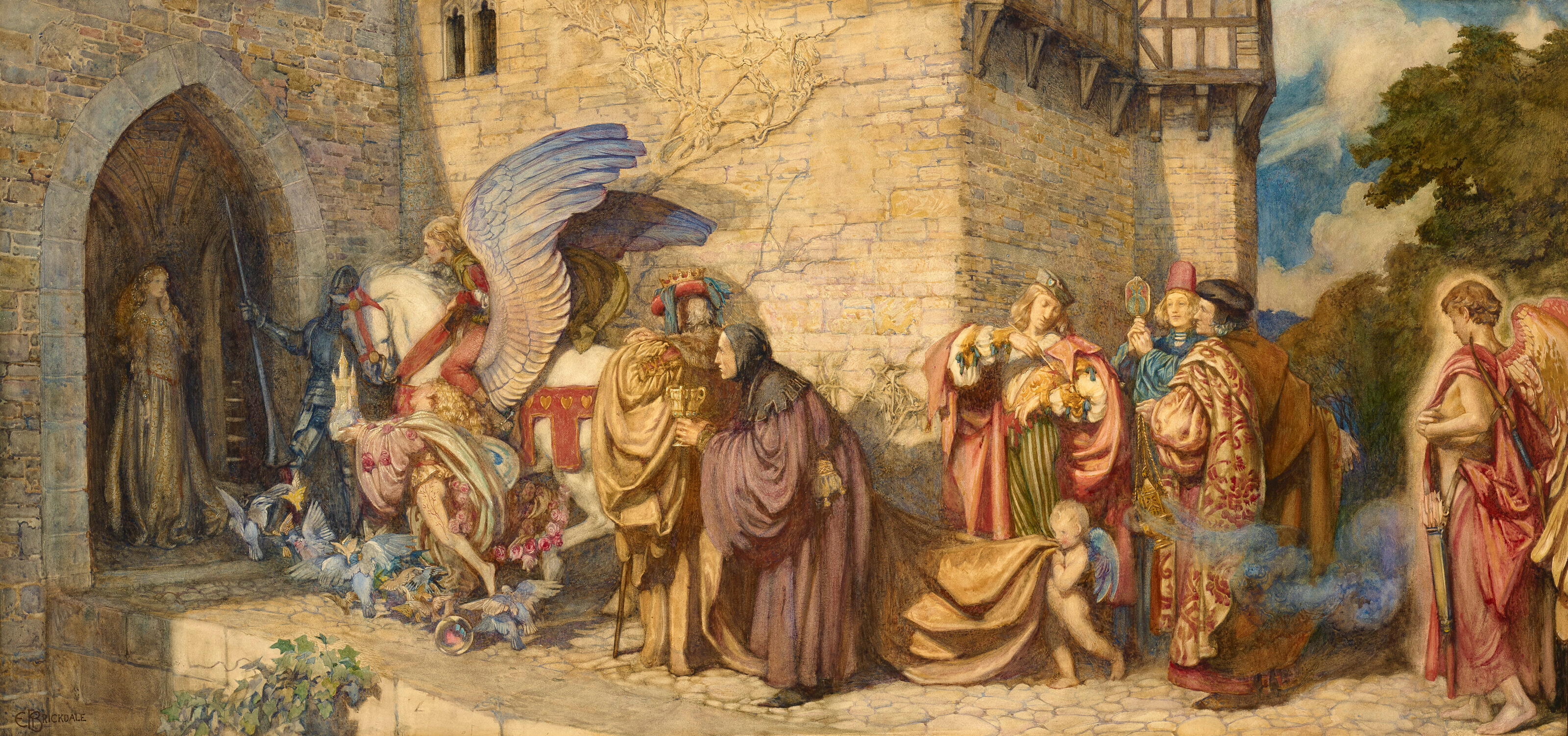
Eleanor Fortescue-Brickdale - Love and his Counterfeits - 1904
What does “love conquers all” mean?
In the Christian sense, the idea that love conquers all could be a good summary of any or all of the points that St. Paul makes in this passage, in the sense that love elevates us to the highest, ultimate reality: the reality of God’s inner life, because “God is love” (1 John 4:8) and is himself, in his nature, a Trinity of persons united in perfect love.
But in the original use in Virgil’s poem, the context is quite different. In that poem, the speaker is bemoaning the fact that the girl he loves is marrying another man. While he was absent for military duty, his girlfriend was unfaithful to him, and now he grieves the loss of the relationship.
Virgil’s story is very different, and while it is not unfamiliar (some things never change), you can see that his understanding of love in this passage is primarily pagan rather than Christian.
For the pagans, love was a realm of desire, and a goddess like Aphrodite (or Venus, as she’s called in Latin) was the patron over this domain, just as a deity like Poseidon was the patron over the sea. Aphrodite was herself full of desires and wants, which often got her into trouble, according to the mythologies surrounding her.
But Aphrodite, as the patron of intense desire, is a very different figure from the God who is love itself, love understood as the state of being, simultaneously, both ourselves and united with others.
Subscribe
Life-giving writing by Christian scholars sent to your inbox once per month

Zachary Porcu has a PhD in church history from the Catholic University of America in Washington DC, with additional degrees in philosophy, humanities, and Classics (Greek and Latin). He is an Eastern Orthodox Christian.
Keep reading
Jesus and the Syrophoenician Woman: Gentile Salvation

Who was the first woman preacher in the Bible?
Was Jesus a Rabbi?
Who was Phanuel? Archangel or Father of Anna?
Tychicus of the Seventy Apostles: The Bishop of Colophon