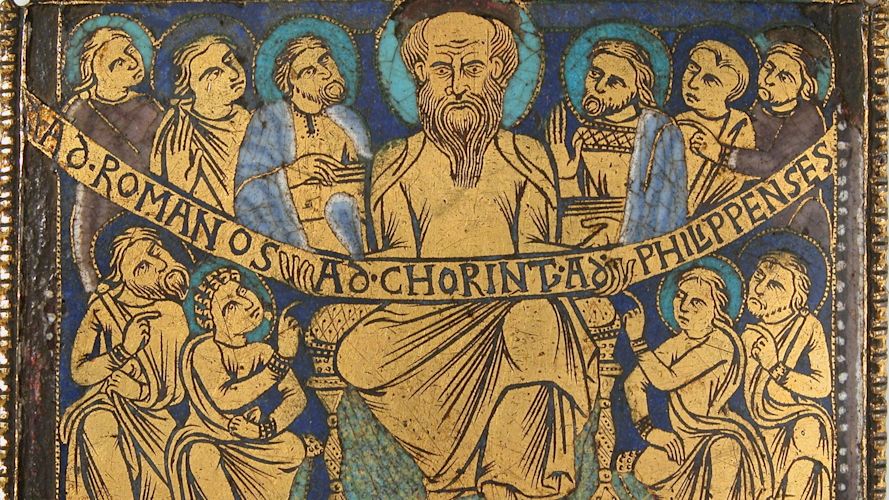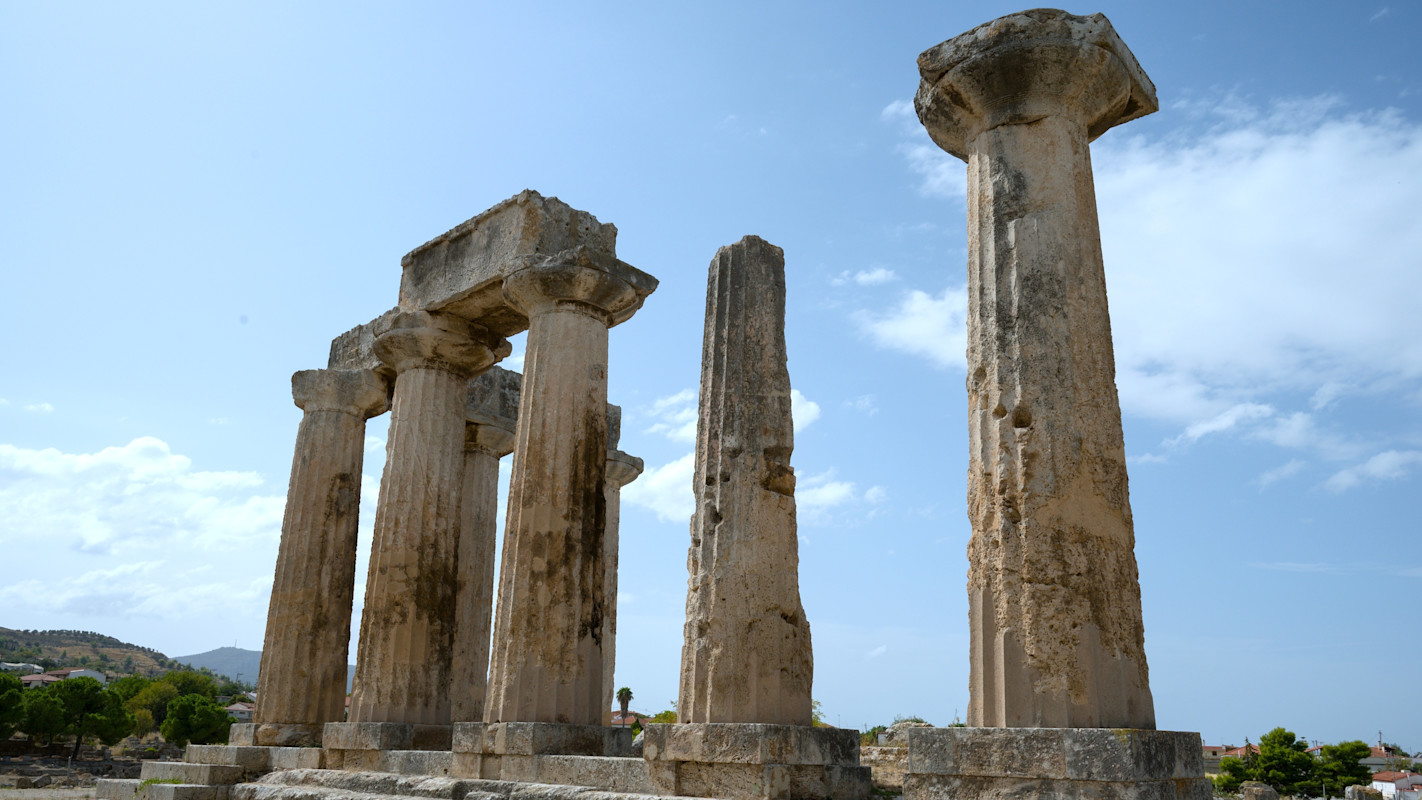
Apollos in the Bible: Convert, Missionary, Bishop
The short story:
Apollos was a Jewish convert to Christianity from the second generation of apostles, one of the Seventy Disciples mentioned in the New Testament, a companion of St. Paul, and a bishop of the early Church.
Everyone knows about Jesus’ Twelve Disciples, but there were also a group called “the Seventy” who were also followers of Jesus. They came from a number of different backgrounds, and ended up playing pivotal roles in the formation of the early Church.
The apostle Apollos was one of these second-generation apostles. He was baptized by before the ministry of Christ, by John the Baptist. Apollos went on to become a follower of Christ and one of the Seventy Apostles. He was an educated Jew from Alexandria, like his companion St. Paul; he served as a helper to Paul throughout his missionary journeys and was a major player in the formation of the early Church.
What happened to Apollos in the Bible?
The book of Acts, written by the Apostle Luke, recounts some of the primary bibliographic information about Apollos:
“Now a certain Jew named Apollos, born at Alexandria, an eloquent man and mighty in the Scriptures, came to Ephesus. This man had been instructed in the way of the Lord; and being fervent in spirit, he spoke and taught accurately the things of the Lord, though he knew only the baptism of John. So he began to speak boldly in the synagogue. When Aquila and Priscilla heard him, they took him aside and explained to him the way of God more accurately. And when he desired to cross to Achaia, the brethren wrote, exhorting the disciples to receive him; and when he arrived, he greatly helped those who had believed through grace; for he vigorously refuted the Jews publicly, showing from the Scriptures that Jesus is the Christ” (Acts 18:24-28).
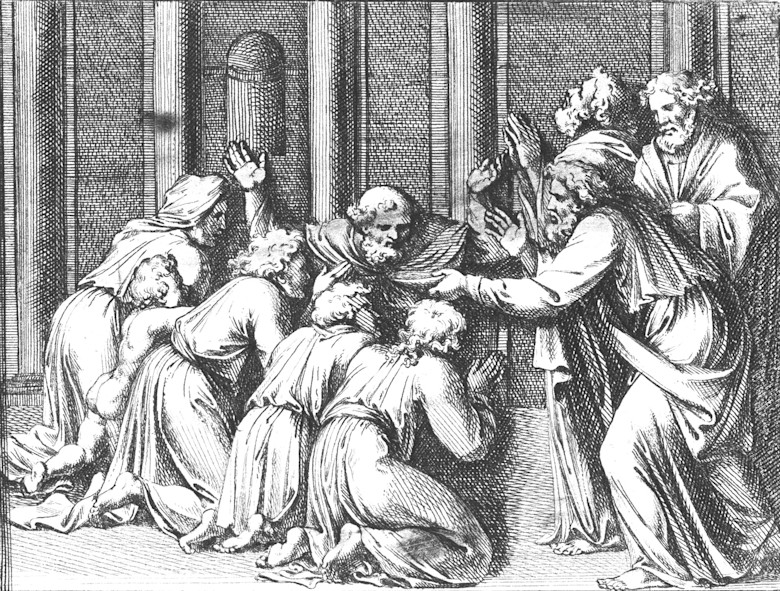
Pietro Santi Bartoli - Saint Paul Baptizing the Christians of Corinth - after Raphael - 1600s
The story continues in Acts 19:
And it happened, while Apollos was at Corinth, that Paul, having passed through the upper regions, came to Ephesus. And finding some disciples he said to them, “Did you receive the Holy Spirit when you believed?”
So they said to him, “We have not so much as heard whether there is a Holy Spirit.”
And he said to them, “Into what then were you baptized?”
So they said, “Into John’s baptism.”
Then Paul said, “John indeed baptized with a baptism of repentance, saying to the people that they should believe on Him who would come after him, that is, on Christ Jesus.”
When they heard this, they were baptized in the name of the Lord Jesus. And when Paul had laid hands on them, the Holy Spirit came upon them, and they spoke with tongues and prophesied. Now the men were about twelve in all” (Acts 19:1-7).
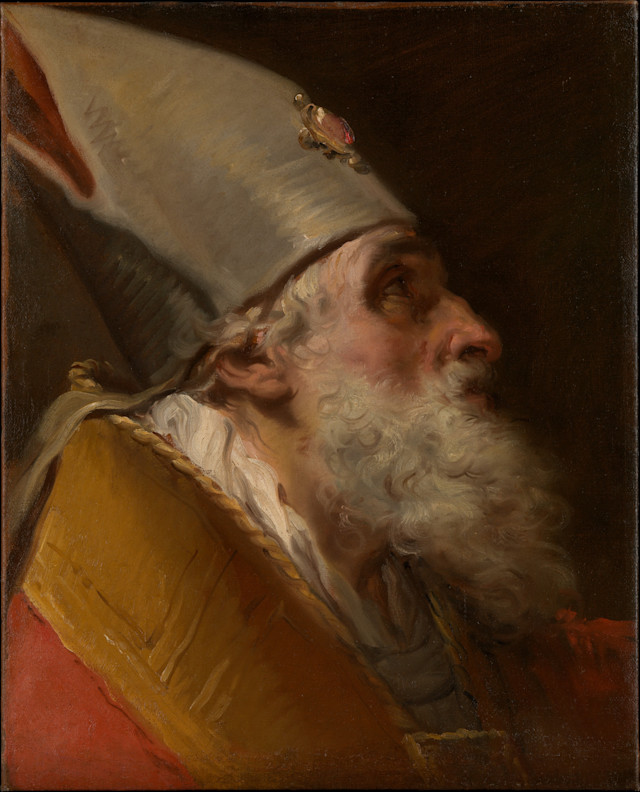
Gaetano Gandolfi - Head of a Bishop - circa 1770
But, as we know from tradition—and can infer from the writings in the New Testament—Apollos became a leader among the early Church, a bishop who baptized people himself. We see part of this in St. Paul’s admonition to the church at Corinth. At that time, the Corinthians were embroiled in a controversy among one another that was leading to factionalism, where some claimed that they were loyal to Paul, others claimed that they were loyal to Apollos, and others that they were loyal to Christ. About this matter, St. Paul wrote the following:
“For when one says, “I am of Paul,” and another, “I am of Apollos,” are you not carnal? Who then is Paul, and who is Apollos, but ministers through whom you believed, as the Lord gave to each one? I planted, Apollos watered, but God gave the increase. So then neither he who plants is anything, nor he who waters, but God who gives the increase. Now he who plants and he who waters are one, and each one will receive his own reward according to his own labor” (1 Corinthians 3:4-8).
This kind of controversy makes sense given that Apollos had become a bishop, like St. Paul, and these early Christians were perhaps confused about their loyalties.
Apollos was a fellow missionary with St. Paul, and it seems that he received his apostleship from Paul. In the early church, and still today in traditional Christianity, becoming a priest or a bishop is a special vocation that you have to receive from another bishop. This concept is called “apostolic succession”, and is an extension of Jesus’ own ministry. Jesus chose people to be his disciples and passed his authority and power on to them through physical touch, which was passed down from his disciples to their disciples through the “laying on of hands” (for example, Acts 8:14-19, 1 Tim 5:22, and 2 Tim 1:6). So at some point Apollos received his status as an apostle from St. Paul and became the bishop of Corinth.
What is Apollos known for?
Saint Jerome believed that Apollos was frustrated by the divisions that had occurred in the Corinthian church (as we saw above, where the Corinthians were fighting over which apostle they belonged to). Because of this, he left and retired to the island of Crete, where he remained until St. Paul had managed to heal the schisms among the Corinthians by way of his letters. Jerome believed that Apollos returned to serve as the bishop of Corinth once the schisms were healed.
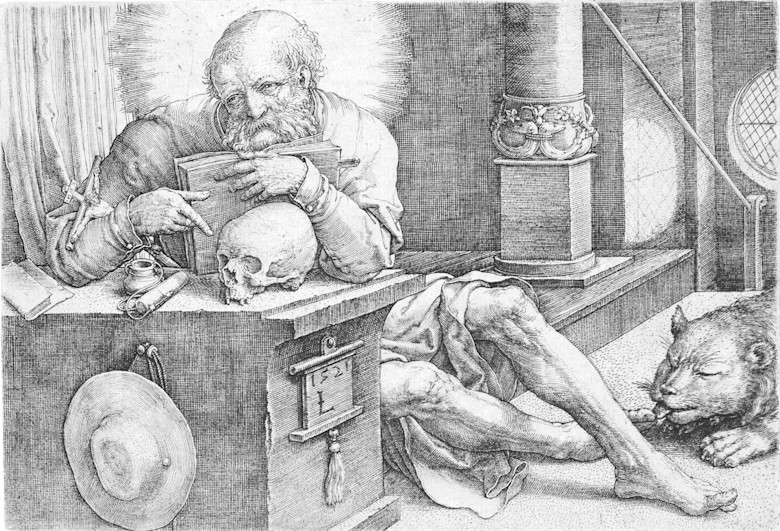
Lucas van Leyden - St. Jerome - 1521
There is evidence to support this view in 1 Corinthians, where St. Paul mentions that Apollos was “unwilling” to return to the church at Corinth:
“Now about our brother Apollos: I strongly urged him to go to you with the brothers. He was quite unwilling to go now, but he will go when he has the opportunity” (1 Corinthians 16:12, NIV).
There is evidence in later tradition that he may have been a bishop to various churches, including those in Smyrna and Caesarea.
Another controversy has to do with the authorship of the Book of Hebrews. Some have argued that Apollos was the author of Hebrews, though the broad consensus of tradition is that Hebrews was authored by St. Paul. One way of resolving this tension is that, in the ancient world, it was a commonly accepted practice to publish or otherwise attribute your work to your teacher rather than to yourself. Partly this was a way of showing respect for him, but in reality it was often the case that the student was simply recording or writing down the things his teacher had taught him, without much (or any) substantial additions of his own. So it may be that the content of the Book of Hebrews was entirely St. Paul, and that Apollos was summarizing it; or it could have been that St. Paul dictated the letter and Apollos wrote it down, or something in between. No one knows for sure, but traditionally the book is attributed to Paul—though Apollos may have been involved in some way.
Apollos, like the rest of the Seventy, was recognized as a Saint. He is commemorated in the Orthodox church on December 8th and January 4th, along with the rest of the Seventy. One final note: be sure you don’t confuse him with Saint Apollo of Egypt, a fourth-century saint who was a monk during the reign of Julian the Apostate, hundreds of years after Apollos served as bishop of Corinth.
Subscribe
Life-giving writing by Christian scholars sent to your inbox once per month

Zachary Porcu has a PhD in church history from the Catholic University of America in Washington DC, with additional degrees in philosophy, humanities, and Classics (Greek and Latin). He is an Eastern Orthodox Christian.
Keep reading

Jesus and the Syrophoenician Woman: Gentile Salvation

Who was the first woman preacher in the Bible?
Was Jesus a Rabbi?
Who was Phanuel? Archangel or Father of Anna?

Is “love conquers all” in the Bible?