Skip to content
Athaliah, ancient queen regnant of Israel

Athaliah, ancient queen regnant of Israel

Dr. Zachary Porcu

May 10, 20263 min read

The short answer:

Athaliah was the only queen of the ancient Israelites who ruled in her own right, rather than sharing power with a husband. However, her rule began with a bloodthirsty power grab, and she supported the worship of pagan gods.

It’s important to get definitions right when trying to answer this question. Athaliah was the daughter of the king of Judah, king Ahab, and his wife, queen Jezebel. Through a series of political maneuvers, she became the first and only queen who ruled in her own right—as distinct from a queen whose power comes from marrying a king.

The proper names for these different roles are “queen regnant” and “queen consort.” A queen regnant is a woman who reigns with an equivalent power and authority to a king, on her own and by her own power. A queen consort, on the other hand, is a queen because she is the wife of the reigning king. While a queen consort shares the social status and much of the power of her husband, she does not rule in her own right as a queen regnant does. Jezebel was a queen but seems to have been a queen consort, sharing in the power of her husband, king Ahab.

The exact lineage of Athaliah is debated among scholars. The Old Testament states that she was the daughter of king Omri, but some scholars consider her to be the granddaughter of Omri and the daughter of Ahab and Jezebel.

What did Athaliah do in the Bible?

20260510_CranesNorthernIsrael

Wildlife in northern Israel.

Athaliah married Jehoram who was the king of Judah. Judah was the northern kingdom of Israel at a time when Judah and Israel were two different kingdoms.

While Jehoram’s father, Jehoshaphat, was devoted to Yahweh—the Old Testament name for the God of Israel—Jehoram rejected these ways and “did evil in the eyes of the lord.” The text indicates that he “Followed the ways of the kings of Israel, as the house of Ahab had done, for he married a daughter of Ahab” (2 Kings/2 Kingdoms 8:18), meaning he followed in the ways of those previous kings of Israel who promoted the Baalist cults rather than the worship of the true God of Israel. The text explains that, because of this rejection of the God of Israel, his rule began to decline as he dealt with revolutions and raids.

After Jehoram died, his son Ahaziah became the king of Judah and his wife Athaliah became the queen mother of Judah. But things continued to be contentious. The prophet Elisha secretly anointed Jehu, son of Jehoshaphat, as the true king of Israel. He began to lead a rebellion to take back the kingdom and slew Ahaziah in the process. As a result, Athaliah became a true queen regnant—there was no one else to rule. Athaliah seized the throne and ordered a massacre of the other members of the royal house who could lay any claim to the throne. She reigned as the sole monarch of Judah for the next seven years.
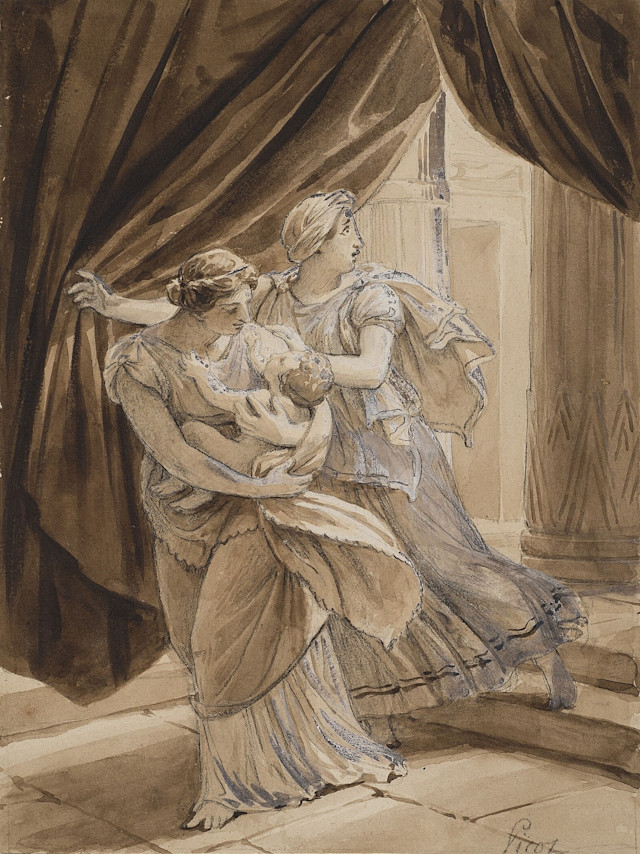
20260510_Francois-EdouardPicot_JoasSauveDuMassacre

François-Édouard Picot - Jehoash Saved from the Massacre of Athaliah - 1825

However, one of the children of the royal family was hidden during the massacre and survived in secret. The child’s name was Jehoash, the son of Ahaziah, and he was raised in secret by one of the priests. In the meantime, Athaliah established a Baalist cult in Judah—directing people to worship the old pagan gods rather than the God of Israel.

Eventually, Jehoash grew old enough and the priest who had raised him declared him the true king of Judah, which sparked a rebellion in which Athaliah was captured and killed.

How was Athaliah related to Jezebel?

Jezebel was a Phoenician princess who married Ahab, and brought with her the worship of Baal. How Athaliah is related to her is a matter of some dispute. While the text states that Athaliah was the daughter of Omri and therefore the sister of Ahab and sister-in-law to Jezebel, some scholars believe that she was in fact the daughter of Ahab and Jezebel. The text might list her as the daughter of Omri to mean that she was “of the house of Omri” or “in the line of Omri” which was not an uncommon way of writing about people’s identities, but can be a little ambiguous.

What does the name Athaliah mean?
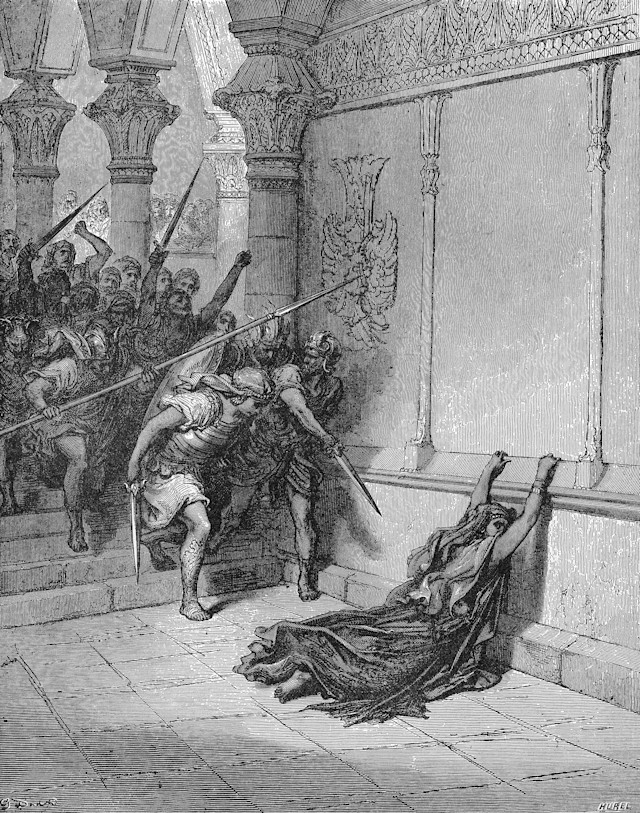
20260510_GustaveDore_Athaliah

Gustave Doré - Athaliah - 1911

If you search for “what is the meaning of Athaliah,” you will find numerous baby name websites claiming that it means “the Lord is great” or “the Lord is exalted” or “the Lord is mighty.” However, from a scholarly perspective, it’s not clear what the word means in the context of Biblical Hebrew. The last syllable of the name is “Yah,” which is clearly part of the word “Yahweh,” so it does have some connection to the Lord, but the first part of the name is in dispute. That part may mean “is exalted,” but the verb “Atal” could also mean “dealt violently with,” which suggests that the name might mean, “Taken Away of the Lord.” The evidence for “the Lord is exalted” may come from a related Assyrian verb that means “to grow great.” There are a few scholarly websites available if you know some Hebrew or are interested in the grammar of the word. But, given that Athaliah was a usurper, ordered the murder of infants, and supported the worship of bloodthirsty near-eastern deities, if you’re searching for a good baby name, you may want to keep looking.
Image credit
  • Jean Audran - Athaliah and Joab - 1677-1756
  • Wildlife in northern Israel, photograph by Tomere
  • François-Édouard Picot - Jehoash Saved from the Massacre of Athaliah - 1825
  • Gustave Doré - Athaliah - 1911

Article folder: Old Testament

Tagged with: The Twelve Tribes of IsraelidolatryHebrewhistoryJezebel

Dr. Zachary Porcu

Zachary Porcu has a PhD in church history from the Catholic University of America in Washington DC, with additional degrees in philosophy, humanities, and Classics (Greek and Latin). He is an Eastern Orthodox Christian.

Full author bio

Keep reading

Who was Tartak in the Bible? The idol of the Avites

Who was Tartak in the Bible? The idol of the Avites
Dr. Zachary Porcu
by Dr. Zachary PorcuCatholic University of America
Tartak is mentioned in the second book of Kings (also called “4th Kingdoms” in older Bibles) as one of the idols that was set up in Samaria by the people who were living there. 2 Kings chapter 17 describes the religious confusi...
Maher-Shala-Hash-Baz, the Son of the Prophet Isaiah

Maher-Shala-Hash-Baz, the Son of the Prophet Isaiah

Dr. Zachary Porcu
by Dr. Zachary PorcuCatholic University of America
The book of Isaiah features a long name: Maher-Shala-Hash-Baz. It is often considered the longest name in the Bible, though that depends on how you count. It first occurs in Isaiah 8:1: “Moreover the Lord said to me, ‘Take a la...
Plant of Fertility and Magic: Are mandrakes in the Bible?

Plant of Fertility and Magic: Are mandrakes in the Bible?

Dr. Zachary Porcu
by Dr. Zachary PorcuCatholic University of America
The mandrake is mentioned in two places in the Bible: in an episode between Rachel and Leah concerning fertility, and in the Song of Solomon. The Song of Solomon, also known as the Song of Songs or the Canticle of Canticles, is...
What is the meaning of Jehovah Shammah?

What is the meaning of Jehovah Shammah?

Dr. Zachary Porcu
by Dr. Zachary PorcuCatholic University of America
Jehovah Shammah is a transliteration of the Hebrew phrase יְהוָה שָׁמָּה, which means “God is there.” The phrase is the same as “Yahweh Shammah” because “Jehovah” and “Yahweh” are both variations of the same Hebrew word. Ancie...
Pentagram vs Star of David: Symbolism Historical and Modern

Pentagram vs Star of David: Symbolism Historical and Modern

Dr. Zachary Porcu
by Dr. Zachary PorcuCatholic University of America
While modern people tend to associate the pentagram with the devil, satanism, or magic in general, it’s important to realize that the pentagram is a perennial symbol that’s been used in huge range of cultural contexts for all o...
Abdiel: Milton's Angel who Scorned the Devil - By a PhD

Abdiel: Milton's Angel who Scorned the Devil - By a PhD

Dr. Zachary Porcu
by Dr. Zachary PorcuCatholic University of America
The name “Abdiel” appears in the Bible only one time, in 1 Chronicles 5:15: “Ahi the son of Abdiel, the son of Guni, was chief of their father’s house” (NJKV). In this passage, Abdiel appears as someone’s father in a genealogy,...