What is the meaning of Jehovah Shammah?
The short story:
Jehovah Shammah is a Hebrew phrase from the book of Ezekiel that means “the Lord is there.” It’s a double prophecy that refers both to the restoration of Israel after the Babylonian Captivity and the restoration of all things after the ultimate return of Christ.
Jehovah Shammah is a transliteration of the Hebrew phrase יְהוָה שָׁמָּה, which means “God is there.”
The phrase is the same as “Yahweh Shammah” because “Jehovah” and “Yahweh” are both variations of the same Hebrew word. Ancient Hebrew was written without vowels, and (to put it simply) one of their letters could be taken as either a “Y” or a “J.” The original Hebrew word was written as YHWH, but if depending on how you add the vowels and translate the Hebrew letters, it could be either “Yahweh” or “Jehovah.” In either case, the meaning is the same.
What does the Bible say about Shammah?
The word “shammah” appears in several places in the Bible as the name of a few different people. Shammah, the son of Agee, was a Hararite (or a Harodite) who is mentioned in the book of Samuel as one of King David’s top three “mighty men.” He defeated an entire squad of Philistines single-handedly:
“And after him was Shammah the son of Agee the Hararite. The Philistines had gathered together into a troop where there was a piece of ground full of lentils. So the people fled from the Philistines. But he stationed himself in the middle of the field, defended it, and killed the Philistines. So the Lord brought about a great victory.” (2 Sam 23:11-12)
Several other men named Shammah are mentioned in passing through the Bible, such as Shammah, the son of Reuel in the line of Esau (1 Chronicles 1:37 and Genesis 36:13-17) and Shammah the son of Jesse, who would have been the brother of the renowned King David (1 Samuel 16:9).
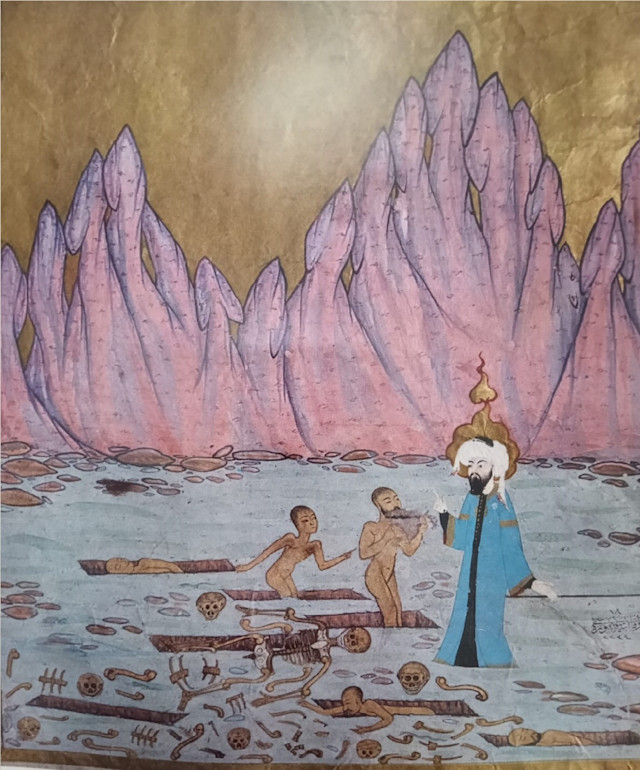
This illustration from the 1583 Ottoman manuscript Zübdet-üt Tevarih, compiled by Seyyid Lokman, depicts the prophet Ezekiel in the valley of the dry bones.
Eventually, the Babylonians were conquered by the Assyrians, and Cyrus the Great ordered the Israelites to rebuild their temple, but Ezekiel wrote before the Assyrians arrived. He prophesied about the future restoration of the temple and the end of the captivity. His prophecy ended with a vision of the city of Jerusalem restored to its former glory with the temple rebuilt, and the last words of the book are, “and the name of the city from that day shall be: THE LORD IS THERE” (Ezekiel 48:35), which is “Jehovah Shammah” in Hebrew.
What does it mean that the name of the city is Jehovah Shammah? Ezekiel uses a prophetic way of writing that we may not be used to in the modern day. Everything in the ancient world had moral and spiritual significance, including numbers, shapes, and names. For the ancients, names were not arbitrary; they were a way of describing the moral and spiritual aspect of a thing, especially in prophecy. Therefore, to call the city “God is there” is to do more than point to a location where God happens to be—it’s a way of saying what the city is, what gives it its nature: its identity as Jerusalem is that it is a place where God dwells.
This idea makes sense in the context of the ancient Israelite understanding of the temple as a place where God was truly (and often physically) present. But this understanding was taken to the next level in the Christian interpretation of Ezekiel.
Following the life of Christ, the early Christians looked back on the writings of the Old Testament in a new light. They started to notice that all throughout it, imagery pointed towards the coming of Christ—and also his second coming and the restoration of all things. The early Church understood that Christ’s return would mean a complete change in the cosmos as a whole: a new heaven and a new earth. That’s why they used the phrase, “I look for the resurrection from the dead, and the life of the age to come” in the Creed.
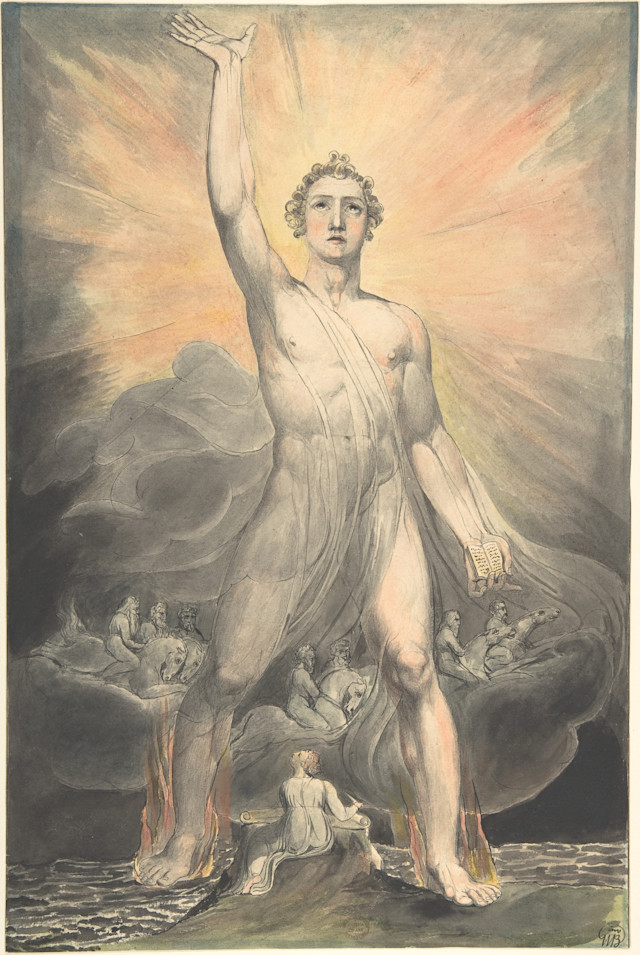
In this watercolor by William Blake, St. John writes beneath the Angel of the Revelation.
The best evidence for this early Christian belief is in the last book of the Bible: the Revelation of John, also called John’s Apocalypse. No other book in the Bible makes more references to the Prophecy of Ezekiel. As a result, some of the imagery in the Revelation can seem random or bizarre: for example, the references to Gog and Magog in Revelation 20:8 are references to Ezekiel 38-39.
What does this relation tell us? It tells us that St. John understood the ultimate prophetic significance of Ezekiel as a vision of both the near future (from Ezekiel’s perspective, writing at the time of the Babylonian captivity) and the ultimate future (which St. John saw in his vision of the end of the world and the return of Christ).
The double prophecy is tied to the ancient Christian idea that things can be both present and also coming. The technical term for this idea is “proleptic,” which means “already” and also “not yet.” The New Testament often uses this language to describe the Kingdom of Heaven: Christ has come and has saved us, but he is also coming back to bring the kingdom of heaven to its fullness.
What is the Jehovah Shammah prayer?
There isn’t any particular prayer that’s called the “Jehovah Shammah” prayer. That doesn’t mean that contemporary people haven’t made up their own songs or prayers that feature this phrase, but there isn’t any traditional or Biblical prayer in the same way that, for example, the psalm “The Lord is my shepherd” has been set to music many times over the last several millennia.
Subscribe
Life-giving writing by Christian scholars sent to your inbox once per month

Zachary Porcu has a PhD in church history from the Catholic University of America in Washington DC, with additional degrees in philosophy, humanities, and Classics (Greek and Latin). He is an Eastern Orthodox Christian.
Keep reading
Benaiah, soldier of David and Solomon: What did he do?


What is a sardius stone in the Bible? Carnelian symbolism
Emperor, Liberator: Who was Cyrus in the Bible?
Hineni in Hebrew: “Here I am” from God and Man
Who was Jotham, king of Judah?