Plant of Fertility and Magic: Are mandrakes in the Bible?
The short answer:
The mandrake is mentioned in only a few places in the Bible and tends to refer to fertility or sexuality in general.
The mandrake is mentioned in two places in the Bible: in an episode between Rachel and Leah concerning fertility, and in the Song of Solomon.
The Song of Solomon, also known as the Song of Songs or the Canticle of Canticles, is an extended love poem that has little to do with the other topics we’d expect from the Old Testament. Christians have traditionally interpreted this poem as an allegory between Christ (the lover) and the church (the beloved).
The Song of Solomon mentions mandrakes in chapter 7, verse 13: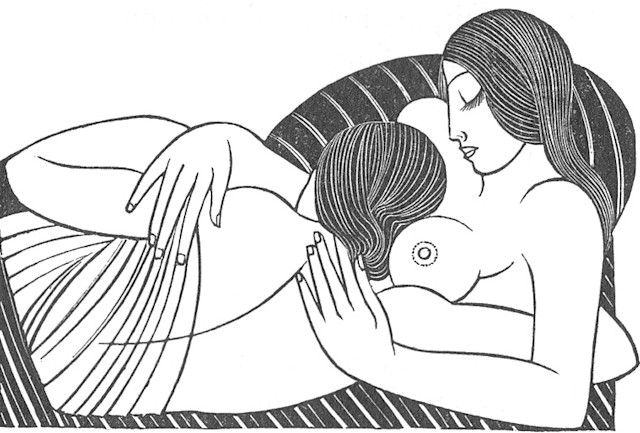
Eric Gill - engraved illustration for The Song of Songs - 1925
The mandrakes give off a fragrance,
And at our gates are pleasant fruits,
All manner, new and old,
Which I have laid up for you, my beloved.
While there may be some ancient Christian commentary by the church fathers that remarks on the mandrake as a symbol, I’m not personally aware of it. At a surface level, the mandrake is probably in this passage because it was considered a fertility food in the ancient world.
Why did Rachel want the mandrakes?
The other passage in the Bible that mentions mandrakes is in Genesis. It is part of the dispute between Rachel and Leah, two sisters who married the same man.
“Now Reuben went in the days of wheat harvest and found mandrakes in the field, and brought them to his mother Leah. Then Rachel said to Leah, ‘Please give me some of your son’s mandrakes.’
But she said to her, ‘Is it a small matter that you have taken away my husband? Would you take away my son’s mandrakes also?’
And Rachel said, ‘Therefore he will lie with you tonight for your son’s mandrakes.’
When Jacob came out of the field in the evening, Leah went out to meet him and said, ‘You must come in to me, for I have surely hired you with my son’s mandrakes.’ And he lay with her that night.” (Genesis 30:14-16)
Why was Rachel so keen on acquiring mandrakes? Again, it’s because of the fertility-related powers that were attributed to the mandrake in the ancient world. The context for this episode is that Rachel was barren and trying to conceive, while her sister Leah had already had several children by Jacob, the husband that the two sisters shared. The rivalry between the two sisters was the source of much drama for Jacob’s household, though it eventually led to the Twelve Tribes of Israel.
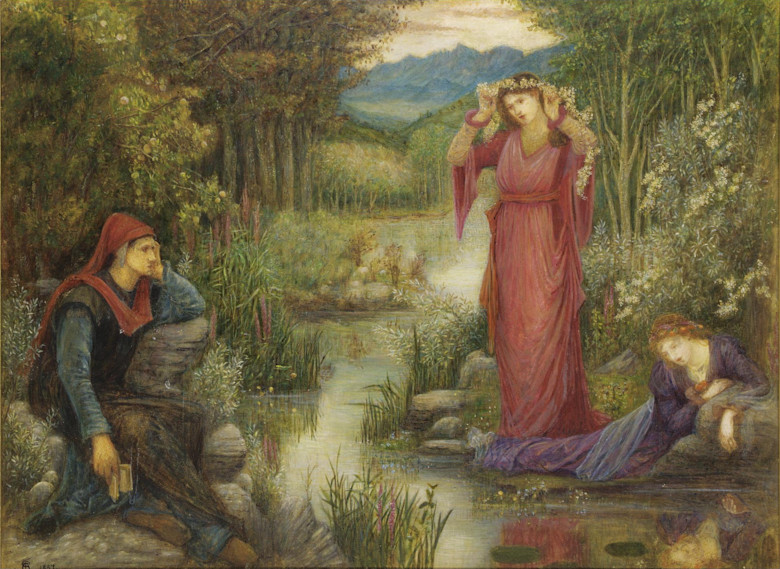
Marie Spartali Stillman - Dante's Vision of Leah and Rachel - 1887
What does a mandrake symbolize?
Mandrakes have been attributed various powers throughout history, including the power of fertility, as we see in these Old Testament passages. The mandrake has hallucinogenic properties and has historically been used in magical rituals across many cultures. People have associated mandrakes with good luck or wealth and success, and there are reports of people sleeping with them under their pillows or wearing them around their necks, at least according to the National Library of Medicine.
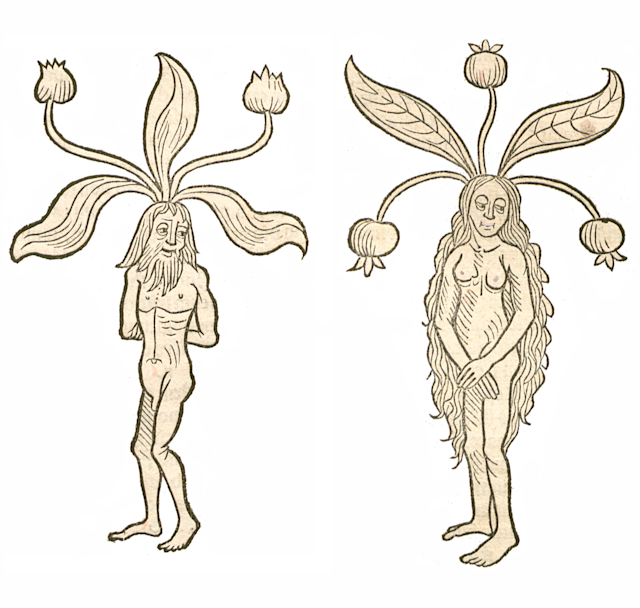
One curious tidbit is that the mandrake is shaped somewhat like a small human being, giving it a bit of an eerie look. This resemblance was captured in many Medieval and early modern illustrations of the plan.
Legends eventually emerged about a demon inhabiting the mandrake that would kill anyone who uprooted it. This tale came to be called the curse of the mandrake, which sometimes included a shriek that the mandrake would purportedly emit when it was uprooted—an idea that was re-imagined in the Harry Potter movies. There are many Medieval and early modern instructions about how to safely harvest a mandrake without dying, including this one from Jean-Baptiste Pitois' The History and Practice of Magic:
“Would you like to make a Mandragora, as powerful as the homunculus (little man in a bottle) so praised by Paracelsus? Then find a root of the plant called bryony. Take it out of the ground on a Monday (the day of the moon), a little time after the vernal equinox. Cut off the ends of the root and bury it at night in some country churchyard in a dead man's grave. For 30 days, water it with cow's milk in which three bats have been drowned. When the 31st day arrives, take out the root in the middle of the night and dry it in an oven heated with branches of verbena; then wrap it up in a piece of a dead man's winding-sheet and carry it with you everywhere.”Anonymous - illustration of a mandrake - 1491
What is a mandrake used for today?
The exact plant identified in the Bible as a “mandrake” is disputed by scholars, so identifying the plant in any particular ancient document is a dubious affair. But the modern day plant genus that we identify as Mandragora, which includes a variety of different species, is known to have leaves that are hallucinogenic, can cause asphyxiation and poisoning, blurred vision, dizziness, vomiting, elevated heart rate, and hyperactivity—at least, according to Wikipedia. Medieval alchemy books often mention far more bizarre effects.
Subscribe
Life-giving writing by Christian scholars sent to your inbox once per month

Zachary Porcu has a PhD in church history from the Catholic University of America in Washington DC, with additional degrees in philosophy, humanities, and Classics (Greek and Latin). He is an Eastern Orthodox Christian.
Keep reading
Hineni in Hebrew: “Here I am” from God and Man

Who was Jotham, king of Judah?
What are the prophetic books of the Bible?
Who is Esaias in the Bible? Answered by a Christian Scholar

Peor: The Mountain and God of the Moabites