Is manifesting a sin? The Bible on the law of attraction
The short answer
Yes, manifesting is a sin if you selfishly use it as a magical way to get what you want out of the universe. But the idea that our thoughts shape our lives is an ancient and true fact.
“Manifesting” is a popular practice in which one tries to create changes in one's life by directing one's thoughts. The practice has a variety of forms. It might look like saying an affirming sentence out loud to yourself every day, such as, “I will be a millionaire in five years.” Or it might involve taking time to engage in a kind of meditation where you picture the thing you want. However it’s practiced, the idea is the same: your life will come to resemble what you focus your thoughts on.
This idea is by no means new, but the renewed popularity of this kind of thinking makes a lot of sense in today’s world. In the midst of the epidemic of anxiety, depression, and increasing social and economic pressures, many people are looking for a way to bring some sort of orientation to their lives. We have a sense that buying more things and spending more time doomscrolling on the internet doesn’t do anything to solve the most important issues in our lives, so it makes sense that a practice of properly orienting your thoughts and feelings would see a resurgence in popularity.
But because the practice of manifesting has a pseudo-spiritual vibe, many people have begun to wonder about its spiritual implications. Is it actually spiritual? Do you have to be spiritual to believe in it? What about if you’re already spiritual? How compatible is it with a religion like Christianity?
The law of attraction
Let’s start with the basic idea behind manifesting, which is that your thoughts influence the things that happen to you. This idea has, as far as I can tell, existed for the entirety of human history in one form or another, across many cultures and time periods. The modern practice of manifesting, as seen in Rhonda Byrne's popular self-help book, The Secret, is just another form of this ancient idea.
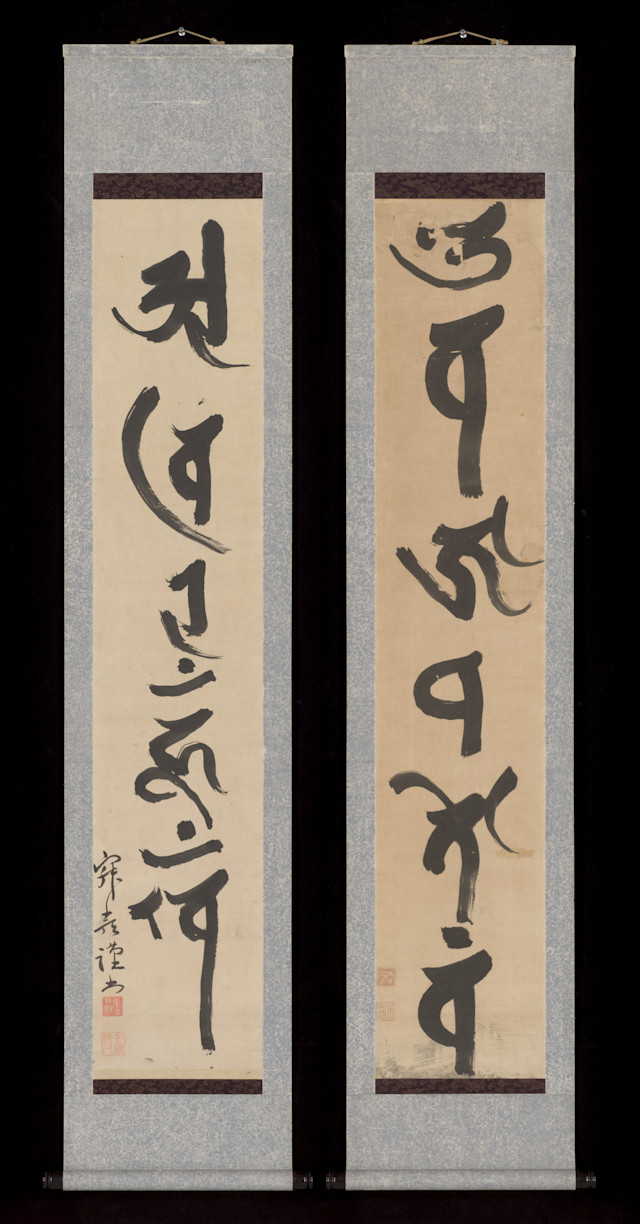
Two Buddist mantras written in Sanskrit, designed to bring practitioners to a specific spiritual state.
But this idea isn’t unique to magic systems. It shows up in practical psychology and even physics. Modern thinkers who have explored the topic have found that what you focus your thoughts on is, in a literal sense, the only thing you see. The famous invisible gorilla experiment in psychology asked subjects to watch a video in which students passed a basketball between each other, and they were told to count the number of times the ball was passed to certain players. The subjects were so focused on this goal that they completely failed to notice a man dressed in a gorilla costume walking into the scene, waving at the audience, and walking off! Similar experiments have been performed to test people’s memories, especially in trying to establish the credibility of eyewitnesses, and the evidence that we only see what we’re looking for has been quite clear!
What is manifestation?
What does the invisible gorilla experiment have to do with manifesting? If you orient your thoughts towards something, you will start start seeing it everywhere; and, vice versa, if you aren’t orienting your thoughts towards something, you’re not going to see it, even if it’s right in front of you. A practice of orienting your thoughts towards the thing you want will, therefore, increase your chance of seeing it when it comes into your life!
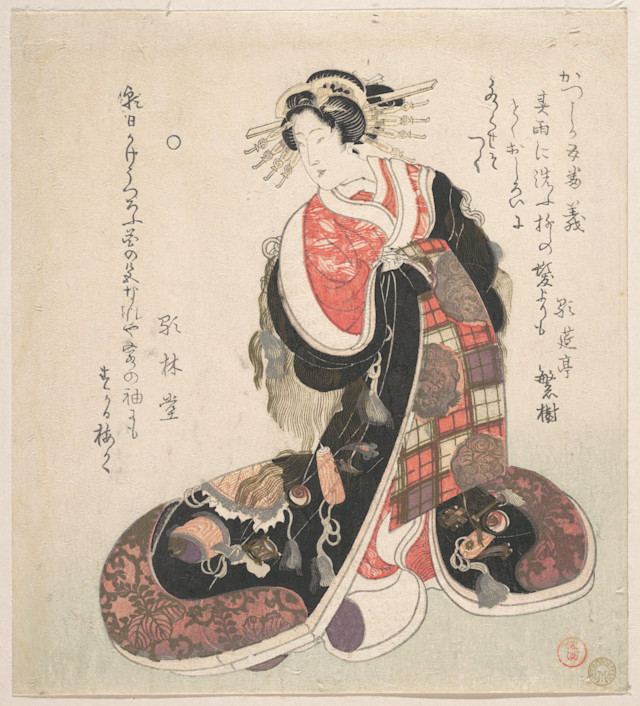
An image of a courtesan in a gown embroidered with emblems of good luck, possibly by Kubo Shunman, circa 1800.
One of the best examples of a non-magical way of thinking about this concept is the famous book by Napoleon Hill, Think and Grow Rich. The main idea behind the book is that changing one's thought-patterns is central to success. Or, to put it another way, if you can’t imagine yourself being successful, then you cannot be successful. If you have a self-defeating mindset, you’re not going to perform well, you will give up when you should keep fighting, and so on. Though he didn’t use this language, much of what Napoleon Hill describes in his book could be called “manifesting” by modern standards.
Is manifesting sinful or unchristian?
Given all these examples throughout history of the principle behind manifesting, there are a few things we can say about its spiritual content. At a very basic level, it seems undeniable that our thoughts can affect what we see and how we behave, and therefore what happens to us. It’s so universal an experience that you can see it in practices as divergent as Wiccan spellbooks and financial advice books.
But it’s also something we see, very explicitly, in Christianity. Since the days of the early church, Christians have believed that your spiritual life consists of how you orient your thoughts and feelings. Throughout history, Christians have practiced certain types of meditative prayer to bring about exactly this sort of spiritual orientation. This tradition is especially strong in Catholic mysticism and Eastern Orthodoxy. One of the best modern witnesses to this tradition is the writings of a Christian monk named Elder Thaddeus, whose collected sayings were published in a recent book called Our Thoughts Determine Our Lives. On this topic, Elder Thaddeus writes,
“Everything, both good and evil, comes from our thoughts. Our thoughts become reality. Even today we can see that all of creation, everything that exists on the earth and in the cosmos, is nothing but Divine thought made material in time and space. We humans were created in the image of God. Mankind was given a great gift, but we hardly understand that. God’s energy and life is in us, but we do not realize it. Neither do we understand that we greatly influence others with our thoughts. We can be very good or very evil, depending on the kind of thoughts and desires we breed” (Our Thoughts Determine Our Lives: the Life and Teachings of Elder Thaddeus of Vitovnica, trans. Ana Smiljanic, Saint Herman of Alaska Brotherhood, 2015).
The idea that our thoughts determine our lives is a Christian idea. It has a much older tradition than the modern trend of manifesting.
What do we make of this trend, therefore? Like everything, there are dangers depending on how you implement the idea. Our thoughts do determine our lives, that’s simply true. But how you choose to engage with that truth could be better or worse.
For example, if you think of manifesting as a specific, almost a magical practice of getting what you want out of the universe, you may fall into the spiritual danger of thinking that things exist for the sake of your satisfaction. You might think that the goal of your life is to make yourself happy by forcing the world to conform to your standards, and end up becoming a self-centered, self-absorbed person with a sinful, greedy lifestyle.
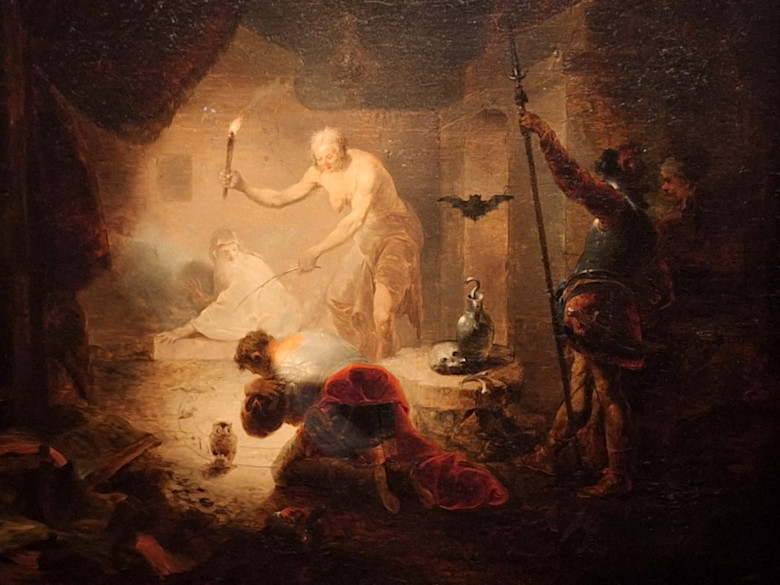
Januarius Zick - Saul at the Witch of Endor - 1753
Similarly, there’s a danger that becoming overly interested in the spiritual mechanisms behind manifesting can lead to involvement in dangerous religious practices. Wicca, astrology, and modern magical practices are adjacent to the idea of manifesting. The idea that you can focus your thoughts through specific ritual actions into changing how reality works is the definition of magic for many of these groups, and getting involved with them is more than a practice of “having the right thoughts”—it may involve the cooperation of various spiritual entities or neo-pagan deities.
While I accept that our thoughts determine our lives (and learned a lot from Elder Thaddeus’ book), I personally avoid using the term “manifesting” to describe any of the meditative prayer or spiritual practices I do. The main reason is that manifesting is an application of the principle that our thoughts determine our lives, but it isn’t the only one. The subculture that surrounds manifesting is generally not religious in a traditional sense, and often champions practices like manifestation as an alternative to traditional religious worship. They may even connect it to other modern spiritual or pseudo-religions practices, like Wicca.
But as an Eastern Orthodox Christian, I’m part of a very old tradition that has implemented this principle in its own way, as part of the spiritual tradition of the ancient church. I don’t want to be associated with a quasi-spiritual modern movement that may have dubious implications. I don’t need a modern term like “manifesting” to accept the very real, very Christian idea that our thoughts determine our lives.
Subscribe
Life-giving writing by Christian scholars sent to your inbox once per month

Zachary Porcu has a PhD in church history from the Catholic University of America in Washington DC, with additional degrees in philosophy, humanities, and Classics (Greek and Latin). He is an Eastern Orthodox Christian.
Keep reading
How Hot is Hell? Biblical Ideas vs. Pop Culture Depictions

The Problem with Sexual Sin

The Baptism of Poland: Unification and Christianization
What is a Pastor Emeritus? Should they exist?
What are the best Bible verses about love and trust?