
What are the best Bible verses about love and trust?
The short answer:
There are many beautiful passages about love, trust, and loving relationships in the Bible. However, the Bible doesn’t have any “relationship advice” because there was no such thing as dating in the ancient world. Instead, the Bible speaks to marriage in the context of the unique Christian vision of love.
There are many passages in the Bible that address love—some of which are quite powerful. Two of the most famous are from 1 John and 1 Corinthians:
1 John 4:7-8:
“Beloved, let us love one another, for love is of God; and everyone who loves is born of God and knows God. He who does not love does not know God, for God is love.”
1 Corinthians 13:1-13
“Though I speak with the tongues of men and of angels, but have not love, I have become sounding brass or a clanging cymbal. And though I have the gift of prophecy, and understand all mysteries and all knowledge, and though I have all faith, so that I could remove mountains, but have not love, I am nothing. And though I bestow all my goods to feed the poor, and though I give my body to be burned, but have not love, it profits me nothing.
Love suffers long and is kind; love does not envy; love does not parade itself, is not puffed up; does not behave rudely, does not seek its own, is not provoked, thinks no evil; does not rejoice in iniquity, but rejoices in the truth; bears all things, believes all things, hopes all things, endures all things.Augustin Pajou - Fidelity, the Mother of Constant Love - 1799
Love never fails. But whether there are prophecies, they will fail; whether there are tongues, they will cease; whether there is knowledge, it will vanish away. For we know in part and we prophesy in part. But when that which is perfect has come, then that which is in part will be done away.
When I was a child, I spoke as a child, I understood as a child, I thought as a child; but when I became a man, I put away childish things. For now we see in a mirror, dimly, but then face to face. Now I know in part, but then I shall know just as I also am known.
And now abide faith, hope, love, these three; but the greatest of these is love.”

While parts of this Corinthians passage are frequently quoted, it’s important to consider the overall context of what St. Paul is talking about, which is our relationship to God (He who is Love itself) and how God’s love spills over into our other relationships.
What does the Bible say about love and trust?
There are also many passages about love that focus on trusting God. Many are from the Psalms, but there are plenty from the New Testament as well, including Psalm 56:3-4:
“Whenever I am afraid,
I will trust in You.
In God (I will praise His word),
In God I have put my trust;
I will not fear.
What can flesh do to me?”
Psalm 13:5:
“But I have trusted in Your steadfast love; my heart shall rejoice in Your salvation.”
Matthew 17:20:
“So Jesus said to them, “Because of your unbelief; for assuredly, I say to you, if you have faith as a mustard seed, you will say to this mountain, ‘Move from here to there,’ and it will move; and nothing will be impossible for you.”
These are some of the famous verses, but there are many others that deal with themes surrounding God’s love for mankind and our need to trust in God.

Benjamin West - Omnia Vincit Amor, or The Power of Love in Three Elements - 1809
What are good bible verses for relationships?
There are likewise many passages that address how to love each other, but it’s worth noting that these passages are generally about relationships in the context of Christian communities, including 1 Corinthians 16:14:
“Do everything in love.”
1 Peter 4:8:
“Above all, love each other deeply, because love covers over a multitude of sins.”
Ephesians 4:2-3:
“Be completely humble and gentle; be patient, bearing with one another in love. Make every effort to keep the unity of the Spirit through the bond of peace.”
Proverbs 15:1:
“A soft answer turns away wrath, but a harsh word stirs up anger.”

Samuel Alken - Courtship in Low Life - 1785
The only thing approximating real “relationship advice” in the Bible is the passage in Ephesians where St. Paul explains the duties that a husband and a wife owe to each other:
“Wives, submit to your own husbands, as to the Lord. For the husband is head of the wife, as also Christ is head of the church; and He is the Savior of the body. Therefore, just as the church is subject to Christ, so let the wives be to their own husbands in everything.
Husbands, love your wives, just as Christ also loved the church and gave Himself for her, that He might sanctify and cleanse her with the washing of water by the word, that He might present her to Himself a glorious church, not having spot or wrinkle or any such thing, but that she should be holy and without blemish. So husbands ought to love their own wives as their own bodies; he who loves his wife loves himself. For no one ever hated his own flesh, but nourishes and cherishes it, just as the Lord does the church. For we are members of His body, of His flesh and of His bones. ‘For this reason a man shall leave his father and mother and be joined to his wife, and the two shall become one flesh.’ This is a great mystery, but I speak concerning Christ and the church. Nevertheless let each one of you in particular so love his own wife as himself, and let the wife see that she respects her husband.” (Ephesians 5:22-33)
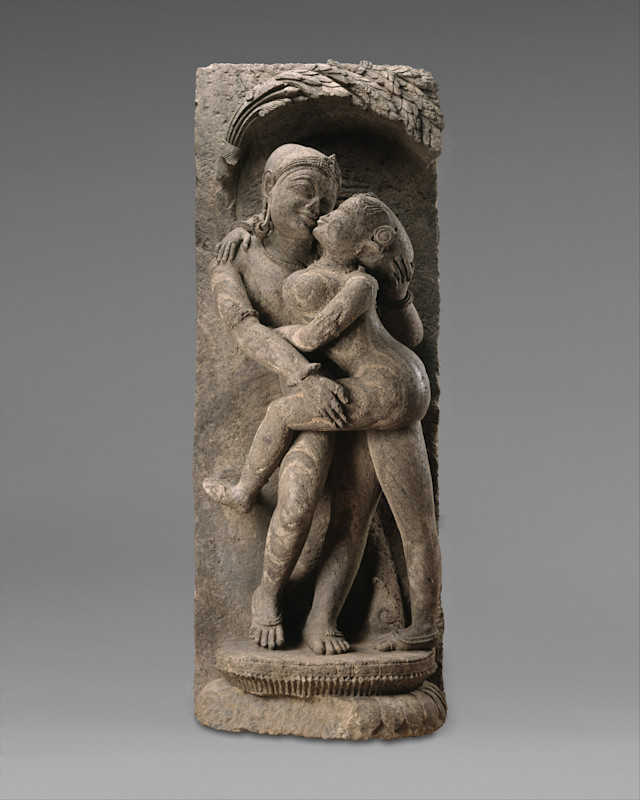
Loving Couple (Mithuna) from a Hindu Temple, 1200s.
Love is Not a Feeling
For traditional Christianity, love is not a feeling. Affection and desire are feelings, but that’s not what the early Christians meant when they said radical things like “God is love” (1 John 4:8). God is love because God is a Trinity—three persons in one God.
If you have ever wondered about the relationship between the belief that “God is Love” and the Trinity: God is in his very nature a community of persons who are completely united in perfect love.
What is love, if it’s not a feeling of affection or desire? Good relationships certainly include those things, but what the early Christians meant by love is a description of our nature: we can be both distinct persons and totally united; we are both one and many simultaneously. This idea is ultimately true in the Trinity, but, in a more faint way, it is true of our relationships with one another in marriage and families.
If you’re interested in one of the easiest, most accessible explanations of what the Trinity is (and why it matters that God is love), I recommend Journey to Reality: Sacramental Life in a Secular Age, in which the first section of the book is dedicated to this topic. But in the meantime, it’s important to be careful about how we try to get the Bible to “perform” for us: you can’t go to the Bible “for relationship advice” in your dating life in the same, direct way that you’d go to it to learn the history of the ancient Israelites, because the Bible is not a dating guide. But you can go to the Bible to learn something much bigger than that, which is the true nature of ultimate love as revealed in the New Testament’s picture of God, and especially how marriage is a central part of that reality.
Subscribe
Life-giving writing by Christian scholars sent to your inbox once per month

Zachary Porcu has a PhD in church history from the Catholic University of America in Washington DC, with additional degrees in philosophy, humanities, and Classics (Greek and Latin). He is an Eastern Orthodox Christian.
Keep reading

What are the best Bible verses for men?


How Hot is Hell? Biblical Ideas vs. Pop Culture Depictions

The Problem with Sexual Sin

The Baptism of Poland: Unification and Christianization

What is a Pastor Emeritus? Should they exist?