How Hot is Hell? Biblical Ideas vs. Pop Culture Depictions
The short answer
A vision of Hell as a physical place of fire and brimstone is too literal, but it's also wrong to assume that Hell is just a metaphor or isn’t real. In thinking about the reality of Hell, you must avoid two incorrect ideas: first, becoming lazy and assuming Hell isn’t a threat; and second, becoming so worried about Hell that you lose your peace and start living in Hell now.
Modern discourse about Hell is often confused, and Christians from the early Church period probably wouldn’t recognize many modern ideas about it. Across the centuries, pop culture from Dante’s to TV shows like Futurama or the Good Place has given modern people the idea that Hell is a physical location underground with literal sulfur and brimstone, where people are set on fire and magically kept alive while they burn.
If you want to know the temperature of Hell according to the pop culture image of it, the answer could range from the temperature of the Earth’s core (9,000-11,000 degrees Fahrenheit, assuming Hell is literally underground) to the boiling point of sulfur (832.3 degrees Fahrenheit). However, in Dante’s Inferno, the deepest ring of Hell is actually freezing cold, so the question of Hell’s temperature is sort of impossible to answer without asking, “according to whom?”
Does the Bible say that Hell is hot?
When the Bible describes Hell, it’s not as straightforward as “the place you go when you die if you were bad.” The topic of death, sin, salvation, heaven, Hell, and the second coming of Christ would require a much longer article (or, realistically, many different articles), but I can offer a few basic parts of the traditional Christian understanding of Hell:
- Hell doesn’t exist yet. The Bible generally refers to “Hades,” “Sheol,” “the pit,” or other places where the dead go. Ancient people across all cultures understood that when you die you go to the place of the dead, which generally wasn’t pleasant (though it could be a place of rest or something like Elysium, depending on the mythology). But Christians distinguished between the place of the dead, where everyone goes, and the “lake of fire” (see Rev. 20:10, 20:14, and 21:8) into which the devil and those who follow him are cast at the end of the world when Christ returns. But the lake of fire is mentioned as a future reality, not something that’s happening now. Now, when people die, they go to Hades—the place of the dead. But all the dead are going to be raised when Christ returns, and only then will Hell—or heaven—come into existence.
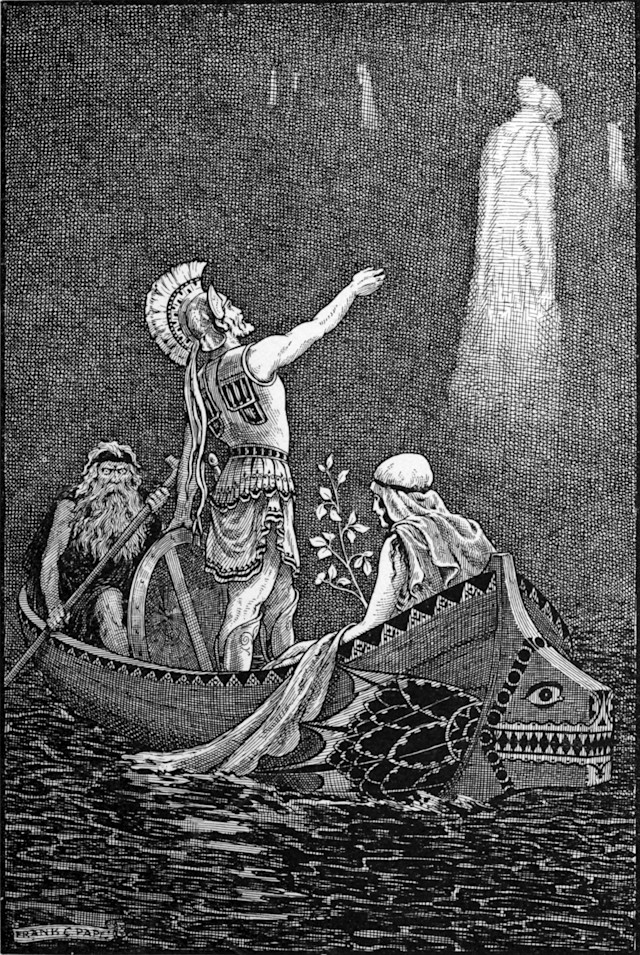
Frank Papé - Aeneas in Hades - 1913
There is a lot of imagery in the New Testament about the final destination of those who do not inherit the kingdom of heaven, but the Bible doesn’t clearly present it as the pop-culture idea of literally being on fire forever but never burning up. Jesus does speak about a place of “everlasting punishment” (Matthew 25:46), and there are certain places where he refers to this place with fiery imagery (Matthew 3:12 and 25:41), but this imagery isn’t the only way that Christ talks about the ultimate destination of the wicked: he also talks about it as (a) destruction, and (b) exile or banishment.
In Matthew 10:28, Jesus warns, “And do not fear those who kill the body but cannot kill the soul. But rather fear Him who is able to destroy both soul and body in Hell” (NKJV, my emphasis). In the parables of the Wedding Garment (Matthew 22:10-12) or the Foolish Virgins (Matthew 25:1), the main metaphor is being “cast out,” in other words, exclusion.
There are many elements to the Bible’s account of Hell, and while all of them are obviously undesirable, to over-fixate on a place of literal torture is a sign of taking your cues from the Medieval and Renaissance imagination.Some people have a hard time with the doctrine of Hell—and I must admit that I am often one of them. Here’s what I would say: if you get too fixated on the idea of torture (which is not explicitly in the New Testament), you’re going to forget the basic and most important things that we know about God. Instead of understanding God as Love and Beauty itself, as the God who is all-merciful and more fair than any human being, you may start to get the idea that God is a cruel and wicked tyrant who punishes people forever simply because they displease him. But this tyranny is not a traditional Christian understanding of God—it’s another pop-culture idea.
That said, the Church Fathers and others have written a huge amount on the topic of Hell, but reading too much on the subject may make you despair or suffer anxiety. Instead, I suggest you focus on a few key truths:
God is more than a creator who loves his creation—he is love itself (“He who does not love does not know God, for God is love”, 1 John 4:8, NKJV, my emphasis). And because of this incredible, unmatched love for man, he became one of us and voluntarily underwent suffering and death alongside us. While a lot of people think he did so to give us an example of goodness—which is true—the primary reason was so that he could conquer death and evil, and then invite us all to participate with him in that conquering. In other words, he’s not “somewhere else” looking down on us and making a “naughty or nice list” like some sort of omnipotent Santa Claus; he joined us in facing and experiencing death, suffering, and evil so that we can ultimately defeat it through him.
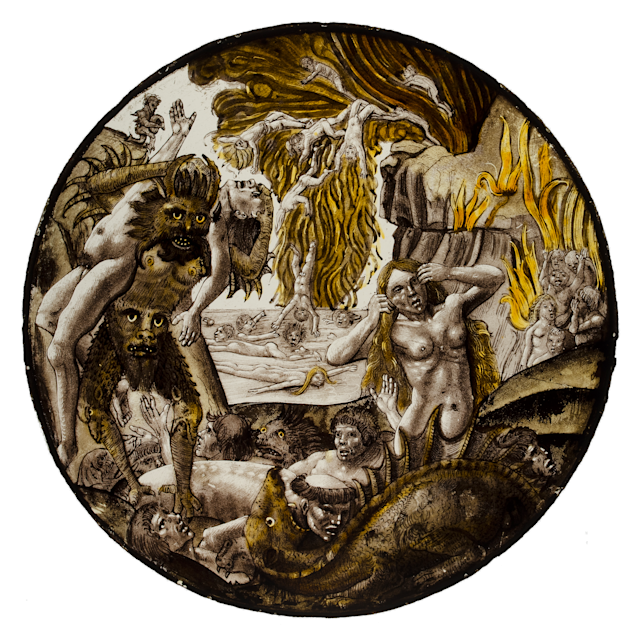
Unknown Artist - Roundel with Souls Tormented in Hell - 1510
Of course, the great spiritual teachers of the Church insist that Hell is real and that it’s terrible, to keep us from becoming slothful. As modern people, we tend to go one of two ways: anxious or lackadaisical. Anxiety about punishment and Hell can make us neurotic or cause us to give up on the idea of God altogether. A lackadaisical attitude, on the other hand, makes us think that it doesn’t matter what we do because God is merciful. Personally, when things are going right in my life, I have a little thought in the back of my mind that I don’t need to pray or seek God because “everything is fine”—at some level I feel like I don’t need God.
So yes, Hell is real, though I can’t say much about it in detail because it doesn’t exist yet. There is plenty to read in the Church Fathers, but it’s important to remember to balance two ideas if you’re going to investigate this subject:
First, not everyone—it seems—will enter the kingdom of heaven, and that person who is excluded can be you if you aren’t careful. This idea should be sobering. It should lead you to repentance.
Second, anxiety is from the devil, and any thought which takes away your peace is not from God. Meaning, if you think about Hell and start to become anxious, depressed, or hopeless—then something is wrong with how you’re thinking about it.
While it’s a difficult thing to do, you have to keep both of these points in mind equally: be sober and serious, but don’t lose hope or allow yourself to be imprisoned by anxiety.
Subscribe
Life-giving writing by Christian scholars sent to your inbox once per month

Zachary Porcu has a PhD in church history from the Catholic University of America in Washington DC, with additional degrees in philosophy, humanities, and Classics (Greek and Latin). He is an Eastern Orthodox Christian.
Keep reading

Do you go to Hell if you commit suicide?


Jesus went to Hell for 3 days as seen in Scripture


The Problem with Sexual Sin

The Baptism of Poland: Unification and Christianization

What is a Pastor Emeritus? Should they exist?