The Baptism of Poland: Unification and Christianization
The short story:
The “baptism of Poland” refers to the period in Polish history where Poland stopped being pagan, generally, and became Christian. While these kinds of cultural shifts aren’t black-and-white, and all transitions take time, a good marker for the occasion is the baptism of Mieszko I, the Duke of Poland. The baptism of Poland is also part of the unification of Poland as a nation, and both find their origin in the character of Mieszko.
Mieszko I was born around AD 930 and ruled from 960 until 992—over thirty years. He was baptized on Holy Saturday, April 14, 966, which serves as a good official date for the Christianization of Poland—at least the beginning of its Christianization. Keep in mind that religious beliefs were not considered matters of personal opinion until recently; instead, they were bold answers to ultimate questions about the nature of reality, morality, purpose, and human nature. A ruler’s religious beliefs were especially significant, because what he thought about issues like morality affected how he ruled his country. So it makes a lot of sense to date the beginning of Poland’s Christianization to the baptism of its ruler.
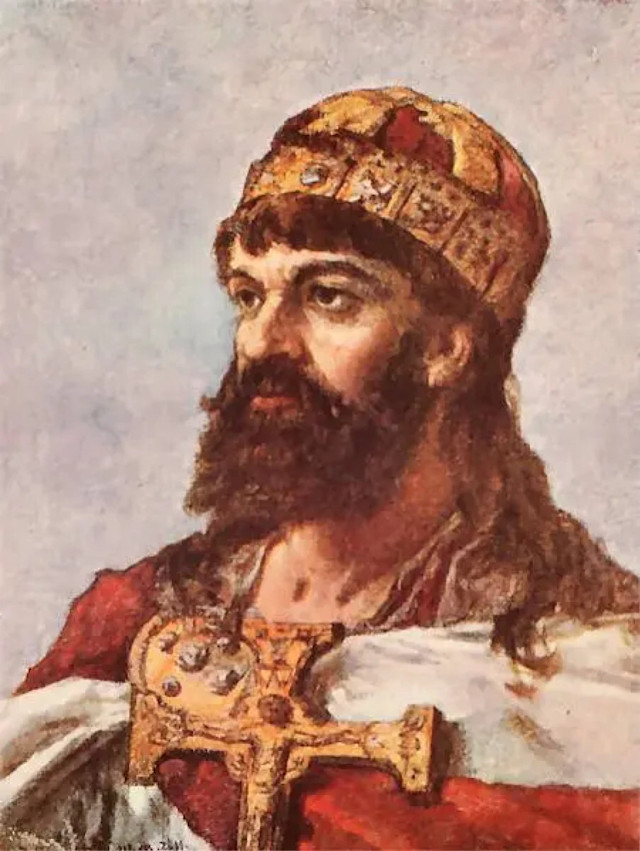
Jan Matejko - Mieszko I of Poland - 1700s
Prior to Christianization, Poland consisted of multiple, decentralized pagan tribes. Svetovit, the god of abundance and war, was a common object of worship among the pagan Polish. Some scholars regard him as a form of the god Perun, a central God in Slavic mythology—the most frequently mentioned god in historical records.
Why did Poland convert to Catholicism?
Scholars have speculated as to the reasons for the conversion. It’s easy to see the conversion as being helpful to Mieszko’s personal goals for unifying the Polish state around his court. Like many countries at the time, Poland not a modern nation state; it was an area inhabited by a variety of loosely associated tribes. This lack of unity was reflected in the existence of a variety of smaller pagan cults that exerted control over different local areas. As Mieszko wanted to unify Poland, a single, unified religion would have been vital in establishing a homogenous culture in Poland. Christianity offered cultural unification, one that could be tied to and therefore centralized in Mieszko’s throne.
It’s also speculated that the existing pagan priests were a powerful impediment to the unification of Poland, as they would have been reluctant to give up their local power. Christianity’s intolerance of pagan practices would have helped Mieszko weaken and eventually eliminate their power. In the same vein, a Catholic Poland had a stronger international connection to the greater culture of Western Europe, who were primarily Christian rather than pagan.
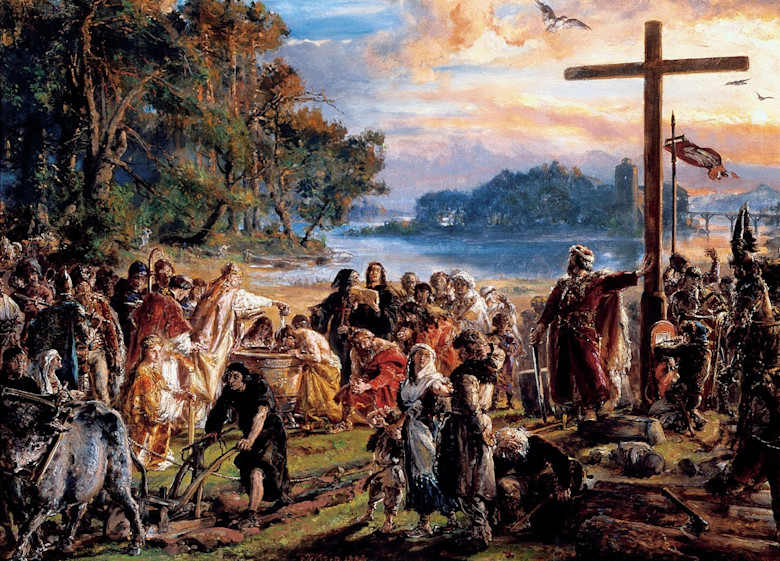
Jan Matejko - Adoption of Christianity, 965 AD - 1889
Mieszko’s father and grandfather had begun the process of unifying the disparate Polish tribes into a single Polish state, and you could argue that Mieszko more or less completed this process through the religious unification of Poland.
Still others attribute his conversion to his wife’s influence. Dobrawa Doubravka was a Bohemian princess who may have pressured or inspired her new husband to adopt Christianity, with one source (the twelve-century chronicler Gallus Anonymus) saying that she would agree to marry him only if he were baptized. Many modern scholars find this less plausible, believing that it was primarily the political advantages which made Christianity attractive to Mieszko, but this more cynical theory remains merely speculative.
Was it specifically Catholicism that Poland converted to? At the time, there wasn’t a denomination called “Catholicism” as there is today. The Christian churches of the East and West would separate formally in 1054 at the Great Schism, but there was still a precedent for a distinctly Western kind of Christianity that would have been the main influence on Poland. The priests who came to Poland were sent by Western European countries. It wasn’t until the high Middle Ages that native Polish clergy began to emerge, and these mostly came out of Catholic monasteries, which guaranteed that Poland had a Catholic character in the high Medieval Era and eventually became a decidedly Catholic country in the modern era.
Subscribe
Life-giving writing by Christian scholars sent to your inbox once per month
Zachary Porcu has a PhD in church history from the Catholic University of America in Washington DC, with additional degrees in philosophy, humanities, and Classics (Greek and Latin). He is an Eastern Orthodox Christian.
Keep reading
How Hot is Hell? Biblical Ideas vs. Pop Culture Depictions

The Problem with Sexual Sin
What is a Pastor Emeritus? Should they exist?
What are the best Bible verses about love and trust?
Are soul ties a Christian idea? A scholar responds