The Problem with Sexual Sin
The short story:
Sexual immorality covers a wide range of issues and is discussed all throughout the Bible. While the immorality of certain sexual acts matters, more important is the reasoning behind their immorality: misusing sexuality can actually hurt your soul.
Sexual immorality is one of the most significant categories of sin mentioned in the Bible, and there are numerous passages throughout the Old and New Testament that explicitly reference this category of sin. Some of the most famous passages include St. Paul’s letters to the Corinthians, his letter to the Hebrews, and the council of Jerusalem as depicted in the Book of Acts:
“Flee sexual immorality. Every sin that a man does is outside the body, but he who commits sexual immorality sins against his own body. Or do you not know that your body is the temple of the Holy Spirit who is in you, whom you have from God, and you are not your own? For you were bought at a price; therefore glorify God in your body and in your spirit, which are God’s.” (1 Cor 6:18-20, NKJV)Lambert Suavius - St. Paul - 1500s
“...because of sexual immorality, let each man have his own wife, and let each woman have her own husband. Let the husband render to his wife the affection due her, and likewise also the wife to her husband. The wife does not have authority over her own body, but the husband does. And likewise the husband does not have authority over his own body, but the wife does.” (1 Cor 7:2-4, NKJV)
“Let marriage be held in honor among all, and let the marriage bed be undefiled, for God will judge the sexually immoral and adulterous.” (Hebrews 13:4, ESV)

The passage that may offer the best indication of the significance of sexual immorality is in the Book of Acts. Some context for this passage will be helpful: at the time, there were many pagans who wanted to become Christians, but they were unfamiliar with the Law of Moses. The Apostles and the first followers of Jesus were all Israelites, which meant that they followed the religious law handed down by Moses, as recorded in the Old Testament. This law included things like circumcision, the prohibition of certain foods, and the whole sacrificial system of Temple worship. The question, therefore, was simple: “To what extent must pagan converts to Christianity abide by the Israelite code of conduct?” The Apostles met to discuss the matter and, after hearing everything out, the Apostle James—who was the bishop of Jerusalem at this time and presided over the council—concluded the following:
“Therefore my judgment is that we should not trouble those of the Gentiles who turn to God, but should write to them to abstain from the things polluted by idols, and from sexual immorality, and from what has been strangled, and from blood.” (Acts 15:19-20, NKJV)
Why does this matter? It strikes me as extremely significant that, of all the vast multitude of laws, requirements, prohibitions, and stipulations in the Old Testament Laws of Moses, the Apostles decided that only four things were absolutely necessary, and one of them is avoiding sexual immorality. This restriction remained essential even when previous mandatory practices like circumcision or sacrifices in the Temple did not—which is incredible, given that both of those practices had been central to the religion of ancient Israel for all of its history.
What is considered a sexual sin?

James McNeill Whistler - Venus - 1859
The question, of course, is “why?” Why does God put restrictions on how we enjoy ourselves? It’s quite common to see Christianity stereotyped as a religion that is against pleasure or fun, and to see God as a prudish judge who’s really fixated on everyone behaving in a very specific way. Many modern people, if they can’t accept the traditional Christian teaching on sexuality, either stop being Christian or functionally make up their own version of Christianity where they try to downplay or outright ignore the very clear sexual ethics of the Bible. Some people say that prohibitions against homosexuality are only in the Old Testament (which isn’t true; St. Paul specifically addresses homosexuality), or that God is loving (which is true) so he’ll forgive cohabitation (which is only true if they seek forgiveness), or that masturbation isn’t technically in the Bible (which is actually irrelevant), and so on.
What’s more important than telling people that what they are doing is considered wrong under a Christian understanding of sexuality is explaining why these things are inconsistent with a Christian view of morality—specifically, the human person—as a whole. It’s a wonder to me that some Christians simply use Bible verses to explain that God is against certain sexual practices, offering only surface-level explanations of why: it’s “contrary to God’s design” or “it makes you too impure to be in God’s presence” or it’s because you’re “insisting on your own will rather than submitting to God’s will”—all of which may be technically true, but don’t explain anything or answer the question.
So what’s the issue? There’s a lot to say about sexual sin, and we have other articles on Holy Ground that get into these topics more specifically, but here’s one general way to think about these issues: modern people think that sex is primarily a recreational activity like eating ice cream or watching television, but the early Church (and traditional Christianity today) understood it as something closer to an enchanted act—meaning that it that had a real spiritual effect on your being, depending on how well you ordered it.
The modern, secular idea is that our bodies don’t really matter. We tend to think that our emotions, thoughts, and feelings are the most important things, while the things we do with our bodies aren’t as spiritually important. But all ancient people understood that the human being was a body as well as a mind and a spirit, and that all of these things were deeply interconnected. Whatever you do with your body affects your soul, and vice versa. The Christian idea is that sex is not just a physical action, it’s a physical act that has spiritual consequences. Specifically, it unites two people into a physical and spiritual unity, a unity which has profound spiritual effects and which cannot be easily broken. Check out my article on a Christian understanding of marriage for more on this idea.
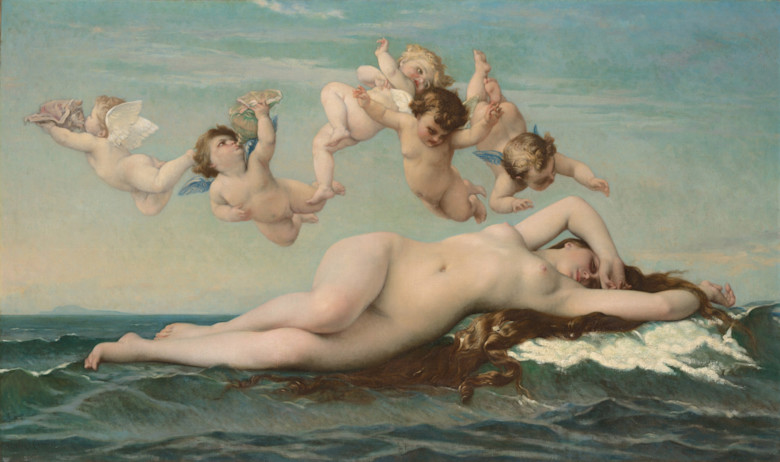
Alexandre Cabanel - The Birth of Venus - 1875
While sexuality—like all things—was created good, we as created beings can use our free will to corrupt sexuality. Some of the ways you can misuse sexuality is by using it to unite yourself with bad things (like pagan deities) or by using it merely for self-gratification. The former issue was more of a problem for ancient people, although some have argued that pornography is a kind of worship in that you’re directing intense emotional energy at a representation—exactly the way pagans used to worship idols. But modern people tend to struggle more with consumerism, treating everything as if it were meant purely for our own gratification. Why does the church have a problem with that view? Is it because the Church is against pleasure and enjoyment?
No, but the Church also warns us that there are dangers in pleasure. One danger is that we can very easily become enslaved to pleasure. When that happens, the pleasure is no longer good for you, it destroys you. Check out my articles on pornography and pleasure versus joy for more explanation.
The Church blesses and condones sexual union in marriage just as it blesses and condones eating good food. Because of the dangers of pleasure, however, it also recommends periods of fasting, both from food and sex—so we don’t become enslaved to pleasure. Check out my article on sexual fasting.
Unknown Artist - Preparation for a Feast - 1400s
There are other dimensions to this issue, but hopefully now you have some sense of why the condemnation of sexual immorality doesn’t mean that God is a controlling tyrant who wants to keep people from having fun. Sexual immorality is wrong because sexuality is a deeply spiritual activity with profound consequences on the state of our souls. Honestly, sexuality isn’t different from anything else in this way. Everything is good, but everything can be misused and turned to evil.
Does God forgive sexual sin?
Of course. God is willing to forgive anything, but it’s important to understand that this willingness isn’t the same thing as God being tolerant of anything. If you truly love someone, you’re willing to forgive that person for basically anything, but there’s an important prerequisite there: the person has to ask for forgiveness or at least want to be forgiven. Think about it: if someone does something to hurt you, and they say, “yeah, but so-and-so loves me,” how does that change the fact that they hurt you?
Or put it another way: let’s say I steal something of yours and lie to you about it, and you ask me to give it back. If I said, “you’re right, I’m sorry, I shouldn’t have done that,” and I give it back to you and ask your forgiveness, then we can have a relationship. But what if I said, “I know it’s wrong to steal and lie but I’m not going to give it back, and I’m going to keep stealing from and lying to you, but I’m going to assume you’re fine with it because you love me”? Could we really have a relationship?
The point I’m trying to make is that God will forgive anything, but only if we repent of it. A (good) coach or teacher isn’t upset with you for making bad plays, having bad habits, or having difficulty learning something. He’s upset if you refuse to admit that you need to improve and consequently never practice. We’ve all fallen short of the glory that we could have and the people we could be if we never sinned. That’s okay—provided we continue making the effort to move towards goodness and glory. If we sit around and say, “it’s fine, I’m good enough”—well, then we’re just living a lie.
But if we really make the effort, if we sincerely repent, then there’s nothing we can’t overcome with God’s help. Two famous examples of this are St. Mary of Egypt—who was what we would today call a sex addict—and St. Moses the Black—who was a murderous thief—both of whom repented and became incredible saints. You can read more about their lives, and the question of God’s forgiveness of sexual sins, in my article on cheating in relationships.

Marcantonio Franceshini - The Last Communion of Mary of Egypt - 1680
What causes sexual sin?
Because we have free will, we can use that free will to turn any created thing into something evil. Nothing is evil by nature, including sexuality—that’s not a Christian idea. All evil things are corruptions of good things, so the question is always: what is the right way to engage in this activity such that it makes me a better person, and what are the ways in which I can enslave and destroy myself by misusing this activity?
Our animal instincts to procreate are good. God even blesses Adam and Eve’s union, right after he creates them, and tells them to have sex. The issue comes when we take something good and corrupt it, using it as a means to the end of our own pleasure. We can do this with sex, but we can also do it with literally anything—from food to games to relationships. Ultimately, a life that’s focused only or primarily on satisfying yourself is inherently meaningless, because meaning is, by definition, something that’s higher than the self. Sexuality, rightly used, is supposed to take you out of yourself and unite you with another person. But only if you do it in the right way: otherwise, it just sucks you into yourself and makes you a self-centered consumer of pleasure.
Subscribe
Life-giving writing by Christian scholars sent to your inbox once per month

Zachary Porcu has a PhD in church history from the Catholic University of America in Washington DC, with additional degrees in philosophy, humanities, and Classics (Greek and Latin). He is an Eastern Orthodox Christian.
Keep reading

"A man shall leave his father and mother." What does it mean?

Bestiality and other deviant sexual practices in the Bible
The Bible on pornography: What does God say about porn?
How Hot is Hell? Biblical Ideas vs. Pop Culture Depictions

The Baptism of Poland: Unification and Christianization