“I Believe in God the Father”: Creeds and Controversies
The short story:
The Nicene Creed is the ultimate, universal statement of the Christian faith, though the Church went through a few versions of the Creed beforehand. The Apostles’ Creed is probably a slightly older version, and while it’s used in certain liturgical contexts, it isn’t considered as authoritative as the Nicene Creed.
If you’ve been around any older Christian traditions, such as Catholicism, or even some Lutheran or Methodist groups, you’ve probably heard them talk about “the Creed.”
The general idea behind a creed is that it’s an official statement about what a group believes. In the context of Christianity, the Creed outlines the fundamentals of the faith—the things you must believe and practice to be considered a Christian.
What can be confusing is that there are two major versions of the Creed that have been used over the centuries: the Apostles’ Creed and the Nicene Creed.
What is the Apostles’ Creed?
There are small variations in the exact phrasing of this creed, depending on the translator, and different denominations have favored different translations. The most current version of the Apostles’ creed in Catholicism, as of the time that I’m writing this, is as follows:
“I believe in God,
the Father almighty,
Creator of heaven and earth,
and in Jesus Christ, his only Son, our Lord,
who was conceived by the Holy Spirit,
born of the Virgin Mary,
suffered under Pontius Pilate,
was crucified, died and was buried;
he descended into hell;
on the third day he rose again from the dead;
he ascended into heaven,
and is seated at the right hand of God the Father almighty;
from there he will come to judge the living and the dead.
I believe in the Holy Spirit,
the holy catholic Church,
the communion of saints,
the forgiveness of sins,
the resurrection of the body,
and life everlasting.
Amen.”
This is a new English translation of the liturgical texts that are used in the Mass of Roman Catholicism. Protestant churches often use similar versions of the Apostle’s Creed, with some language and spelling differences depending on the denomination, such as saying “Holy Ghost” instead of “Holy Spirit.”
The Apostles’ Creed is a common version used in many Western churches, including many of the original Protestant denominations, including Lutherans, Methodists, Anglicans, and Presbyterians.
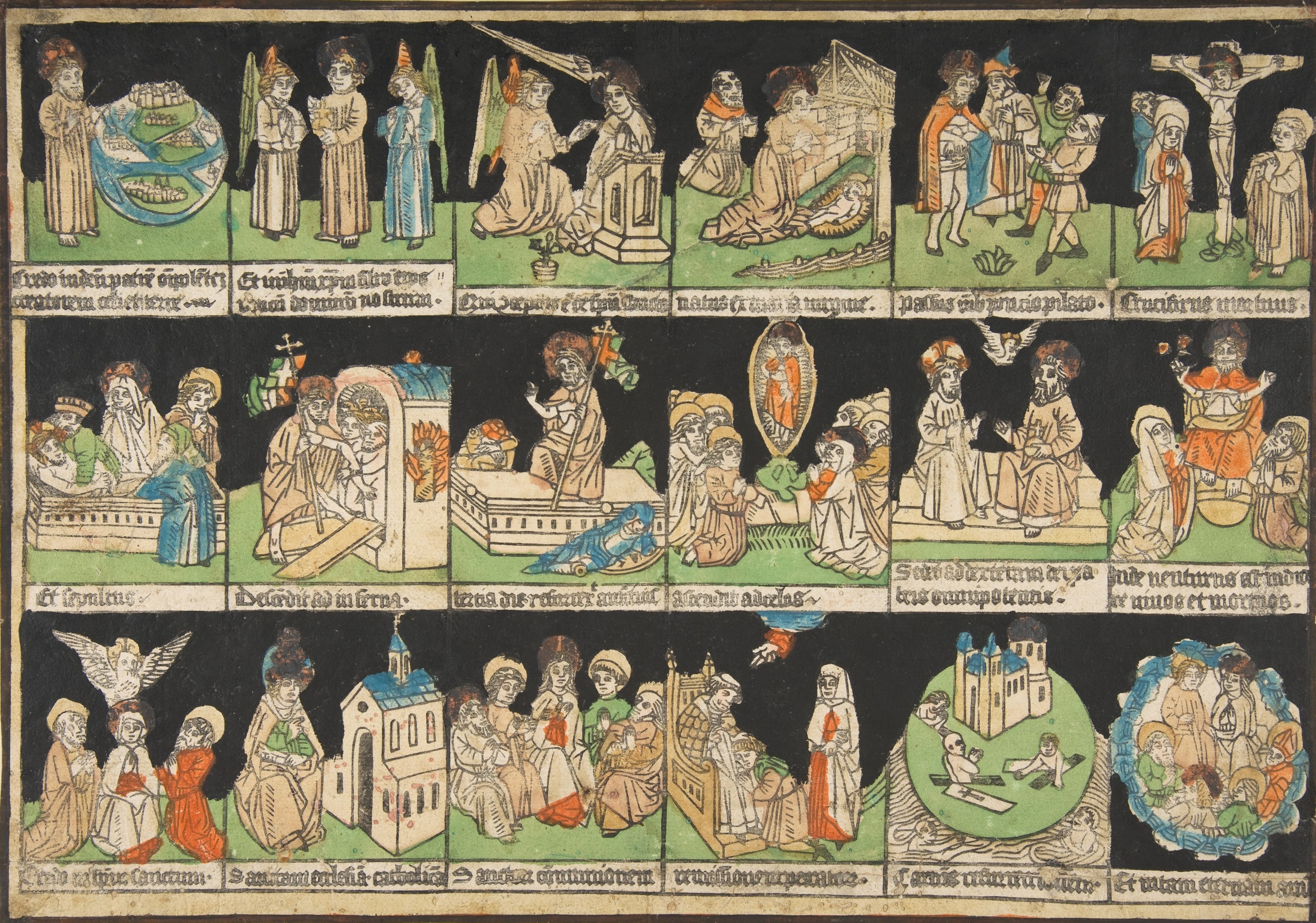
A German depiction of the Creed circa 1470.
What is the Nicene Creed?
The Nicene Creed, on the other hand, is longer and goes into a bit more detail about specific issues, especially more technical language about the nature of the members of the Trinity. Here is the full text of the Creed in English and Greek:
English Text | Greek Text |
|---|---|
I believe in one God, the Father Almighty, Maker of heaven and earth, and of all things visible and invisible. | Πιστεύομεν εἰς ἕνα Θεόν, Πατέρα, Παντοκράτορα, ποιητὴν οὐρανοῦ καὶ γῆς, ὁρατῶν τε πάντων καὶ ἀοράτων. |
And in one Lord Jesus Christ, the Son of God, the Only-begotten, Begotten of the Father before all ages, Light of Light, Very God of Very God, Begotten, not made; of one essence with the Father; by whom all things were made. | Καὶ εἰς ἕνα Κύριον Ἰησοῦν Χριστόν, τὸν Υἱὸν τοῦ Θεοῦ τὸν μονογενῆ, τὸν ἐκ τοῦ Πατρὸς γεννηθέντα πρὸ πάντων τῶν αἰώνων· φῶς ἐκ φωτός, Θεὸν ἀληθινὸν ἐκ Θεοῦ ἀληθινοῦ, γεννηθέντα οὐ ποιηθέντα, ὁμοούσιον τῷ Πατρί, δι οὗ τὰ πάντα ἐγένετο. |
Who for us men and for our salvation came down from heaven, and was incarnate of the Holy Spirit and the Virgin Mary, and was made man; | Τὸν δι ἡμᾶς τοὺς ἀνθρώπους καὶ διὰ τὴν ἡμετέραν σωτηρίαν κατελθόντα ἐκ τῶν οὐρανῶν καὶ σαρκωθέντα ἐκ Πνεύματος Ἁγίου καὶ Μαρίας τῆς Παρθένου καὶ ἐνανθρωπήσαντα. |
And was crucified also for us under Pontius Pilate, and suffered and was buried; | Σταυρωθέντα τε ὑπὲρ ἡμῶν ἐπὶ Ποντίου Πιλάτου, καὶ παθόντα καὶ ταφέντα. |
And on the third day He rose again, according to the Scriptures; | Καὶ ἀναστάντα τῇ τρίτῃ ἡμέρα κατὰ τὰς Γραφάς. |
And ascended into heaven, and sits at the right hand of the Father; | Καὶ ἀνελθόντα εἰς τοὺς οὐρανοὺς καὶ καθεζόμενον ἐκ δεξιῶν τοῦ Πατρός. |
And He shall come again with glory to judge the living and the dead, Whose kingdom shall have no end. | Καὶ πάλιν ἐρχόμενον μετὰ δόξης κρῖναι ζῶντας καὶ νεκρούς, οὗ τῆς βασιλείας οὐκ ἔσται τέλος. |
And I believe in the Holy Spirit, the Lord, and Giver of Life, Who proceeds from the Father, Who with the Father and the Son together is worshipped and glorified, Who spoke by the Prophets. | Καὶ εἰς τὸ Πνεῦμα τὸ Ἅγιον, τὸ κύριον, τὸ ζωοποιόν, τὸ ἐκ τοῦ Πατρὸς ἐκπορευόμενον, τὸ σὺν Πατρὶ καὶ Υἱῷ συμπροσκυνούμενον καὶ συνδοξαζόμενον, τὸ λαλῆσαν διὰ τῶν προφητῶν. |
And I believe in one, holy, catholic, and apostolic Church. | Εἰς μίαν, Ἁγίαν, Καθολικὴν καὶ Ἀποστολικὴν Ἐκκλησίαν. |
I acknowledge one Baptism for the remission of sins. | Ὁμολογῶ ἓν βάπτισμα εἰς ἄφεσιν ἁμαρτιῶν. |
I look for the Resurrection of the dead, | Προσδοκῶ ἀνάστασιν νεκρῶν. |
and the life of the age to come. | Καὶ ζωὴν τοῦ μέλλοντος αἰῶνος. |
Amen. | Ἀμήν. |
You’ll notice that the Nicene Creed resembles the Apostles’ Creed in the structure and order of the topics covered, but elaborates more on particular issues.
What is the original creed?
Why are there two Creeds? Are they at odds with one another? No. The answers is that, historically speaking, the Nicene Creed is the authoritative, full, ultimate, and universal definition for Christian belief and practice, while the Apostle’s Creed was (probably) an earlier, primitive version of a creed that got preserved in the West through liturgical use.
The reason that the Apostles’ Creed is generally accepted as being older is because it doesn’t directly address the divinity of Jesus or the Holy Spirit, which were understood in the first and second centuries but not rigorously defined through technical theological language yet—it wouldn’t be until the fourth century that theologians came together to produce the Nicene Creed.
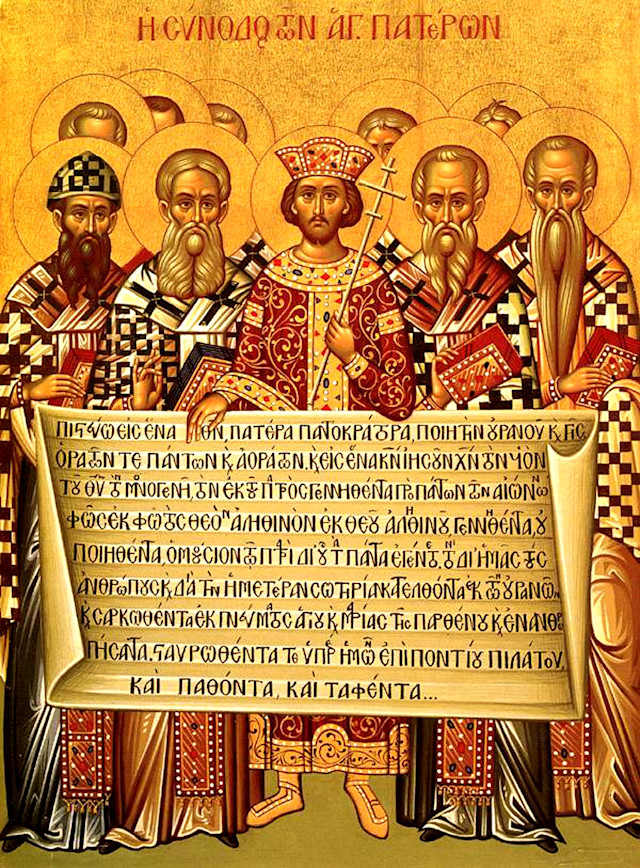
An icon of the Council of Nicea and the Nicene Creed.
As a result, Christianity was largely an underground, subversive religious movement (it was, after all, illegal) until the Roman emperor Constantine converted to Christianity and declared an end to the persecutions. When Constantine considered the state of Christianity at that point, he saw that there were a variety of divisions among Christians in their beliefs about important issues like the divinity of Jesus and the nature of the Trinity.
To solve this, he used his imperial authority to summon all the bishops of the Church to hold a council, where they worked out some basic definitions for Christianity. One of the things they produced was a statement of beliefs—a creed.
Interestingly, the original creed produced at what came to be called the First Council of Nicea was also somewhat primitive. Originally, it simply said,
“We believe in one God, the Father almighty, maker of all things, visible and invisible;
And in one Lord Jesus Christ, the Son of God, begotten from the Father, only-begotten, that is, from the essence of the Father, God from God, light from light, true God from true God, begotten not made, of one essence with the Father, through Whom all things came into being, things in heaven and things on earth, Who because of us men and because of our salvation came down and became incarnate, becoming man, suffered and rose again on the third day, ascended to the heavens, and will come again to judge the living and the dead;
And in the Holy Spirit.”
Unlike the Apostles’ Creed, this early version of the Nicene Creed was quite explicit about the nature of Christ, as the primary heretical movement at the time—called Arianism—held that Jesus was not fully God, but was instead created by (rather than begotten of) God the Father.
However, the original Nicene Creed did not go into much detail beyond that. It didn’t define the nature of the Holy Spirit or the Church.
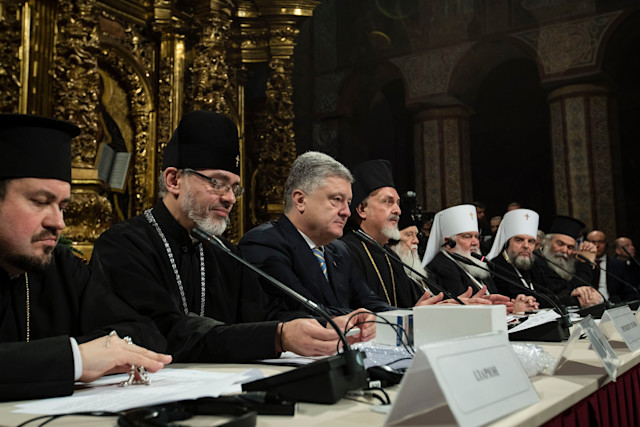
A modern Church council in 2018.
Since that time it became the official and ultimate definition for Christian faith—over and against various heretical movements that have sought to change one thing or another about Christianity. In Greek, the Creed is often referred to as the universal “symbol” of the faith, which means something like the written image of what it means to be a Christian.
So, while the Apostles’ Creed is older than the finalized, official, Niceno-Constantinopolitan Creed, the latter is the more complete, authoritative, definitional statement for the whole Church.
Even in Catholicism, which uses the Apostles’ creed for some liturgical and catechetical purposes, the full Nicene Creed is still the ultimate doctrinal statement of the Catholic Church.
What is the controversy with the Nicene Creed?
That said, there has been one major controversy about the Nicene Creed in the last thousand years, called the “filioque” controversy. In the first thousand years of Christianity, there were no denominations in the way we have them now. A single Creed tied together all of the churches. Over the centuries, however, there was a growing alienation and tension between the Western, Latin-speaking part of the church and the Eastern, Greek-speaking part of the church. These tensions came to a head in part because of a question about how to interpret the Creed.
The controversy behind this is complex and there were a lot of factors involved, but an accurate generalization is that part of the Western church—for various reasons—thought it was necessary to add a single Latin word, “filioque,” to the Creed. This Latin word translates to, “and the son,” and is meant to clarify the clause about the Holy Spirit:
“...and I believe in the Holy Spirit, the Lord and giver of life, who proceeds from the Father [and the Son].”
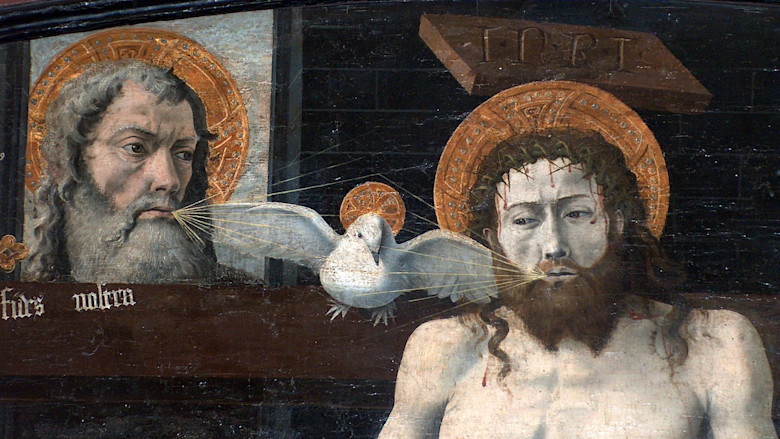
A depiction of the filioque from the Boulbon Altarpiece, circa 1460.
Why exactly the Western church thought this clarification was important is a whole topic by itself, but one major reason is the influence of Charlemagne’s court and the Frankish churches. These major patrons of the Western church thought that the Creed had always meant what the filioque clarified. So they thought that they were being pious by making the meaning of the Creed more apparent and precise. (If you want to read more about this topic from a church historian who writes in a wonderful and captivating style, I highly recommend The Age of Paradise and The Age of Division, the first two volumes in John Strickland’s series on church history).
Why does the filioque matter? There are two reasons, one more technical and one more general.
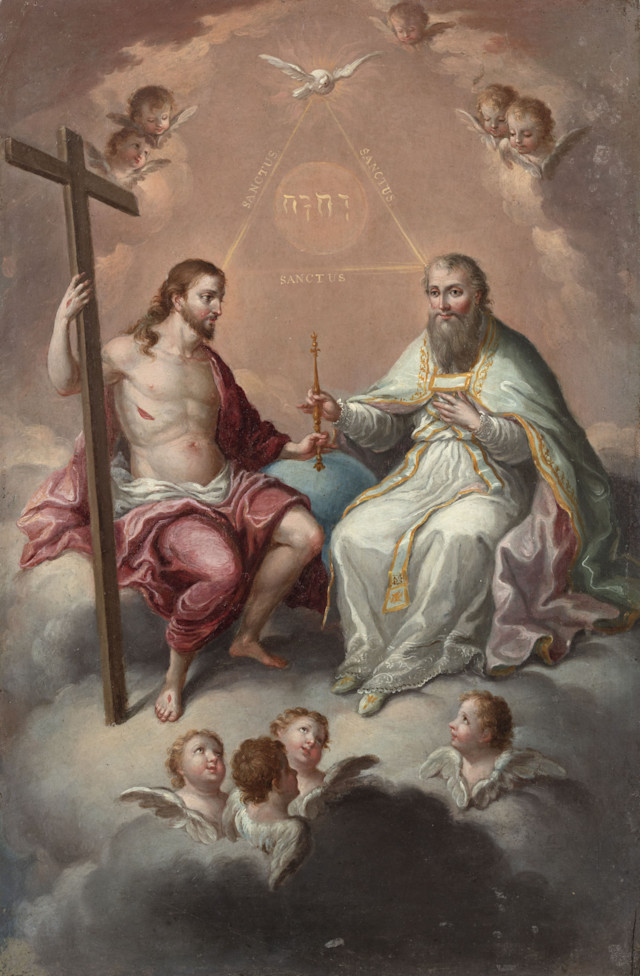
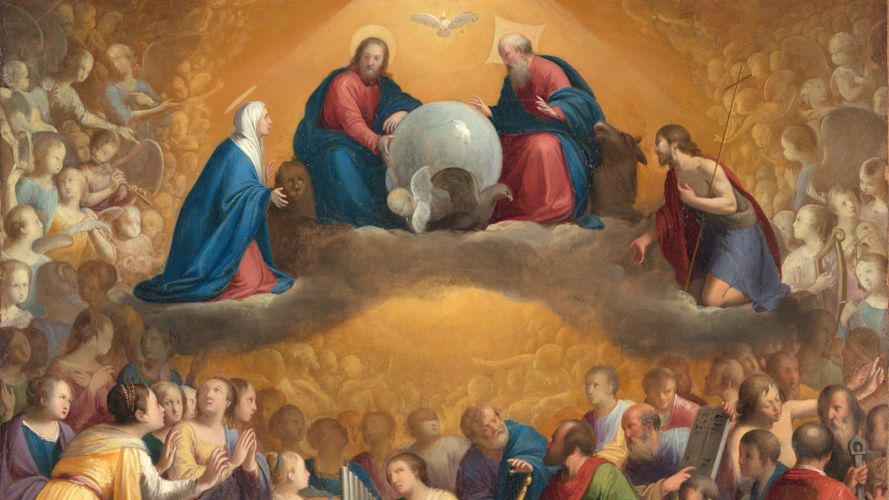
José Campeche - The Trinity - circa 1790
But the shorter, more straightforward answer is that the entire Church had universally agreed on the revised Nicene Creed and understood it as being the ultimate, final statement of her doctrine—meaning that it was complete and did not need to be added to or revised from that point onward.
The fact that the Western Church sought to clarify it was seen by the Eastern Church as totally unacceptable. If the theology of the church really and truly is “faith which was once for all delivered to the saints,” as St. Jude puts it (Jude 1:3), and if the Creed is that ultimate statement, universally agreed upon by all the churches, then by definition there is nothing to add to it.
Controversy over this issue was one of the major contributing factors to the falling out between the Western and Eastern branches of the church, which ultimately led to the so-called Great Schism and the formation of the Roman Catholic Church and Eastern Orthodoxy as separate denominations. But that’s a topic for another article—and, really, for a whole book.
Subscribe
Life-giving writing by Christian scholars sent to your inbox once per month

Zachary Porcu has a PhD in church history from the Catholic University of America in Washington DC, with additional degrees in philosophy, humanities, and Classics (Greek and Latin). He is an Eastern Orthodox Christian.
Keep reading
Forgiveness and the Remission of Sins

Stanley Hauerwas: Virtue Ethicist & Postliberal Theologian
Who is Jürgen Moltmann and What Did He Believe?
Jerry Bridges and The Navigators: A Protestant Order
Greg Bahnsen: Apologist and Presbyterian Minister