"It is well with my soul": Bible verse or hymn lyric?
The short answer:
The phrase “it is well with my soul” does not appear in the Bible, but the sentiment somewhat lines up with the moral message of Psalm 46.
The phrase “it is well with my soul” does not appear in the Bible as an exact quote. It was penned by a nineteenth-century Protestant named Horatio G. Spafford. The sentiment is not entirely un-Biblical, however, as you could argue that this sort of imagery is drawn from various places in the Bible. Consider Isaiah 66:12–13:
Compare a later Psalm, 56:3-4:“For thus says the Lord:
‘Behold, I will extend peace to her like a river,
And the glory of the Gentiles like a flowing stream.
Then you shall feed;
On her sides shall you be carried,
And be dandled on her knees.
As one whom his mother comforts,
So I will comfort you;
And you shall be comforted in Jerusalem.’”
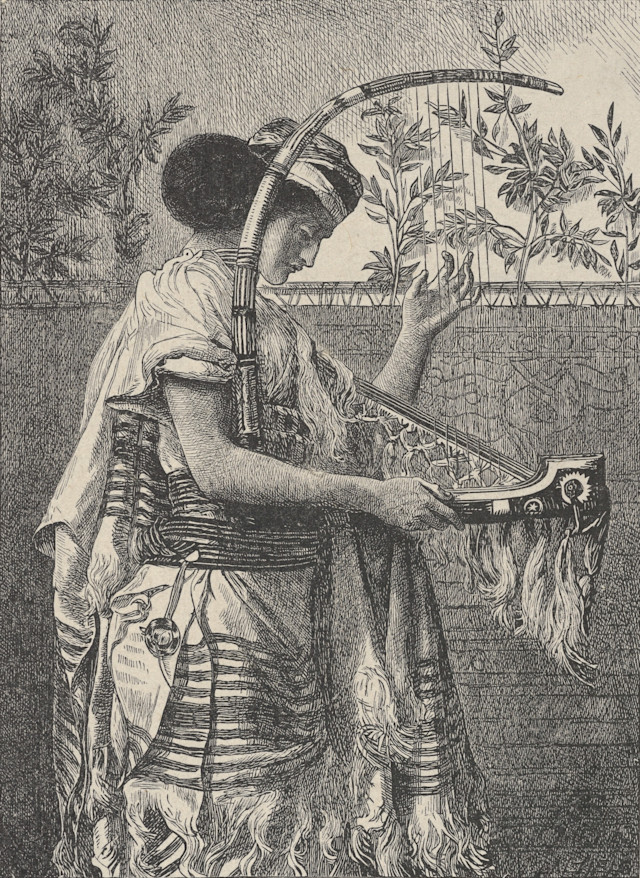
An 1800s engraving of an Israelite temple musician during the Feast of Tabernacles, after Simeon Solomon.
“Whenever I am afraid,
I will trust in You.
In God (I will praise His word),
In God I have put my trust;
I will not fear.
What can flesh do to me?”
The sentiment that “it is well”—in other words, that things are going to go well, because God is our refuge and our defender—is fairly common throughout the canon of scripture and the church fathers.
Does this phrase come from Psalm 46?
Psalm 46 is often cited as the source of this phrase, especially by such unreliable technologies as generative A.I., but the phrase isn’t really there. The following passage is the entirety of Psalm 46:
“God is our refuge and strength,
A very present help in trouble.
Therefore we will not fear,
Even though the earth be removed,
And though the mountains be carried into the midst of the sea;
Though its waters roar and be troubled,
Though the mountains shake with its swelling. Selah.There is a river whose streams shall make glad the city of God,
The holy place of the tabernacle of the Most High.
God is in the midst of her, she shall not be moved;
God shall help her, just at the break of dawn.
The nations raged, the kingdoms were moved;
He uttered His voice, the earth melted.
The Lord of hosts is with us;
The God of Jacob is our refuge. Selah.Come, behold the works of the Lord,
Who has made desolations in the earth.
He makes wars cease to the end of the earth;
He breaks the bow and cuts the spear in two;
He burns the chariot in the fire.
Be still, and know that I am God;
I will be exalted among the nations,
I will be exalted in the earth!
The Lord of hosts is with us;
The God of Jacob is our refuge. Selah.”
As you can see, the phrase doesn’t appear anywhere in this Psalm, though again, the sentiment that God is our true foundation and that therefore everything will “be well” is certainly present.
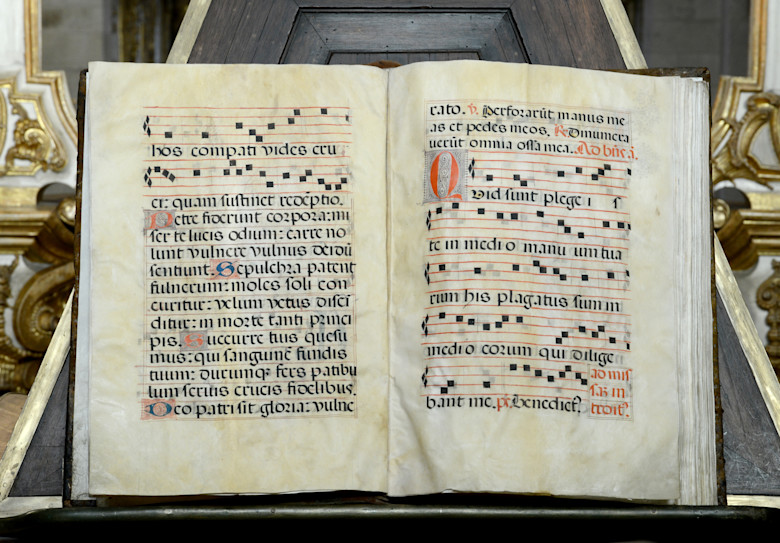
An antiphonarium in the Church of the Monastery of Tibães.
Horatio Spafford’s hymn “It Is Well with My Soul”
The actual phrase is a lyric from a hymn written in 1873 by a Protestant named Horatio G. Spafford. The full hymn is as follows:
When peace like a river attendeth my way,
when sorrows like sea billows roll;
whatever my lot, Thou hast taught me to say,
“It is well, it is well with my soul.”Refrain:
It is well with my soul;
it is well, it is well with my soul.
Though Satan should buffet, though trials should come,
let this blest assurance control:
that Christ has regarded my helpless estate,
and has shed His own blood for my soul.RefrainBartholomeus van der Helst - The Musician - 1662
My sin, oh, the bliss of this glorious thought!
My sin, not in part, but the whole,
is nailed to the cross, and I bear it no more;
praise the Lord, praise the Lord, O my soul!Refrain
O Lord, haste the day when my faith shall be sight,
the clouds be rolled back as a scroll;
the trump shall resound and the Lord shall descend;
even so, it is well with my soul.Refrain

What is the meaning of “it is well with my soul”?
The reason that Psalm 46 is so often thought to contain the refrain from this hymn is, as far as I can tell, because the hymn captures the sentiment of Psalm 46. The hymn is an extension on the theme that, no matter what happens, no matter what tragedies befall us, no matter how much evil there is in the world, including (or especially) our own sins and shortcomings, it’s going to “be well”.
In the context of the ancient Israelites, the language of the Psalm focuses on re-affirming the cosmic moral order: that God is the true ruler of the earth, over and against the “nations” (that is, the nations that were ruled by the fallen angels. But the hymn is, in a sense, more of a post-Incarnation reflection on how Christ has repaired the cosmos, especially in terms of our own sins.
Subscribe
Life-giving writing by Christian scholars sent to your inbox once per month

Zachary Porcu has a PhD in church history from the Catholic University of America in Washington DC, with additional degrees in philosophy, humanities, and Classics (Greek and Latin). He is an Eastern Orthodox Christian.
Keep reading
What does the Bible say about AI or artificial intelligence?


Who was Tartak in the Bible? The idol of the Avites
Hineni in Hebrew: “Here I am” from God and Man

Who was Jotham, king of Judah?
What are the prophetic books of the Bible?