The Shulamite: Bride of Solomon and Allegorical Woman
The short story:
The title “Shulamite” is only mentioned once in the Bible, in the Song of Solomon. The exact meaning of Shulamite is debated; it might be synonymous with Shunamite and refer to the region of Shunem, or it might be a version of Jerusalem and therefore a feminine form of the name “Solomon.” The Song of Solomon was a long, erotic poem by King Solomon about (presumably) his first wife, but contains deeper spiritual meaning about the relationship between Christ and the Church.
The word “Shulamite” (also spelled “Shulammite”) is only used once in the Bible, in the Song of Solomon, chapter 6, verse 13. What does it mean? It’s at least a reference to the bride of Solomon, but the nature of the title is disputed by scholars.
Many scholars believe that Shulammite and Shunammite were synonymous. If so, then the name means someone who was from the place Shulem. This was a village north of Jezreel, south of Mount Gilboa, in the region of Issachar.
One clue is the Shunammite mentioned in 1 Kings, a handmaid who attended to King David while he was in decline in his old age. Her name was Abishag (see 1 Kings 1:1–4, 11: 5, and 2:17–22). She would have been someone familiar to Solomon, as he was David’s son. There was even a situation where one of David’s other sons, Adonijah (a half-brother to Solomon) attempted to take Abishag for his wife, but Solomon stopped him (1 Kings 2:13–25). In the passage, he was motivated by suspicion towards his brother’s intentions about the throne. Whether he had a romantic interest isn’t clear in the text.
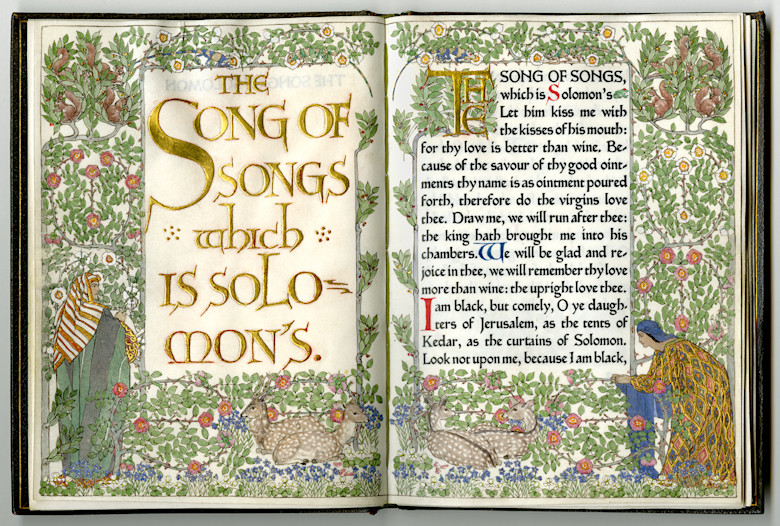
Florence Kingsford - Ashendene Song of Songs - 1902
Others believe that Shulammite was a title that meant “peace,” from the same root as “salem”—which is where the Jewish greeting “Shalom” comes from. Since Solomon’s name was a masculine version of the same word, it may be that the world Shulammite was simply the feminine form of Solomon, and that Shulammite was therefore the title she received upon marrying Solomon.
Which of these theories is correct? We don’t know. The Song of Solomon doesn’t say anything about it, at least not explicitly. But the unknown meaning of the word “Shulamite” isn’t a problem because the text has a deeper spiritual meaning.
Who was the Shulamite bride?
The Song of Solomon—also called the Song of Songs or the Canticle of Canticles, depending on the translation—is an extended love poem by King Solomon about one of his brides. Solomon had hundreds of wives and hundreds of concubines—but many people believe that Solomon wrote this poem about his first wife and therefore first love. The poem details his delight with the young bride, gives us a window into their relationship, and contains many deeper spiritual meanings.
The way the early church interpreted this book as both literally a love poem from Solomon to his bride and also as an allegory for the relationship of God with his people.

An Art Deco engraving from a 1925 edition of the Song of Songs.
Ancient Israelites read the text as an allegory for the love between God and Israel. Because Christians understood themselves as the new Israel, the early church tradition was to read the book as an allegory between Christ and his bride, the Church. This comparison is found frequently in the New Testament, including Revelations 19:7-9, 2 Corinthians 11:2, Ephesians 5:32-33, et cetera.
Interestingly, it was a tradition to not allow younger people to read the Song of Solomon. Modern people often think this tradition is because of the erotic content of the poem, but ancient people were not Puritans. The reason that they didn’t let young people read it is because they were concerned that young people would only read it as a literal, erotic poem rather than understand it at the spiritual level—as a description of the relationship between Christ and the Church. Because a spiritual reading of Old Testament passages has always been considered a very advanced form of Biblical interpretation, it makes sense that you’d want to wait until someone was more mature before reading something that he or she might misunderstand.
The importance of the Shulamite woman, according to this spiritual reading, is that she represents Jerusalem and, ultimately, the Church herself. What’s special about her, therefore, is everything that’s special about the Church and her intimate relationship with Christ.
Subscribe
Life-giving writing by Christian scholars sent to your inbox once per month

Zachary Porcu has a PhD in church history from the Catholic University of America in Washington DC, with additional degrees in philosophy, humanities, and Classics (Greek and Latin). He is an Eastern Orthodox Christian.
Keep reading
Hineni in Hebrew: “Here I am” from God and Man


Who was Jotham, king of Judah?
Who is Esaias in the Bible? Answered by a Christian Scholar
What are the prophetic books of the Bible?

Peor: The Mountain and God of the Moabites