Jesus flipping tables at the Temple: What did it mean?
The short answer
Christ's flipping of tables in the Temple happened because the Jews had turned the Temple away from its original purpose. Flipping the tables was a prophetic act predicting the Jewish Temple's destruction, with Christ's own body taking its place. Christ's body was also destroyed, but rose from dead three days later as the new temple, the new way for us to have connection to God.
It’s an indisputable fact that Jesus is the most influential person to ever live. One easy way to measure is to count the number of books that have been written about a person. When you measure it that way, Jesus ranks very comfortably in the number-one spot (number two is, apparently, Abraham Lincoln).
When you’re that popular, it’s easy for stereotypes to arise, and probably the most common one about Jesus is that he was an advocate for radical peace, tolerance, compassion, and so on. For this reason, people are fond of bringing up the story in the Gospels about Jesus going into the temple and flipping tables. It doesn’t fit into the stereotype of the peace-loving Jesus, and people capitalize on this supposed incongruence in all sorts of ways. Without getting into all the different possible interpretations, what can we say for certain about this story?
Jesus and the money changers

Money changers driven out of the Temple - 19th century engraving by Gustave Dore
Mark’s account adds that Jesus “would not allow anyone to carry merchandise through the temple courts” (Mark 11:15-18). In John’s version, Jesus actually makes a whip first and then (presumably) uses it to drive out the animals (John 2:15). In both Mark and John, there’s specific mention of “those who sell doves”: in Mark's account, Jesus turns over their benches; in John, he tells them, “Get these out of here. Stop turning my Father’s house into a market” (John 2:16).
What is going on here, practically speaking? In the second temple period of ancient Israel, worship was conducted through the sacrifice of animals. Those who were traveling to Jerusalem to worship in the temple needed animals to sacrifice, and that’s why there were animals available to purchase. The doves were the cheap animals, available for those who couldn’t afford a sheep or an ox.
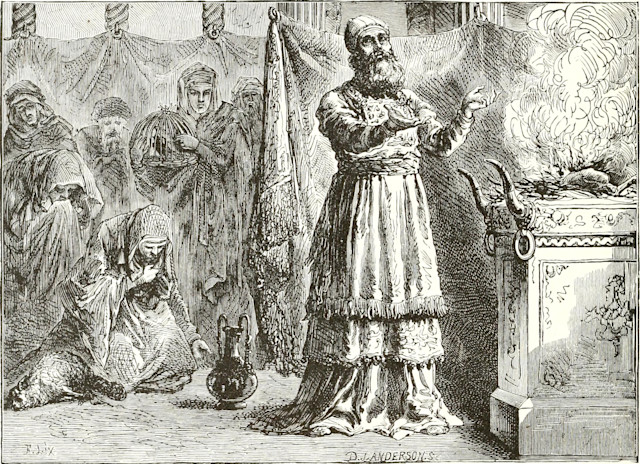
An woodcut depicting a Hebrew temple sacrifice, published in 1897.
Jesus flips tables. Should you?
It’s easy to read this scene as an example of Jesus getting angry and think that he sets an example for us to do the same when the right conditions are met. People use the phrase “righteous anger” for the times when you’re angry about something, but because you’re angry on behalf of something that’s good and true, you are allowed to get angry, even to act out. The fact that you’re angry over a just cause, in other words, gives you permission to act out in this way.
This way of thinking is problematic, and many people recognize it as such. The main reason is because it seems selfless but is actually the opposite. You think you’re acting out of duty or passion for goodness and justice, and therefore you aren’t selfishly indulging your own anger, but how do you know that? If you are the one who decides whether something is just or not, then there’s a danger of becoming a hypocrite without realizing it.
There are certain natural temptations that arise when you put yourself in the position of judge over what’s right and wrong. It’s easy to build criteria in your mind where the things other people do are unjust and wrong, whereas the things that you do are just and right.

A 17th century woodcut by Jacques Callot depicting a man caught between the lion of courage and the demon of anger.
In the end, you make yourself into the ultimate arbiter of justice and truth, which gives you a perpetual license to get angry and act out in all kinds of situations. “Of course I’m angry at this injustice!” you might say. But of course, this is a dangerous way to act, and can lead to the hypocrisy of justifying your own angry behavior but condemning that of others. Hypocrisy aside, at a more basic level it gives you free license to indulge in a vice.
But what about Jesus? You might say that because he’s God and therefore has perfect knowledge of all things, Jesus is able to perfectly judge what’s justice or unjust. Unlike you or me, he knows what’s just and righteous, and isn’t prone to (or even capable of) self-delusion. Therefore (you might argue) Jesus is really the only one who’s able to have righteous anger in this way. So maybe this passage is really about showing us that Jesus alone has the license to be angry because only he can do it perfectly.
But is it really right to say that Jesus was acting in righteous anger in the first place? It’s not like anger is necessarily a good thing; wrath is, after all, one of the seven classical sins. How do we understand Jesus’ anger?
He sits down to do something deliberative, rather than acting out of uncontrolled passion.
It’s true that he takes some pretty intense actions: overturning tables, driving out the animals, and making some severe pronouncements about the bad practices that he saw. But the authors of the gospel passages don’t give any indication of what his emotional state was.
Honoré Daumier - A Literary Discussion in the Second Tier - 1864
But that’s not the portrayal of Christ that we see in these gospel accounts. What we see is Christ taking action: severe action, to be sure, but deliberative, self-controlled, and clear. He speaks the truth, but not for his own satisfaction. He makes a show of anger, but remains in control. He condemns, but he isn’t cruel.
It’s true that Christ is God and has the authority or the “right” to do these things. It’s true that he’s the perfect judge of what is right and wrong. But when you start asking the question of how to imitate Jesus, what stands out about these passages is that the way he conducted himself inspired people towards the good, not—as it may seem at first—that he was condemning and tearing people down.
Notice that in Mark’s account, the text says, “And as he taught them, he said, ‘is it not written: “my house will be called a house of prayer for all nations”?’”(Mark 11:17, emphasis mine). And how do the people respond? “The whole crowd was amazed at his teaching” (Mark 11:18). So even in the midst of what appears to be a scene where Jesus is almost literally tearing something down, the deeper reality is that he is doing it with an aim towards raising the people up towards a higher good.
What did it mean? The fig tree is the Temple
One way to read Jesus’ act of flipping the tables is alongside the earlier passage in Mark’s account (Mark 11:12-14) where Jesus curses a fig tree and it withers. Right before the passage about the money-changers, Jesus encounters a fig tree that has not born any fruit, and he curses it, saying, “may no one ever eat fruit from you again” (Mark 11:14). Then he goes into the temple and turns over the tables. Later that day, when they left the city, Jesus’ disciples see the fig tree that he cursed. What had happened in the meantime? It had withered up in response to Jesus’ curse!

A flourishing fig tree.
But there is a connection between Jesus and the temple. Jesus refers to the temple as his own body. He says, “destroy this temple, and I will raise it again in three days” (John 2:19; see also Matt 26:61, Mark 14:58). Saint John, in his account, explains, “But the temple he had spoken of was his body. After he was raised from the dead, his disciples recalled what he had said” (John 2:22). When the Jews later destroyed the temple that was Christ’s body, he came back from the dead and overcame death itself.
A further meaning has to do with the literal destruction of the Jewish temple. Just a few decades after Christ’s death and resurrection, the Jews launched a revolt against the Roman rulers which began a series of wars. It culminated with the Roman emperor Titus laying siege to Jerusalem and destroying it, including the temple itself, in A.D. 70. The Jewish temple has not been rebuilt to this day.
But the early Christians—the first of whom were themselves Israelites—had taken the core elements of Jewish temple worship and expanded it into a form that came to be called the Divine Liturgy. It was essentially the old worship practiced in the Jewish temple but transfigured and expanded into a full worship of God based on the revelation of Jesus and the teachings of his Apostles. And the Church is famously understood by Christians to be the body of Christ, not just metaphorically but literally through the practice of Communion (called the Eucharist).
Christ, the Liturgy, and the Law
Jesus cursing the fig tree and the historical realities surrounding the destruction of the Temple add another dimension to what’s going on with Jesus overturning the tables in the temple. The withering of the fig tree for bearing no fruit has the same message as Christ flipping over the tables in the temple: the Jews had turned the Temple away from its original purpose, so it was soon destroyed by the Romans for bearing no fruit. But in the same way that the Jews destroyed the temple that was Jesus’ body and he rose from the dead to even greater glory, the greater glory of the Christian Church was raised from the ashes of the destruction of the Jewish temple through the continuation of its worship in the Divine Liturgy.
Subscribe
Life-giving writing by Christian scholars sent to your inbox once per month

Zachary Porcu has a PhD in church history from the Catholic University of America in Washington DC, with additional degrees in philosophy, humanities, and Classics (Greek and Latin). He is an Eastern Orthodox Christian.
Keep reading

Jesus and the Syrophoenician Woman: Gentile Salvation

Who was the first woman preacher in the Bible?
Was Jesus a Rabbi?

Who was Phanuel? Archangel or Father of Anna?

Is “love conquers all” in the Bible?