Symbolism: What is the meaning of an owl in the Bible?
The short answer:
Owls frequently appear as imagery throughout the Bible; they often stand for desolation, destruction, barrenness, and loss. Owls are not presented as evil in the Bible, but they are associated with many negative things, include the night-demon Lilith.
There are a variety of verses in the Bible that refer to owls, though how many depends on the translation. For example, the New King James version refers to owls explicitly in Leviticus 11 verses 16, 17, and 18; Deuteronomy 14, verses 15, 16, and 17; Psalm 102:6, and Isaiah 13:21 and 34:11, while the New International version additionally cites owls in Job 30:29, Isaiah 14:23, Isaiah 43:20; Micah 1:8, and Zephaniah 2:14.
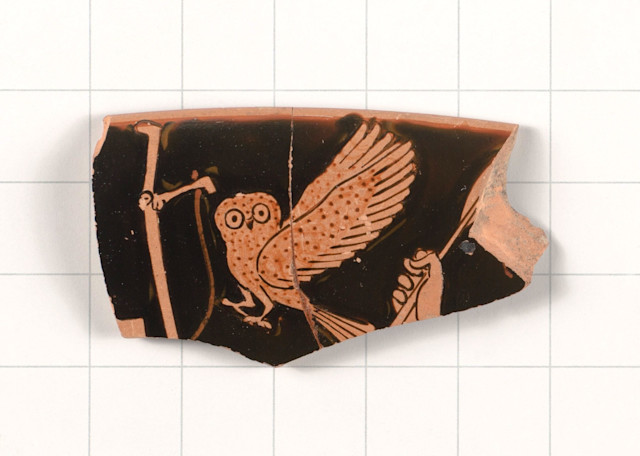
A fragment of a Greek terracotta kylix depicting an owl, from the 470s B.C.
What does an owl represent in the bible?
If you look at how owls tend to be referenced in the Bible, you’ll see a running theme of loneliness, desolation, and uncleanness, in part because owls were classified as unclean animals by the purity laws of ancient Israel. Animals could be considered “unclean” for various reasons, but for carnivorous birds it was probably because they eat the flesh of other creatures, and many birds scavenge the dead as well.
“These are the birds you are to regard as unclean and not eat because they are unclean: the eagle, the vulture, the black vulture, the red kite, any kind of black kite, any kind of raven, the horned owl, the screech owl, the gull, any kind of hawk, the little owl, the cormorant, the great owl, the white owl, the desert owl.” (Leviticus 11:13–18; compare to Deuteronomy 14:11–17.)
Because owls specifically tend to dwell in the desert and places like abandoned ruins, they often symbolize loneliness, barrenness, and desolation.
“For it is the day of the Lord’s vengeance, The year of recompense for the cause of Zion. Its streams shall be turned into pitch, And its dust into brimstone; Its land shall become burning pitch. It shall not be quenched night or day; Its smoke shall ascend forever. From generation to generation it shall lie waste; No one shall pass through it forever and ever. But the pelican [or “owl”] and the porcupine shall possess it, Also the owl and the raven shall dwell in it. And He shall stretch out over it the line of confusion and the stones of emptiness.” (Isaiah 34:8-11)
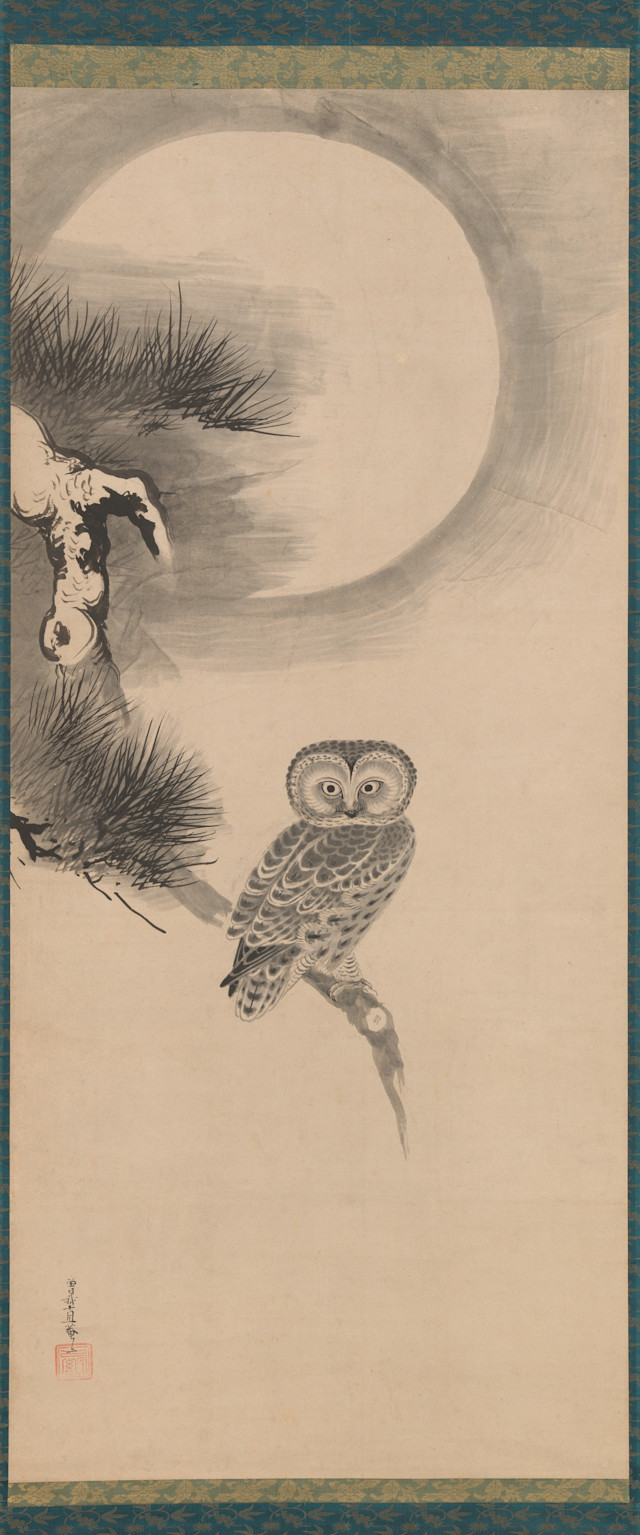
Soga Nichokuan - Owl on a Pine Branch - 1600s
“But wild beasts of the desert will lie there, And their houses will be full of owls; Ostriches will dwell there, And wild goats will caper there.” (Isaiah 13:21)
The Psalmist uses the imagery of the owl to convey the his own grief and loneliness in Psalm 102, verses 3-6:
“For my days are consumed like smoke,
And my bones are burned like a hearth.
My heart is stricken and withered like grass,
So that I forget to eat my bread.
Because of the sound of my groaning
My bones cling to my skin.
I am like a pelican of the wilderness;
I am like an owl of the desert.”
Similarly, Micah employs the image of an owl to communicate his sense of loss and sorrow:
“Because of this I will weep and wail; I will go about barefoot and naked. I will howl like a jackal and moan like an owl.” (Micah 1:8, NIV)
The Prophet Jeremiah uses owls, hyenas, and other desert creatures to emphasize the utter destruction of Babylon:
“So desert creatures and hyenas will live there, and there the owl will dwell. It will never again be inhabited or lived in from generation to generation.” (Jeremiah 50:39, NIV)
Zephaniah also uses the nocturnal predators to make a point about utter destruction in chapter 2, verses 13-14:
“He will stretch out his hand against the north
and destroy Assyria,
leaving Nineveh utterly desolate
and dry as the desert.
Flocks and herds will lie down there,
creatures of every kind.
The desert owl and the screech owl
will roost on her columns.
Their hooting will echo through the windows,
rubble will fill the doorways,
the beams of cedar will be exposed.”
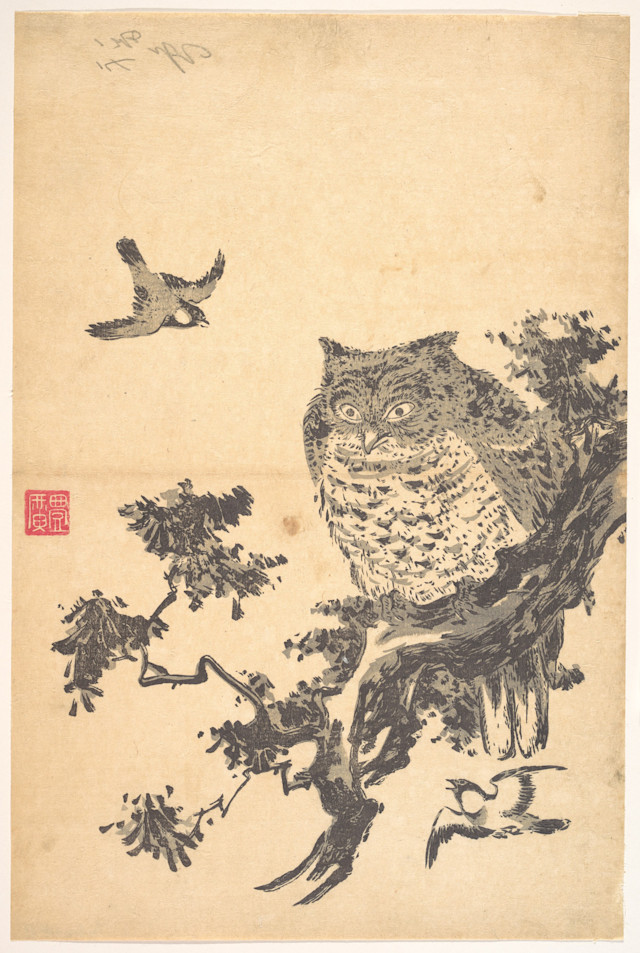
Utagawa Toyohiro - Owl and Two Swallows - Edo period (1615-1868)
“And he cried mightily with a loud voice, saying, ‘Babylon the great is fallen, is fallen, and has become a dwelling place of demons, a prison for every foul spirit, and a cage for every unclean and hated bird!’” (Revelation 18:2)
Here, again, the image is employed to communicate destruction and desolation.
What is the spiritual or prophetic meaning of owls?
We can see through these examples that owls are generally associated with things like bareness, emptiness, and destruction. These images don’t just refer to the emptiness of the desert or the loneliness of a ruined city; the spiritual meaning is that when something is spiritually empty or spiritually in ruins, then it will be filled with the kind of creatures which seek out those places. Though not explicit in any of these verses, it wouldn’t be much of a stretch to associate the general idea of predatory birds (rather than owls specifically) with the idea of evil spirits, since they both fly, prey on things, and are unclean. While this connection isn’t as clear to modern people, this kind of thematic association is how ancient people thought about things. Further, all ancient people thought of evil or unclean spirits as being associated with and actually made of something like air or vapor. There’s even an older English way of referring to ghosts or spirits as “vapors,” and the word “spirit” in Greek also means “breath” or “air.” The early Church fathers all believed that evil spirits and demons were made of air or breath, which is why St. Paul refers to the devil as the “prince of the power of the air” (Ephesians 2:2). For similar reasons, in many folklore accounts you can trap a genie in an oil lamp or a bottle.
The prophetic meaning of owls, as we have seen, often has to do with the foretelling of destruction and future desolation (Isaiah 13:11, Jeremiah 50:39, Zephaniah 2:13-14, Revelation 18:2). But again: there is no strict, one-to-one correspondence between “owl” and “desolation.” Ancient people didn’t do their symbolism through rigid formulae, but through the general associations any normal (ancient) person could have been expected to have.
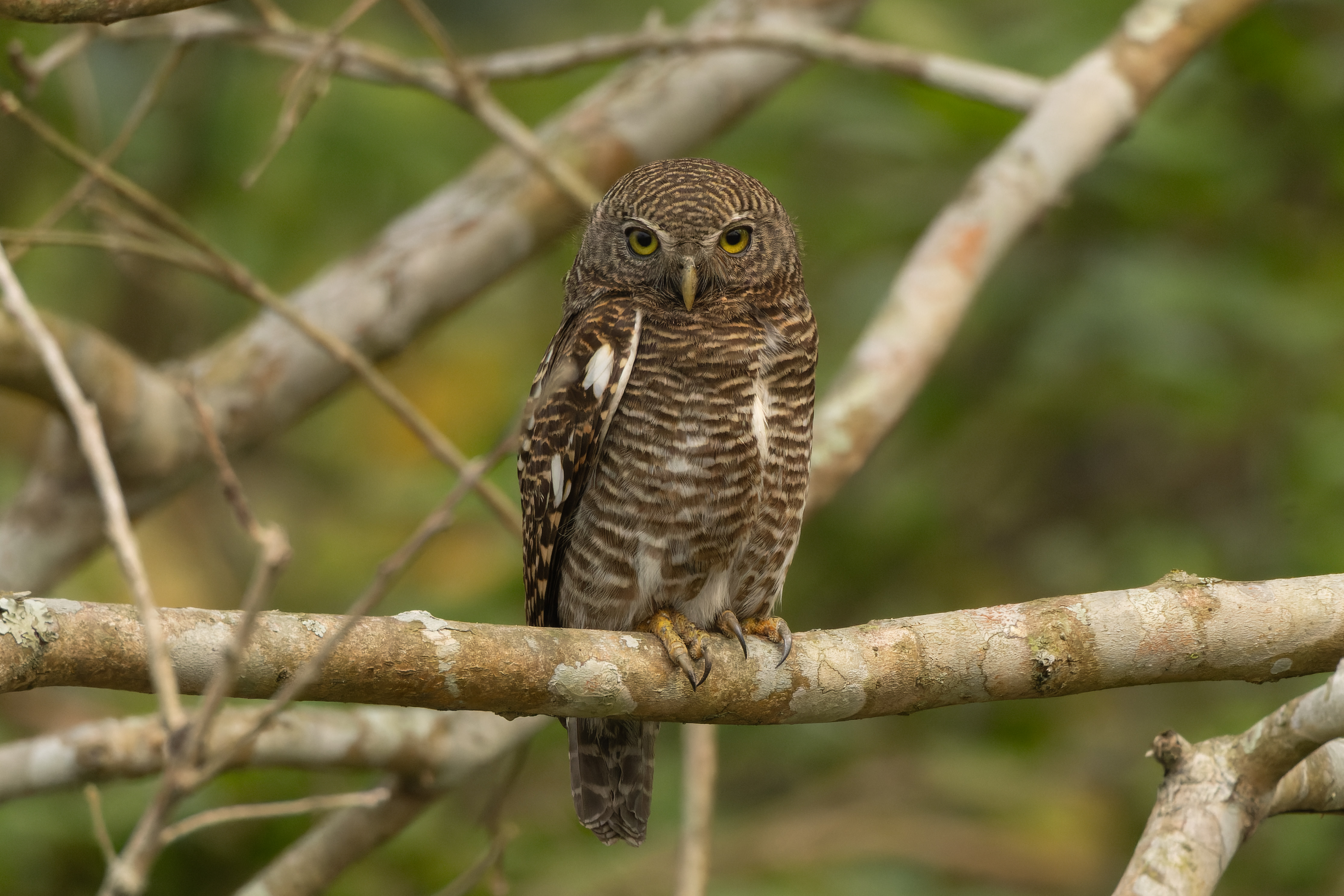
An Asian Barred Owlet
Are owls evil in the bible?
No created thing is evil in the Bible, at least not inherently. In Genesis, creation is presented as entirely good by nature, from the beginning. At every point in the creation arc, God sees that each thing he has made is good, including birds:
“So God created great sea creatures and every living thing that moves, with which the waters abounded, according to their kind, and every winged bird according to its kind. And God saw that it was good.” (Genesis 1:21, my emphasis)
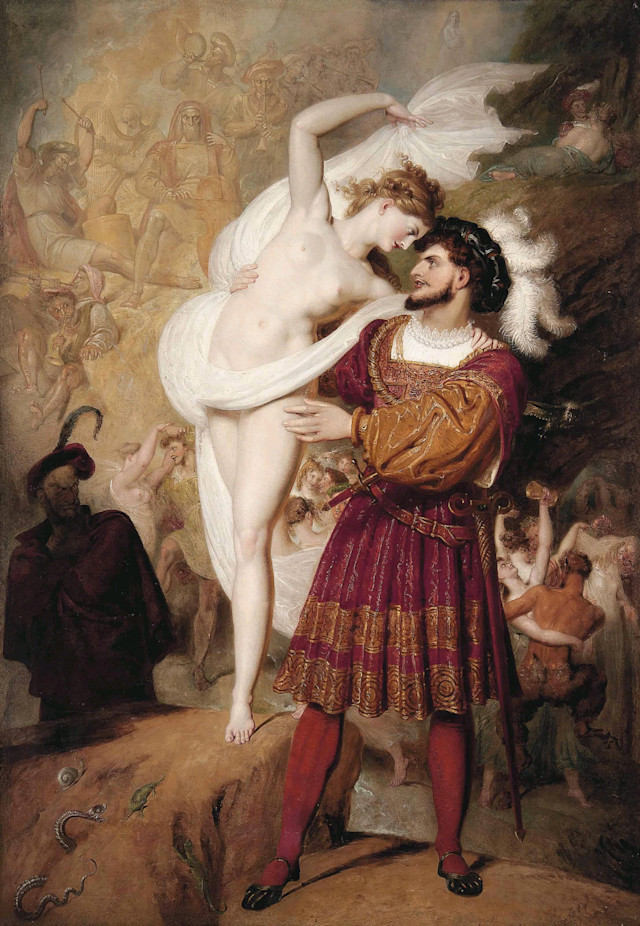
Richard Westall depicts Faust dancing with the witch Lilith, from lines 4118-4182 of Goethe's play Faust.
The clearest association of owls with evil, however, is though the mythical creature Lilith. It appears in Isaiah 34:14; I have emphasized the pertinent phrase:
“The wild beasts of the desert shall also meet with the jackals,
And the wild goat shall bleat to its companion;
Also the night creature shall rest there,
And find for herself a place of rest.”
In Hebrew, the word for “night creature” is “Lilith.” The name could be translated as “screech owl,” simply “owl,” or some sort of nocturnal creature. But the original Hebrew word could also refer to a night bird in general or an evil spirit or demon. This variance results from the common ancient association of owls and evil spirits because of their similarities (but, again, being associated symbolically doesn’t mean that the one stands for the other in every case).
But who is Lilith? Though the word appears in this passage in Isaiah, Lilith is not mentioned in any part of the canonical scriptures, and the word isn’t elaborated on in this passage. There are Rabbinic traditions which present the idea that Lilith was Adam’s first wife prior to Eve, but these ideas appeared hundreds of years after the composition of the full text of the Bible, and something close to a thousand years after the composition of the Book of Isaiah. From the first century onward, it seems that Lilith was mostly understood as an evil spirit that came out at night and preyed on people—very like an owl.
Subscribe
Life-giving writing by Christian scholars sent to your inbox once per month

Zachary Porcu has a PhD in church history from the Catholic University of America in Washington DC, with additional degrees in philosophy, humanities, and Classics (Greek and Latin). He is an Eastern Orthodox Christian.
Keep reading
Hineni in Hebrew: “Here I am” from God and Man

Who was Jotham, king of Judah?
What are the prophetic books of the Bible?
Who is Esaias in the Bible? Answered by a Christian Scholar

Peor: The Mountain and God of the Moabites