What is the Walk to Emmaus weekend Cursillo retreat?
The short story
The Walk to Emmaus, or the Emmaus Walk, is a popular weekend retreat for spiritual discipleship among a number of modern-day Christian groups. Its name comes from the passage in Luke 24:13-47 in which Jesus appears to two of his disciples on the road after his resurrection.
In the early twentieth century, there was a movement in Catholicism to develop a “cursillo,” which means a “little course” of study. A cursillo was a three-day weekend retreat, grounded in a series of talks delivered by both clergy and lay people, aimed at personal spiritual development. After the weekend, participants are directed to take what they have learned and share it with others. They also return at regular times for reunions to continue their spiritual growth. The first cursillo was started in 1949 at the monastery of Saint Honorat in Mallorca, but it became so popular that this model was copied across much of the modern Christian world, including by many non-Catholics (for example, here, here, here, and here!).
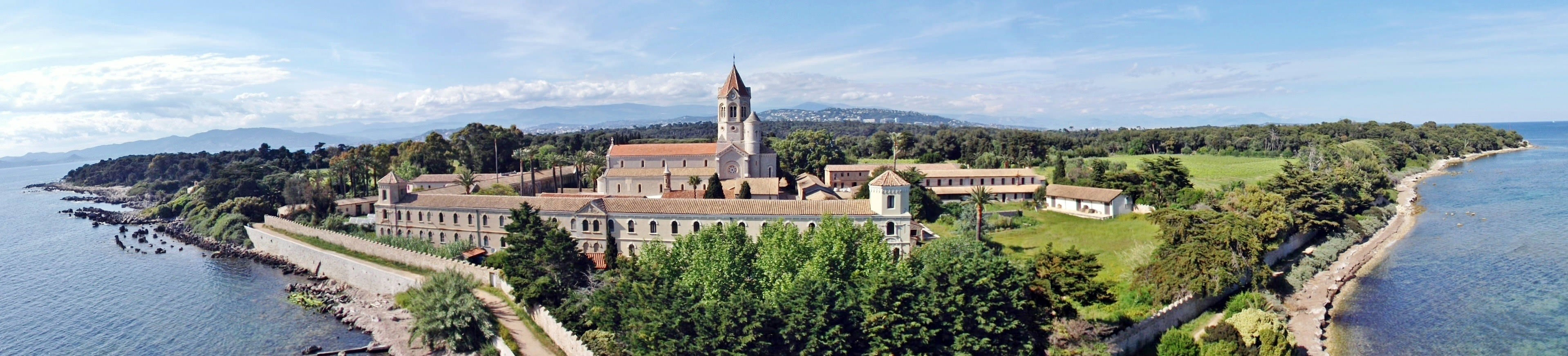
Saint Honorat monastery where the Walk to Emmaus cusillo began (source)
How did the Walk to Emmaus begin?
The Walk to Emmaus is a specific cursillo that started in 1978. It was started by Fr. David Russell, who believed there was a need for a retreat that allowed lay women to minister to and meet the spiritual needs of other lay women. After being denied the request to form a cursillo in his home parish, he reached out to Myrna Gallagher to develop one. They decided on a retreat that was specifically themed on the passage from Luke about Christ’s walk to Emmaus, and it became so popular that there are now many non-Catholic versions of it, some even copyrighted by various Protestant denominations.

A retreat center like those used in Walk to Emmaus (source)
If you’ve never been to a spiritual retreat, or just a series of concentrated lectures over a weekend, it’s difficult to explain how impactful such an experience can be. It’s like a convention in that you’re gathering with a bunch of people who share the same interests as you, but it differs in two important ways. First, the content involves mentorship, as the lectures focus the retreat on purposeful instruction. Second, because of the spiritual content of these retreats, that focus is about ultimate truths, so they tend to have a lot of gravity and impact. The Walk to Emmaus retreat is about deepening one’s spiritual life, and you can imagine that that’s fairly significant for the people who attend it.
The Walk to Emmaus in the Bible
But what was the walk to Emmaus originally? The Road to Emmaus was an episode in the New Testament (Luke 24:13-147) where Christ appeared to his disciples after his resurrection. The strange part of the encounter was that, for some reason, his own disciples didn’t recognize him, even though his physical body was the same as before his death and resurrection. In other places where Jesus appeared to the disciples after his resurrection (like Matthew 28 and John 20) they immediately recognized him—even if sometimes they worried that he might be a ghost. But on this trip to Emmaus, they didn't recognize him at all. When Jesus asked them what they were discussing on the road, the disciples thought he was a stranger and told him everything about the events surrounding Jesus. They only recognized him when he sat down to eat with them, and then all of a sudden he disappeared.
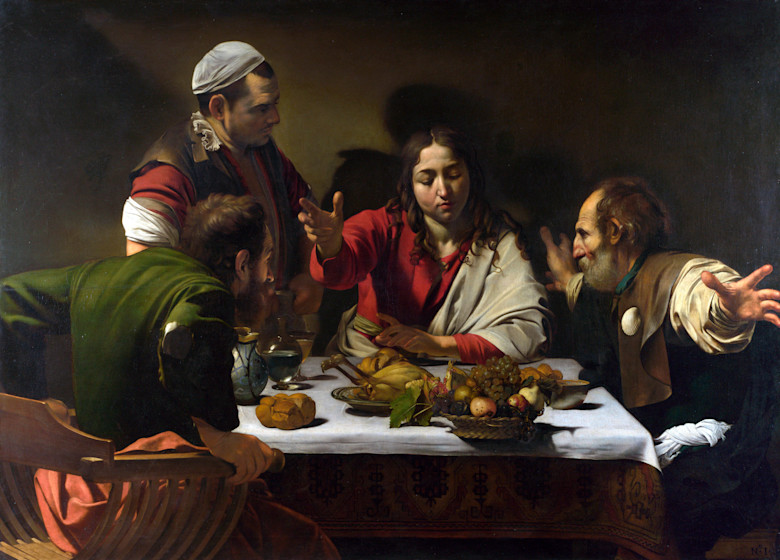
Caravaggio - Supper at Emmaus, 1601
Early Christians read this passage typologically. Typology is kind of like an allegorical reading, except it’s understood that the story really did happen. The story happened, and it contains deep spiritual truths that are communicated through “types”—where one thing stands for another and in doing so reveals the spiritual or cosmic meaning of the passage.
That there are deeper spiritual meanings to everything is the major theme of this passage.
Jesus’ reply is fitting: “How foolish you are,” he tells them, “and how slow to believe all that the prophets have spoken!” (24:25). He then interprets the Hebrew scriptures for them to show that all of the writings they had access to explained these events. The disciples clearly had all of the knowledge necessary to understand the truth, but they weren’t able to grasp it because they were still missing an important ingredient: participation.
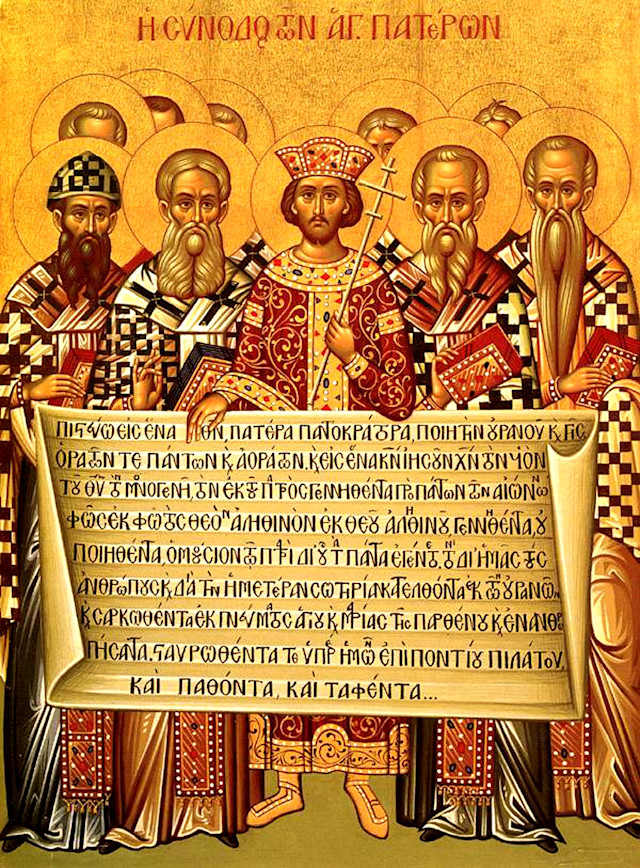
An icon of the First Council of Nicea and the Nicene Creed, which states an important set of Christian beliefs.
But ancient people thought differently. For them, the spiritual and the physical were intrinsically related: all physical things had spiritual content, and (almost) all spiritual things were tied to something physical. The disciples had all of the physical and logical information available to them: they believed in Jesus, they heard his words, and they saw the evidence. However, they lacked a spiritual understanding and their hearts were not in the right place, so they weren’t able to recognize Jesus when he was physically in front of them!
The upper room at Emmaus
For ancient people, the physical was a central ingredient in the spiritual. For example, in the Supper of Emmaus the disciples only recognized Christ after they sat down to eat with him, when he broke the bread. The bread is a “type” for the Eucharist—what we commonly refer to in the West as communion. Communion is itself a physical thing that has spiritual content, namely, the body of Christ. Eating the Eucharist was the central activity that joined the early church together, and the church services that they practiced had this ritual action as the centerpiece of their worship. Of course, the first communion meal was instituted by Jesus at the last supper. So when Jesus broke the bread with them in the upper room, the disciples suddenly realized who he was.
In other words, the disciples came to spiritual insight through participation in a physical act. Notice how Luke describes this: “then their eyes were opened and they recognized him” (24:31). Luke didn’t say, “then their minds were opened and they believed everything he said.” Luke uses the physical language about their literal eyes because of the relationship between the physical and the spiritual.
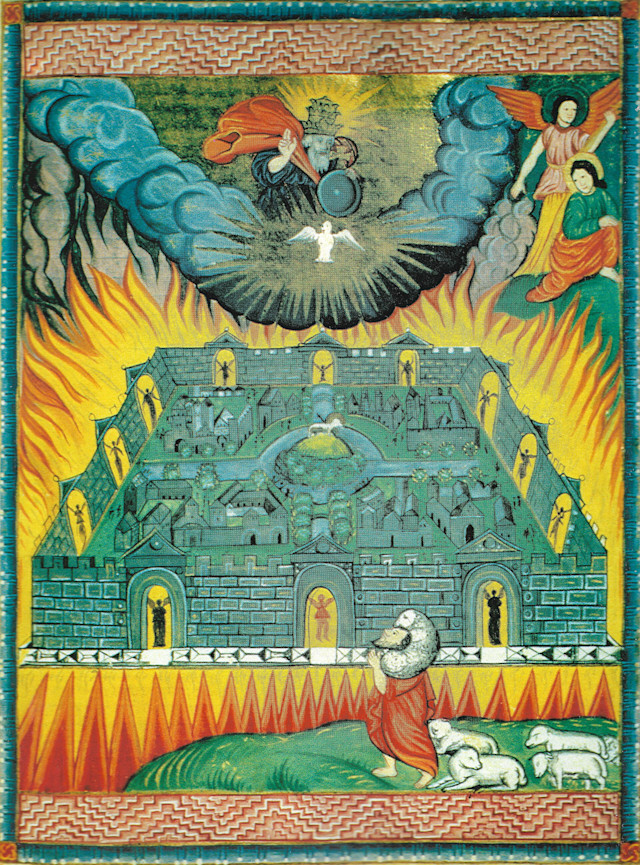
A 1645 manuscript illumination of the New Jerusalem, by Malnazar and Aghap'ir.
You’ll notice that even after Jesus comes back from the dead, he doesn’t immediately introduce the kingdom of heaven. He stays with his disciples for forty days and then ascends to heaven, promising to return and bring the kingdom of heaven in its fullness. Christ defeated death, but he is going to return again and usher in the new kingdom. Just as he vanished from the disciples after the breaking of the bread and went ahead of them to Jerusalem, so too he ascends to heaven to go ahead of us. “I go to prepare a place for you,” Jesus says, “And if I go and prepare a place for you, I will come again and receive you to Myself; that where I am, there you may be also” (John 14:2-3).
The kingdom of heaven is, in a sense, both already here and also not here yet. The New Testament is full of Jesus’ sayings to this effect. In Luke 17:20-21, when Jesus is asked when the kingdom of God will come, he replies, “The kingdom of God is not coming with things that can be observed; nor will they say, ’Look, here it is!’ or ’There it is!’ For, in fact, the kingdom of God is among you”. Yet Jesus also insists that that kingdom of God is “at hand,” meaning it’s very near but not yet here (Matt 4:17). The kingdom is both “already” here among us, and has “not yet” come in its fullness.
St. John of San Francisco
This apparent contradiction between the already and the not yet is perhaps most clear in the lives of the saints. I had the opportunity to visit the relics of one of the few American saints of recent memory, St. John of San Francisco. He is one of those saints whose body is incorrupt—meaning that his body has resisted decay even though it was not embalmed. The bodies of saints are sometimes found to be incorrupt, to various degrees.

Icon of John of San Francisco (source)
This tension between the “already” and the “not yet” became even more pronounced when I talked to the people who looked after his body. I learned that they took St. John out of the casket periodically, to wash him, comb his hair, and change his shoes. When I asked why they changed his shoes, they replied—as though it were the most obvious thing in the world—“well, the soles wear out.” I was shocked. The soles of his shoes wore out just as they would were he walking around in them on a daily basis. As they explained, St. John did miracles all the time, even after death. He was known to appear to people, give spiritual advice, perform miraculous healings, and so on.
They didn’t mean that the body was physically getting up and walking around at night. It stayed there in the casket, unmoving. But in a spiritual sense, St. John was always at work: healing, helping, and loving the people. Because the physical and spiritual are intrinsically related, the soles of his shoes wore out anyway, even though they weren’t being used in a literal, physical sense.
So is St. John of San Francisco alive or dead? In one sense he is clearly dead: he’s in the casket and he stays there. But in another sense he’s completely alive: he’s busy ministering to the people, so much so that his shoes wear out! This example perfectly demonstrates the “already, not yet”: St. John is already alive in Christ, but not yet in fullness. When Christ comes in his glory, everyone will be raised from the dead. But the kingdom of God is coming, and even now, St. John is alive in Christ.
Subscribe
Life-giving writing by Christian scholars sent to your inbox once per month
Zachary Porcu has a PhD in church history from the Catholic University of America in Washington DC, with additional degrees in philosophy, humanities, and Classics (Greek and Latin). He is an Eastern Orthodox Christian.
Keep reading
Jesus and the Syrophoenician Woman: Gentile Salvation
Who was the first woman preacher in the Bible?
Was Jesus a Rabbi?
Who was Phanuel? Archangel or Father of Anna?
Is “love conquers all” in the Bible?