Skip to content
Are curses real? What the Bible says about cursing

Are curses real? What the Bible says about cursing

Dr. Zachary Porcu

March 17, 20264 min read

The short answer

Yes, curses are real. To curse someone is a serious sin, equivalent to the evil of other sins like physical violence. As Christians, we are called to be a blessing to others. As Saint Paul says, "Bless those who persecute you; bless and do not curse" (Romans 12:14 NIV).

When people talk about “cursing” they usually mean “bad words” or “foul language,” but that understanding is a modern one. In the ancient world, a curse was a very specific thing, something you did to someone in the sense of “putting a curse on” someone else. But what is a curse? A curse literally means an “evil word.” The idea is that by using negative or ill-intentioned speech, you can actually cause things to happen to other people, or give them bad luck, or otherwise put negative energy in their lives that manifests in real, tangible ways. You might curse someone by saying, “May you never get married!” or “I hope you get fired from your job!” or “may you get hit by a car on your way home!” To put it into the modern language of “manifesting,” instead of manifesting something good in your own life, a curse is when you try to manifest something bad in someone else’s life.

What is a curse?

Words can have an effect on the physical world itself.

The principle underlying a curse is that words have real power. It is more than just emotional power, such as when you hurt someone’s feelings by saying something mean. The idea is that words can have an effect on the physical world itself. We modern people tend to think of ideas like this one as “superstitious,” but that’s because we assume a certain way of viewing the world. We assume that only physical “laws” are real (like the law of gravity) and that the things we say or think are less real. A spoken sentence is “just” sound that we produce with our vocal cords, we might say. This way of viewing the world is what scholars call a “disenchanted” view. But on an ancient way of viewing the world, speech is not arbitrary, it has an almost magical quality to it. Words and thoughts are intimately related to the physical world and have a real power to influence it. When you put bad energy into someone’s life, through your words, you might actually cause something bad to happen to them!

What does the Bible say about curses?

You might say that all of this sounds un-Christian, but the reality is that curses are frequently mentioned and discussed all throughout the text of scripture. Depending on the translation, the words “curse,” “cursed,” and “cursing” come up over 160 times in the Bible. Curses, being cursed, and putting curses on people appears in many different contexts, but there is one common denominator among all of them, which is an implicit understanding that speech has power to effect the physical world.
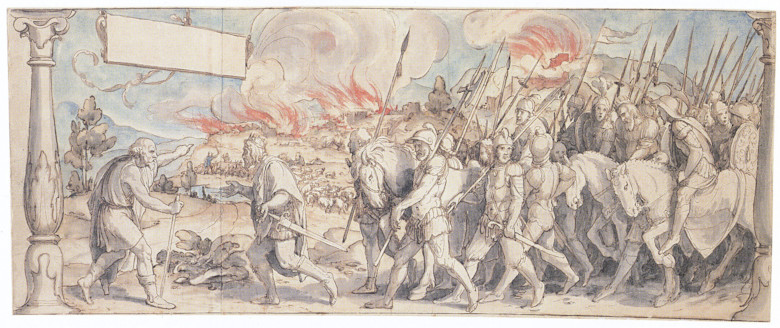
20260317_HansHolbeinYounger_SamuelCursingSaul

Hans Holbein the Younger - Samuel Cursing Saul - 1530

This understanding also applies to actions, such as the frequent warnings in the law of Moses that certain kinds of actions cause their doers to be cursed (Deut 27:16-20). The deeper assumption is that both words and actions have moral or even cosmic significance. Disrupting the cosmic harmony of the universe by breaking its moral laws has physical effects on the world. The chief example of this belief is the fall of Adam and Eve in the garden of Eden, in which an action has cosmic significance: the Earth itself suffers a consequence for the actions of two people (Gen 3:17). In an “enchanted” view of the world, everything is interconnected; everything affects everything else. If that’s true, then people really do have the ability to use words to pronounce curses on one another.

St. Paul warns the early church about engaging in this kind of practice. In his letter to the Romans he addresses this practice directly. He writes, “Bless those who persecute you; bless and do not curse them” (Rom 12:14). This is in the same spirit as Jesus’ admonitions to “love your enemies, do good to those who hate you” (Luke 6:27, see also Matt 5:43-48). In Christianity, the love of God is poured out onto everyone, so we who are trying to be like God need to pour out our love on everyone we meet, regardless of how they treat us.

Is cursing a sin?
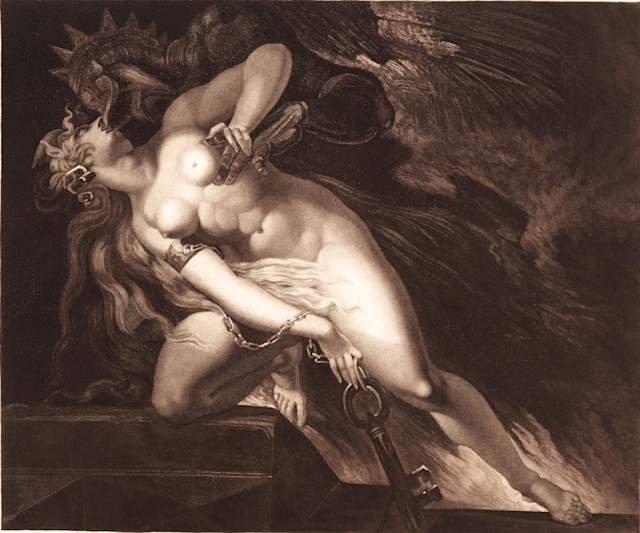
20260317_HaughtonLewis_SinPursuedByDeath

In this illustration of John Milton's book Paradise Lost, Haughton & Lewis depict Sin pursued by Death.

In a sense, sin itself is a kind of self-curse. That’s because sin doesn’t mean, “something God doesn’t approve of” or “something you ought not to do in order to count as a Good Person.” Sin is cosmic in scope: to sin means to fall short of the moral nature of reality. It’s to disconnect ourselves, even briefly, from goodness itself. The ancient Christian idea—and that of many pre-Christian, pagan philosophers—is that the one who does evil is in fact the one who comes to the most harm. If you hurt someone else, obviously that person is harmed, but you are actually the person that comes to greater harm, since in doing evil you wound your own soul. One of the most potent examples of this idea is in Oscar Wilde’s famous novel, The Picture of Dorian Gray, in which the protagonist makes a magical pact to trade his soul with a painted portrait of him: his body will never grow old or decay, but the portrait changes to reflect the nature of his soul. As he does more and more evil, the painting becomes uglier and uglier.

To do evil to others, especially to wish evil on others and try to cause them harm, is therefore obviously sinful! And the sinfulness of cursing isn’t merely an old idea. A 20th century Christian monk named St. Paisios argued at length that curses are real and have real power. He wrote,

“A curse works when injustice is involved. If someone, for example, deceives a person who is suffering or does him harm and that person curses the wrongdoer, then not only the wrongdoer but even his kindred may be adversely affected. In other words, when I harm someone and that person curses me, the curse will be effective. God allows for this to happen in the same way that He allows, for example, for someone to kill a person.”

St. Paisios affirms that there is a real power to curses, but warns that to do so is equivalent to doing physical violence to a person. When asked by his interviewer about who suffers when a curse is pronounced, he replies:

“...The cursed person suffers in this life. The one who curses, however, will suffer not only in this life, but will also suffer in the next life because there God will treat him as a criminal unless he repents and confesses. All right; it may be that someone may have offended you. However, your cursing that person is equal to your taking a pistol and shooting him. Who gives you the right? No matter what the other person has done to you, you don’t have the right to kill him. Those who curse have malice—malevolence—in their hearts.”

This malevolence, the desire to hurt your fellow man, is obviously sinful. St. Paisios ultimately makes the same point as Jesus and St. Paul: we should not do harm to others. To do harm to others is to harm our own souls.

Image credit
  • The Expulsion of Adam and Eve - John Martin - Public domain
  • Hans Holbein the Younger - Samuel Cursing Saul - 1530
  • Moses Haughton the Younger & Frederick Christian Lewis, Senior - Sin Pursued by Death (John Milton, Paradise Lost, Book 2, 787, 790-792) - 1804

Article folder: Life Questions

Tagged with: cursesmanifestingsinThe world as enchanted

Dr. Zachary Porcu

Zachary Porcu has a PhD in church history from the Catholic University of America in Washington DC, with additional degrees in philosophy, humanities, and Classics (Greek and Latin). He is an Eastern Orthodox Christian.

Full author bio

Keep reading

Is manifesting a sin? The Bible on the law of attraction

Is manifesting a sin? The Bible on the law of attraction
Dr. Zachary Porcu
by Dr. Zachary PorcuCatholic University of America
“Manifesting” is a popular practice in which one tries to create changes in one's life by directing one's thoughts. The practice has a variety of forms. It might look like saying an affirming sentence out loud to yourself every...
The Best Order to Read the Bible for the First Time?

The Best Order to Read the Bible for the First Time?

Dr. Zachary Porcu
by Dr. Zachary PorcuCatholic University of America
The Bible is not a single book. It’s a collection of books by many different authors across thousands of years. Where to begin reading, therefore, depends on your goals. If you’re a new reader of the Bible, I would suggest a re...
Do you go to Hell if you commit suicide?

Do you go to Hell if you commit suicide?

Dr. Simon Cunningham
by Dr. Simon CunninghamUniversity of Nottingham
If someone commits suicide, do they go to Hell? This question is tremendously loaded, which means there is a lot involved with giving a good answer. So, before giving one, we need to pause and ask what people mean when they ask...
What does the Bible say about AI or artificial intelligence?

What does the Bible say about AI or artificial intelligence?

Dr. Zachary Porcu
by Dr. Zachary PorcuCatholic University of America
What is “artificial intelligence?” It’s important to understand that when engineers and programmers talk about artificial intelligence, they aren’t actually talking about something that functions like the human brain at all. Wh...
What is sexual fasting? On abstinence in marriage

What is sexual fasting? On abstinence in marriage

Dr. Zachary Porcu
by Dr. Zachary PorcuCatholic University of America
If you’ve been around traditional religion enough, you may have gotten the impression that the Church is not a huge fan of pleasure. Restrictions on food, alcohol, or sex can give the distinct impression that Christianity is ag...
What does the Bible say about self-satisfaction?

What does the Bible say about self-satisfaction?

Dr. Zachary Porcu
by Dr. Zachary PorcuCatholic University of America
Christians in modern, western countries have a weird relationship with pleasure. There’s often a sense that Christianity is against pleasure, or at least suspicious of it, especially with sexual pleasure. How do we navigate ple...