The Bible on pornography: What does God say about porn?
The short story
While it may not be directly discussed in the Bible, pornography clearly fits in with other sexual sins that the Bible warns us against. Indeed, masturbating to pornography is toxic to everything we are: our bodies, our minds, and our spirits.
Pornography is not mentioned in the Bible, which should be fairly obvious. Pornography as we understand it today did not exist in the ancient world, especially since when most people talk about pornography they are talking about internet pornography. Pornography, whether on the internet or in magazines, has only existed for the last several hundred years, so it’s no surprise that the Bible has nothing to say about it.
Well, if the Bible doesn’t say anything against pornography, does that mean looking at pornography is okay? No. There are many things not specifically mentioned in the Bible that we can still say go against Christian morality. We can do this by correctly understanding the Christian idea of morality, especially the Christian concept of the person. This is what theologians call a Christian anthropology.
Anthropology: understanding the human
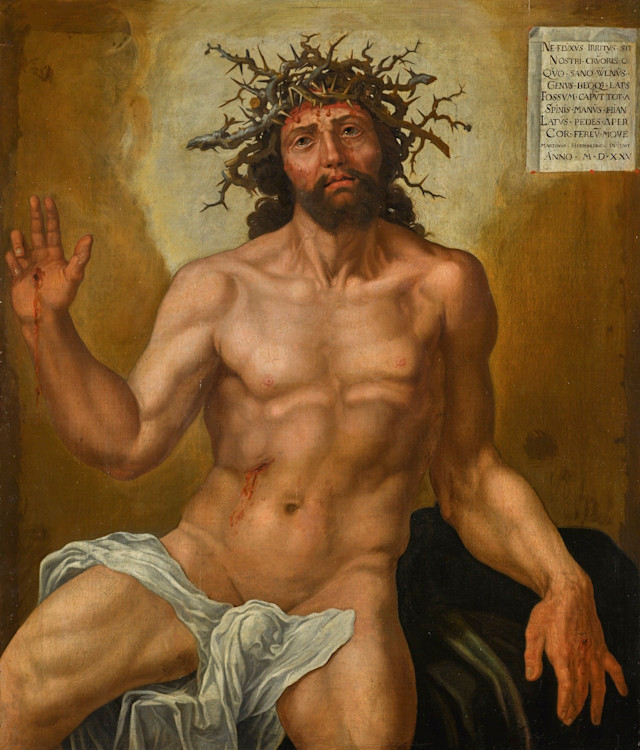
A central idea in Christian anthropology is the belief that Christ was fully man and fully God.
Most modern people believe that human beings are just animals of a particular kind, and therefore there’s nothing of ultimate moral significance to our actions. This belief leads to the idea that we can do whatever we want as long as it doesn’t hurt anyone else. This conception of radical freedom is especially prominent in North America. In this view, sexual pleasure is just a quirk of our biology, and so looking at pornography isn’t a problem because it (supposedly) doesn’t hurt anyone.

Bartolomé Esteban Murillo - The Heavenly and Earthly Trinities - 1675
If sex is a part of our nature and, in a sense, something very sacred, then we must treat sexuality in a sacred manner. This idea isn’t particular to Christianity: all the great religious traditions throughout human history viewed things in the same way. They may have differed on the exact details, but whenever people took morality seriously enough to put it into religious practice, they always put some sort of restrictions on sexuality (just as they did on eating) because they realized that there is spiritual significance to everything that we do.
What is sexual immorality?
The spiritual significance of sex is why the Bible contains frequent references to what it calls “sexual immorality.” For example, in 1 Thessalonians, St. Paul admonishes his flock to “abstain from sexual immorality” as a path to their sanctification (4:3). Improper sexual conduct is constantly mentioned throughout the Bible (Lev 18:22, 20:13; Deut 23:17; Rom 1:26-27, 1 Cor 6:9; Jude 1:7).
Of course, sexuality is a good thing. It’s central to who we are, a beautiful expression of love, and it literally creates human beings. Sexuality is such a powerful, good thing that it’s one of the most predominate images used in the Bible for the union of the church to Jesus. The prophet Isaiah writes, “For your Maker is your husband, the Lord of hosts is His name; and your Redeemer is the Holy One of Israel" (Isaiah 54:5). And in the New Testament, St. Paul uses the same imagery when he tells the church at Corinth, “For I have betrothed you to one husband, that I may present you as a chaste virgin to Christ" (2 Corinthians 11:2).
Sexuality is good, not evil, but there are still right or wrong ways to engage with it. Is pornography a bad way to engage in sexuality? According to a Christian concept of sexuality, the answer is yes.
The three Christian reasons to avoid porn
Pornography involves nakedness. Nakedness leads to lust. Lust leads to masturbation.
Reason #1: Nakedness

Eve covers her nakedness in this 1910 statue by Auguste Rodin.
The prophet Habakkuk writes about this, saying, “Woe to you who make your neighbors drink, Who mix in your venom even to make them drunk so as to look on their nakedness!” (2:15). This exposure brings about disgrace and loss of honor: “You will be filled with disgrace rather than honor. Now you yourself drink and expose your own nakedness. ... And utter disgrace will come upon your glory” (Hab 2:16). Exposing our nakedness is a way that we can disgrace or dishonor ourselves, and if you look at people who are voluntarily exposing themselves, you’re participating in their sin and helping to disgrace them.
Now, you can certainly think of counter-examples of when nakedness is not an issue. Many ancient cultures, and many non-Western cultures today, have public bathing houses where people are naked around members of the same sex. To take another example, in art school it is a common practice to hire someone to pose as a live nude model for a figure-drawing class. You could debate these particular instances, but they’re tangential to our main question, which is about pornography. Nakedness in the context of pornography is problematic because its specific purpose is to inspire lust.
Reason #2: Lust
The Bible clearly states that lusting after someone is sinful. Jesus says that lusting after a woman is a kind of adultery. “Everyone who looks at a woman with lust for her has already committed adultery with her in his heart” (Matt 5:28). St. James describes someone in these circumstances as “carried away and enticed by his own lust,” and goes so far as to say that “when lust has conceived, it gives birth to sin; and when sin is accomplished, it brings forth death” (James 1:14-15). The language is quite harsh here, but why?
Giovanni Segantini - The Punishment of Lust - 1891
Lust is a sin because it makes you into someone who is controlled by your desires. There are, of course, good desires, but when your desires become disordered, then you have a problem. Your desires become disordered when they take control over your life; in other words, when you aren’t in control of them. The church fathers describe these kinds of desires as “the passions,” but they don’t mean things you’re “passionate” about, they mean something very specific: the word “passion” comes from the Greek word for “to suffer.” According to Dr. Maximus Constas, a priest and expert on the church fathers, a better translation of this word for modern people is “the addictions”. If you know anything about addiction, or if you have ever had one, you know that what you really experience in an addiction is the loss of freedom: you become controlled by your desire. And lust, especially for men, is extremely powerful in this regard. Countless tragedies throughout human history have come to pass because of a lack of self-control in this area. Looking at pornography conditions you to be more and more controlled by your lust; it disorders the way you relate to sexuality and other people.
Reason #3: Masturbation
If the issue with pornography was simply that it shamed people through their nakedness and inspired lust in the viewer, that would be bad enough. But looking at pornography is almost always accompanied by masturbation. We have another article on the dangers of masturbation that you can read here. For now, let us say that masturbation makes pornography problematic for all the same reasons that masturbation is problematic.
Is porn a sin? Yes, and more.
We can fairly conclude that it's sinful to look at pornography, according to a Christian anthropology. However, you don’t need a complicated theological argument to say that it’s bad to look at pornography. It may surprise you to know that even on a secular, scientific approach to the world, it’s widely accepted that the use of pornography is considered unhealthy and damaging to the mind and body alike.
There are plenty of reasons not to look at pornography—that is if you care about being a healthy, happy individual. Everything that we’ve learned about pornography through study shows that it’s an addictive behavior that re-wires your brain. Pornography behaves so much like a drug in terms of its addictive qualities that there is now a movement called “fight the new drug,” a non-profit organization that helps raise awareness about the issues related to pornography use and ways to fight back. The problems with pornography are so widely recognized that there is almost no end of resources for this issue.

In this etching, Léon Davent depicts Lust chained to a chariot drawn by beasts.
That said, it’s important to remember that Christianity is not a negative religion, but a positive one. The main reason not to sin isn’t to avoid evil but to become good. Yes, it’s good to avoid evil, but if all you did was avoid evil you still wouldn’t be good. A lot of people view religion as a list of rules to follow, and that following all the rules is what makes you a “good” religious person. But rule following is a shallow way of living. The goal of faith in God is to become like Him, to become good, just like the goal of eating well is to be healthy. While limiting what you’re “allowed” to eat might appear to be a decrease in freedom, in actuality it leads to a long-term increase in freedom, because being a healthier person means you’ll have more energy and be able to do more.
It’s the same with sexuality. It may seem that restricting certain kinds of sexuality is a decrease in freedom or that the church is anti-sex, but neither of these claims reflect reality. God made us sexual, after all. The issue is how we use it. If we use it in a way that narrows our spirits, makes us into addicts, or makes sexuality about self-love rather than love of others, it disorders us and makes our sexuality less beautiful and less good. To say that the church hates sex, therefore, because it counsels us to avoid certain kinds of sexuality is like saying nutritionists hate food because they tell you not to eat junk food.
Subscribe
Life-giving writing by Christian scholars sent to your inbox once per month

Zachary Porcu has a PhD in church history from the Catholic University of America in Washington DC, with additional degrees in philosophy, humanities, and Classics (Greek and Latin). He is an Eastern Orthodox Christian.
Keep reading
How Hot is Hell? Biblical Ideas vs. Pop Culture Depictions


The Problem with Sexual Sin

The Baptism of Poland: Unification and Christianization

What is a Pastor Emeritus? Should they exist?
What are the best Bible verses about love and trust?